
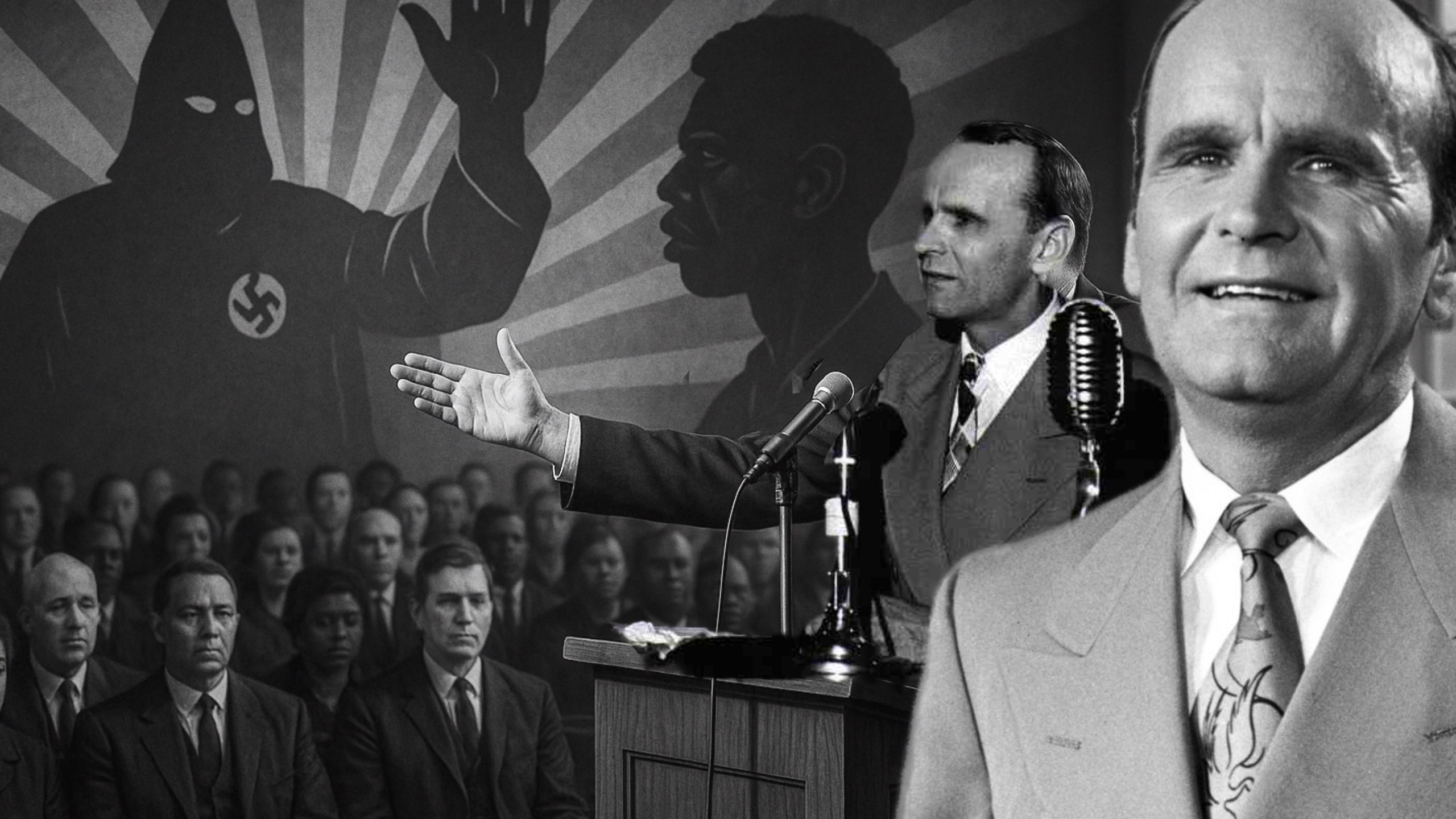
William Branham and the Rhetoric of Racial Propaganda
William Branham’s sermons reinforced segregationist ideology by using racial stereotypes, derogatory language, and propaganda techniques framed as divine authority. By embedding these messages within a religious context during the civil rights era, he helped legitimize and perpetuate white supremacist assumptions among his followers.
As the battle for civil rights grew heated and leaders of white supremacy unleashed several tools of propaganda to sway public opinion, William Branham did the same in his revival meetings. White supremacists were trying very hard to prevent the spreading of approval for the integration of blacks and whites in the public school system, because as a result, they believed, it would result in a higher number of interracial marriages. The Klan used religion as a vehicle to sway public opinion against a person with black skin marrying a person with black skin. It was during the heat of the battle that Branham introduced his "hybreeding" doctrine, as well as two different propaganda techniques: Stereotyping, and name-calling.[1]
Branham stereotyped Africans as "big, burly, heavy fat-like people" that were "seven foot tall and weighed three hundred pounds." He stereotyped black teenagers as having sexually transmitted diseases. He stereotyped the "good black person" as being "satisfied in the state he is in" and an "alien who conducts himself as a 'king’s son'".[2]
Cause, the Africans are big, burly, heavy fat-like people. Some of them are nearly seven-foot tall, and weigh, oh, two hundred and eighty, three hundred pounds, burly. The Zulus, now, the Shunghi and Basutos, and, oh, there’s many different tribes. There’s fifteen different tribes sitting there that day, I was speaking to.[3]
Branham also made use of name-calling propaganda techniques by using insulting racial slurs in his sermons. He referred to black mothers as "Aunt Jemima",[4] or "Auntie".[5] Black men were called "darky".[6] He referred to an interracial child as a "mulatto".[7]
To ensure a clear distinction between the racial lines, Branham also frequently used a different dialect when describing alleged conversations with African Americans. His "venereal disease" stereotyping propaganda story made use of language portrayed by southern African American slaves in early cinema, with words such as "mammy" and "honey child" and a much different pronunciation of the words than was common in the 1950s.
I was going down a little hill, like this, a beautiful morning, the sun was coming up, flowers just blooming around Memphis. And I was…The sun had just peeping up over the hill, and it'd been a rain the night before, and so it was all beautiful there in the South. And I looked, hanging out over the gate and there hung a typical Aunt Jemima. She had a…Instead of…She had a man's shirt tied around her head. She was looking over the gate.
I come walking by, going [Brother Branham hums—Ed.] going down the street looking, wondering where the Lord was leading me. She looking, tears over her big fat cheeks. She said, “Good morning, parson.' I said, “Howdy do, Auntie.' It caught me, “Parson?'
I looked around, I said, “Do you know me?' She said, “Yes sir.' And I said, “Do you know my name?' She said, “No, sir.' I said, “How'd you know I was a parson?'
She said, “Parson.' Said, “Did you ever hear about the Shunammite woman that had a baby by…The Lord promised her the baby, and the baby died?' And I said, “Yes.' She said, “I was a woman that way. And I promised the Lord that I'd raise my baby for Him.' And said, “The Lord give husband and I a lovely boy.' And said, “Parson, he took the road that's wrong when he's about—a few years ago.'
And said, “He got a—a dangerous disease, venereal disease.' And said, “It went so long on him, we didn't suspect it.' And said, “And now he's laying in the room dying.' Said, “The doctor has give him all kinds of shots.' And said, “He can't get well.' And said, “He's been unconscious since yesterday.
The doctor was back here and said, ‘Look for the worst at any time.' There was no hopes for him. His blood was four-plus, and nothing could help him at all.' And said, “He's dying.' And said, “I got down on my knees.' And said, “I prayed.' And said, “I prayed, ‘O Lawd.' Said, “‘I's a woman like the Shunammite. Where is You Elijah?' And just begin to praying.' Said, “I prayed and prayed.' And said, “This morning, just before daylight.' Said, “The Lord told, ‘Stand at this gate.'
And there was her back was wet where she'd been standing. She wasn't telling me anything wrong. She said, “And look.' Oh, my. Begin to…I walked into the house. There was a great big husky looking boy. And she patted him. He was laying there with a—with a blanket in his hand, going, “Um, Um, Um,' like that. And he was saying, “Mammy, it's so dark. Um. I don't know where I's a going, mammy,' like that. She said, “Honey child, do you know mammy?' Honey child.
He was…'Course, no matter how old you are, you're mother's child just the same. No matter what you've done, you're still mother's boy. And there she was, patting him and loving him. She said, “Do you know mammy?' saying, “You know your mammy?' He didn't seem like he recognized her. He's hollering, “Mammy,' going on; he was unconscious like condition.[8]