
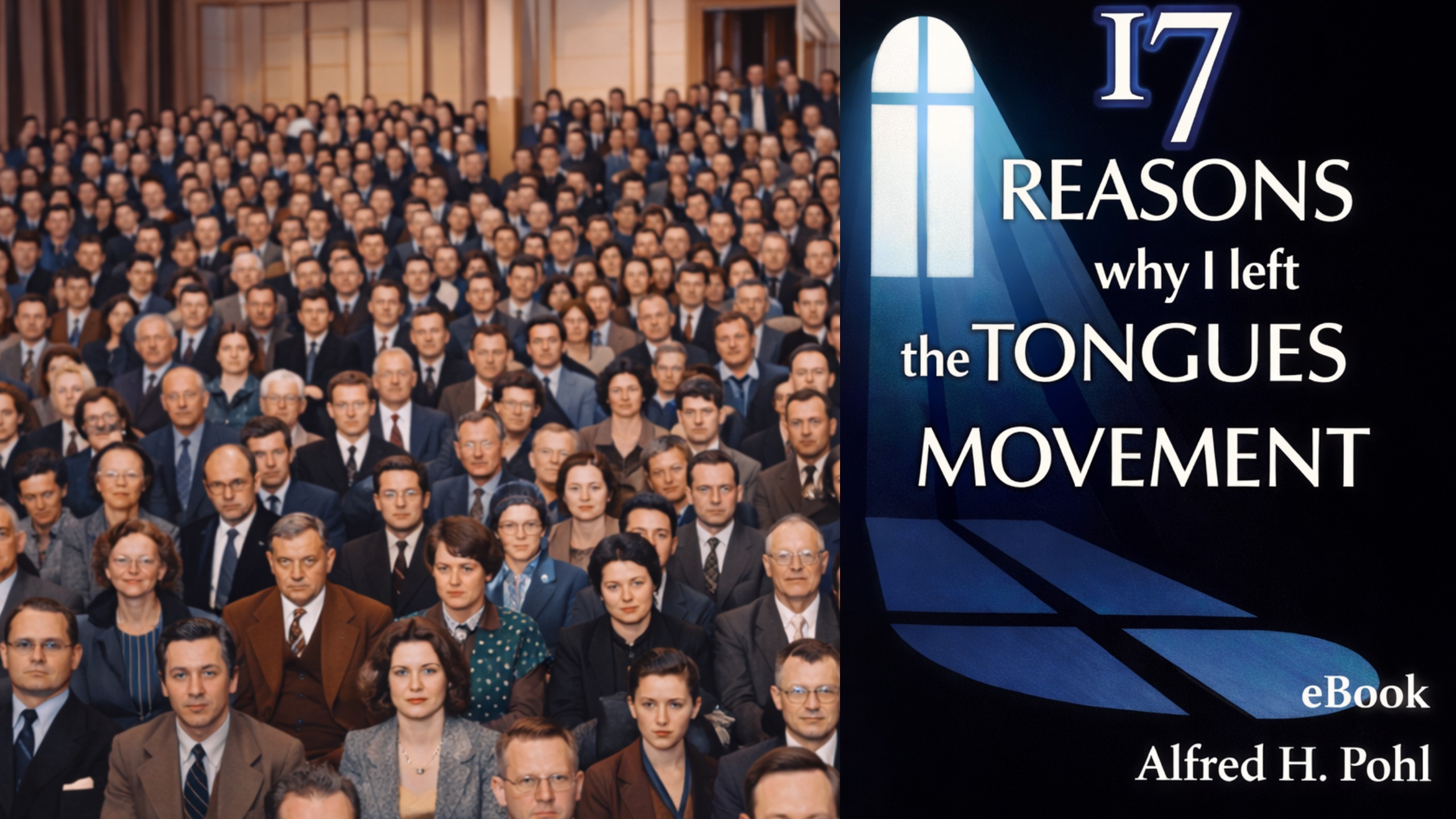
Alfred Pohl: Secrets Behind the Revival Curtain
Alfred Pohl’s firsthand experiences during William Branham’s 1947 Canadian healing campaigns led him to question the legitimacy of Branham’s methods, financial practices, and repeated pronouncements of healing that were later contradicted by the outcomes. His subsequent reflections, supported by journalistic investigations that failed to verify a single genuine healing, highlight significant ethical and pastoral concerns surrounding Branham’s ministry.
Alfred Pohl's involvement in William Branham's 1947 healing campaigns in Canada positions him as one of the most significant firsthand witnesses to the inner workings of Branham's early revival ministry. At the time, Pohl served on the teaching staff of a denominational Bible school in Saskatoon, Saskatchewan, located adjacent to the church auditorium where Branham conducted his meetings. His responsibilities during the campaign placed him in direct, sustained contact with Branham — not merely as an observer in the audience, but as an assistant who accompanied the evangelist into private ministry rooms to pray for those too ill to attend the public services. Pohl later reflected that this proximity afforded him an unobstructed view of Branham's methods, claims, and interactions with the sick, forming the basis for his subsequent reassessment of the authenticity of Branham's healing ministry.
When Mr. Branham had concluded his meeting in the church auditorium, I would take his arm and lead him from room to room in the dormitory, so that he could pray for those who were unable to attend the public meetings or stand in the healing-lines. This gave me an excellent opportunity to work in very close contact with him and observe what was happening. Let me repeat here, I was fully behind Mr. Branham at this time, and prayed earnestly with him for the healing of these dear suffering people. At that time, as he gave assurance to one after the other that they were healed, I rejoiced and praised the Lord with them.
Pohl, Alfred. 1982. Why I Left The Tongues Movement.
Pohl also observed that the healing campaigns generated significant financial contributions from those seeking prayer. Because of his close proximity to Branham and his direct contact with the sick who came to the meetings, Pohl was regularly entrusted with monetary gifts intended for the evangelist. He later recalled that many donors, moved by Branham's assurances of healing, contributed sums that were disproportionate to their financial means, revealing an economic dimension to the campaigns that compounded his growing concern regarding their ethical and pastoral implications.
A common practice of Mr. Branham was to take the hand of the sick person, and then say something like this, "The vibrations in your hand tell me that you have cancer. But I will pray for you that the Lord will heal you". When he had prayed, he would say something like this, "The vibrations are gone, the cancer is dead. You are healed! But you will be very sick for about three days till your body throws off the dead cancerous tissue. But don't worry, you are healed. Just trust the Lord." With similar words he would give assurances to these suffering ones that they would recover. This, of course, would bring hope and joy to these dear souls, many of whom responded with a large financial gift, sometimes far beyond their means. At times I was given large sums of money to pass on to Mr. Branham, which I always did gladly, for I too believed him.
Pohl, Alfred. 1982. Why I Left The Tongues Movement.
Pohl later reflected that Branham's public assertions of healing created profound pastoral challenges for those who remained after the evangelist's departure. When Branham declared individuals healed in the meetings and instructed them to "go home healed," many accepted these pronouncements without question. As the campaign concluded and Branham left the region, the longer-term outcomes of these declarations became evident: a significant number of those pronounced healed experienced no improvement, and many ultimately died of their illnesses. In the absence of the evangelist, it fell to local ministers such as Pohl to address the confusion, grief, and theological questions raised by these unfulfilled assurances, a responsibility he described as both painful and spiritually disorienting.
Time went on, the campaign ended, and Mr. Branham and his party were gone. Then we began to see the results being tested by time. It was a difficult time for us, and particularly for me. For one by one these that I had personally seen "healed" and declared so by the "healer," died. Our faith was severely tested. Relatives of the deceased ones would ask, "Why?" What could we tell them?
Pohl, Alfred. 1982. Why I Left The Tongues Movement.
Now, several days later, this dear brother sat before me in our office, his heart heavy and his mind in turmoil. He had come nearly 200 miles to speak to me. Before he did, however, I already sensed what had probably happened. But in spite of this, his question still hit me very hard. "Brother Pohl," he said, "you were there beside my wife's bed the night Mr. Branham prayed for her and pronounced her healed?" "Yes," I replied, " I was right there." He went on, "Can you tell me why it is that my wife who was healed just a few days ago is now in the grave?"
Pohl, Alfred. 1982. Why I Left The Tongues Movement.
In a later interview with O Timothy magazine, Pohl recounted the complications that arose when local journalists sought to verify the reported healings by interviewing individuals whom Branham had publicly pronounced well. Despite efforts to locate such cases, neither Pohl nor the pastor of the hosting church was able to identify a single verifiable instance of healing. This absence of corroboration intensified public scrutiny and further underscored the disjunction between Branham's claims and the documented outcomes.
When the pastor of the church saw these reports in the paper, he went to the editor rather disturbed and not very happy about the situation, and he confronted the editor: “Why do you do this to our church? You're hurting the reputation of our church, and you shouldn't do that to us.” And the editor said words something to this effect, “Well, pastor, if the healings are genuine, you don't have to worry, do you?” I thought to myself later on when I heard this, well, that editor certainly had a lot of common sense, because if they're genuine, why worry? If they're not, well then they should be exposed--which is what the paper did. And the editor said, “Pastor, we gave you good coverage when Mr. Branham was here.” The pastor had to admit they did. “Now,” he said, “we owe it to our people to give them the rest of the story.” And he said, “That's what we found.” He said to the pastor, “I'll tell you what I'll do, if you can bring me one genuine case of a genuine healing, I'll give you the front page.” And I was told right in that pastor's home that they couldn't find one.
O Timothy: Not one?
Pohl: Not one. ... I stood beside bed after bed, person after person who was pronounced healed and yet, where were they? They passed away. So there was something very wrong with this type of healing.
Pohl's book:
http://www.bereanresearchinstitute.com/03_Doctrines/D.0030_00_Why_I_Left_the_Tongues_Movement_-_Alfred_H._Pohl.html
https://www.amazon.ca/Reasons-why-Left-Tongues-Movement/dp/B007EJND1I