
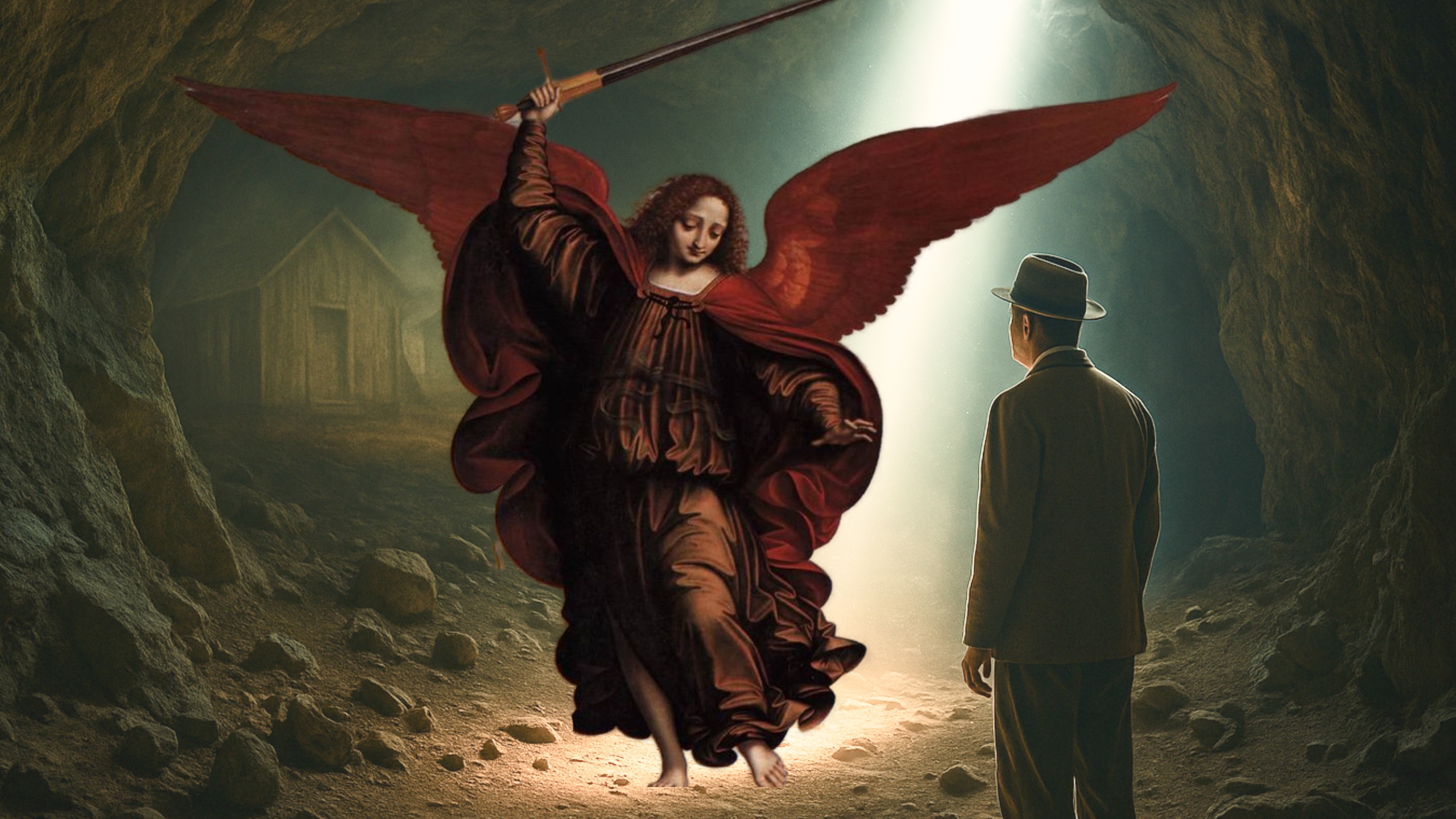
Vision, Angel, or Cave Encounter? The Unstable Origins of Branham’s Healing Ministry
William Branham’s shifting accounts of his alleged angelic visitation—alternating among a house, a cabin, and a cave—reveal a striking inconsistency in the foundational narrative of his prophetic authority. Over time, followers institutionalized the cave version, embedding it into “Message” folklore despite Branham’s own contradictory retellings.
Accounts of divine encounters occupy a central place in the construction of prophetic authority within Pentecostal and post-Pentecostal movements. William Branham's claim to have received a supernatural commission from an angelic being functioned as the foundational legitimating narrative for his healing ministry and later for the "Message" sect that formed around his teachings. Yet Branham's descriptions of this event display striking instability over time, shifting in location, detail, and theological framing. Such instability is particularly noteworthy because modern psychological research consistently demonstrates that memories formed during moments of extreme emotional intensity — whether interpreted as trauma, crisis, or heightened religious experience — tend to be encoded with unusual vividness and remain comparatively resistant to alteration. The contrast between this established pattern and the fluidity of Branham's accounts invites closer historical scrutiny and raises important questions about the development and performative reshaping of his prophetic persona.
Modern studies of memory and crisis indicate that individuals who undergo events perceived as frightening, overwhelming, or life-altering often retain unusually vivid recollections of their sensory and spatial environment. Even though ordinary autobiographical memories are susceptible to blending, omission, or reinterpretation over time, memories formed during periods of acute emotional arousal--whether described as trauma or as an intense religious experience--tend to exhibit a relative stability in core features. This framework offers a useful lens for evaluating the changing narratives surrounding William Branham's alleged angelic visitation.
It is within this context that researchers have questioned whether Branham himself consistently believed the version of the angelic encounter that came to dominate later iterations of his stage persona. Across the span of his ministry, Branham alternated between three distinct settings for the event: his house, a cabin with a wood floor, and a cave. The fluidity with which he relocated the scene of his commissioning stands in marked contrast to the expected fixity of memory associated with highly charged personal experiences.
The earliest extant version of his angelic-visitation narrative situates the event within his home. According to this account, Branham had just returned from "patrol," entered his house, and prayed until approximately 1:00 a.m.[1] He reported hearing what he assumed was an automobile turning a corner and ran to look out the door. Finding no car, he described seeing a light that then transformed into an angelic figure.
A little over two years ago now, I was sitting in the room. I was reading my little Scofield Bible, and I heard something. First, I saw a Light. And I thought it was an automobile that turned the corner. But it turned, but it got brighter. And I looked out the door and there was no automobile. Then I heard something coming like this, going…[Brother Branham knocks on the podium four times.—Ed.] walking. And I looked, and the Light got greater. And just above me hung a great Star. And the Light was kind of a, more of a green, between green and yellow, shining on the floor. And coming walking through this Light, came a Man that looked like, as I said before, would weigh two hundred pounds, a huge Man. He did not have beard over His face, like Christ's picture does. Who He is, I do not know. But He had…[Blank spot on tape—Ed.]…shoulder. He was more of an olive complexion; He had dark eyes. He walked as close to me as the microphone is there.[2]
In September 1951, William Branham introduced a significantly revised version of the commissioning narrative, relocating the encounter to a secluded cabin situated on the bank of a waterway near Green's Mill. In several retellings from this period, the angelic figure reportedly emerged from a luminous manifestation that gradually assumed bodily form, a transformation Branham claimed to perceive audibly as footsteps resonated across the "old boards" of the wooden floor[3] before the alleged angel appeared.
But when the Angel of the Lord appeared to me out there on Green's Mill bank, out there in that little cabin that night, He told me to go, and I'd be praying for statesmen, and great men, and kings, and monarchs. It would sweep around the world, and now, there's a revival sweeping the world, originating in Jeffersonville, Indiana.[4]
This was a significant change from the back story used in earlier versions of William Branham's stage persona. In his 1945 tract, I Was Not Disobedient to the Heavenly Vision, Branham claimed that he had experienced a vision that commissioned him to heal the sick.[5] There was no mention of an angelic visitation in the tract, and participants in the revivals from 1945 through late 1947 believed that Branham had indeed been given a vision by God instead of an angel. When confronted by news media in Vancouver in November 1947, Gordon Lindsay referenced the 1945 tract to use the "vision" back story when describing how and when William Branham began healing the sick.
Mr. Lindsay outlined the "healer's" brief career in this field. "His special ministry came to him in a vision two years ago," Lindsay said. "He prays for the esick, calmly, unless it is a virulent disease, and then Mr. Branham must resort to a more authoritative tone to drive out the evil." Mr. Lindsay pointed to no specific miracles or cures his charge has performed, only to say, "I have seen hundreds of them." When asked specifically to name some, Mr. Lindsay ignored the question.[6]
- Vancouver Sun.
By May 1953, Branham presented yet another iteration of the narrative, asserting that the angel had first appeared to him in a cave near Green's Mill. This cave-based account eventually became the standardized version promoted in Branham's "official" biographies and remains the version embraced by most adherents of his cult of personality, many of whom believe that his healing ministry commenced in 1947 following an angelic commission in this cave--unaware that Branham had circulated alternative, non-angelic "healing commission" narratives for earlier stage personas, including the account published in his 1945 tract.
Well, one night up yonder in Green's Mill, Indiana, to a cave where I was at in a place, the Angel of the Lord appeared and said, 'You're to go pray for sick people.' And told me what would take place. He said, 'Do not fear. I will be with you.' I took off, and come through the country, and down through Jonesboro, telling what He said was and what would come to pass. And it's been that way and proved now plumb around the world.[7]
Even after adopting the cave narrative, Branham showed difficulty maintaining consistency across retellings and continued at times to assert that his first visitation had occurred in the cabin. In March 1961, for example, he referenced the cabin while praying in a healing line.[8]
Leaders within Branham's cult of personality, however, have generally privileged the cave version of the story. Because the purported cabin cannot be located, whereas a cave constitutes a tangible and visitable site,[9] the Indiana cave system has come to occupy a prominent place within "Message" folklore and devotional practice.[10]