
Avak Hagopian: The Forgotten Mystic Who Helped Launch the Healing Revival
Avak Hagopian was an Armenian-born mystic faith healer who burst onto the American scene in 1947 with spectacular “atomic energy” healing campaigns, backed by wealthy Armenian-American businessmen connected to families like the Shakarians and Arakelians. The article argues that Hagopian’s networks, themes of impartation, and stylized “Rembrandt Christ” theatrics helped prefigure the Latter Rain, FGBMFI, and modern Charismatic/NAR currents—even as his own ministry slid into a reclusive, high-control cult in his later years.
Avak Hagopian was an Armenian-born mystic and faith healer whose arrival in the United States in 1947[1] marked the beginning of a new chapter in postwar American religion. Though largely forgotten by mainstream histories of Pentecostalism and revival, Avak’s brief but sensational healing ministry captured national media attention [2] and introduced themes of supernatural healing, combined with cross-cultural mysticism that would soon define the Healing Revival. His public persona—clothed in white robes, speaking little English, and moving solemnly through crowds of the desperate—was interpreted by many as Christlike or angelic [3], and his meetings quickly drew thousands [4]. Avak’s influence did not end with the emotional fervor of those early tent gatherings; rather, his ministry helped lay the groundwork for a movement that would grow to include figures such as William Branham, Oral Roberts, and eventually the broader Charismatic Renewal. How did this little-known mystic from Cairo [5], supported by a network of Armenian-American businessmen [6], and propelled into the spotlight by a media-hungry public, play such a key role in shaping the trajectory of American revivalism, from the tent meetings of the 1940s to the global Charismatic and New Apostolic currents of the late twentieth century?
The Mysterious Arrival of Avak Hagopian
In the spring of 1947, an unfamiliar name began appearing in California’s local press: Avak Hagopian, an Armenian mystic and faith healer who had just arrived from Cairo[7]. His presence in the United States was no accident. He had been brought over by a coalition of wealthy Armenian-American sponsors[8], some of whom would later be instrumental in launching the Full Gospel Business Men’s Fellowship International. The earliest reports, beginning in The Desert Sun and other Southern California outlets, painted a picture of a man who closely resembled the Western imagination of Christ—dressed in robes, accompanied by an interpreter[9], and praying for lines of the sick and infirm in makeshift tents and rented halls. These gatherings often overflowed, with newspapers documenting chaotic yet reverent crowds that spilled into streets[10]. What made Avak’s arrival so significant was the timing: his campaign occurred before the Latter Rain movement broke out in Canada, and before William Branham’s fame had solidified. In many ways, Avak introduced the visual and emotional grammar of the postwar healing revival—mysticism, solemnity, physical healing, and mass audience engagement—all in a highly photogenic package that resonated with both spiritual seekers and the press. His immediate impact would set the stage for the more structured revivals that followed.
The Arakelian-Kardashian Connection
Avak Hagopian’s entrance into the United States and sudden fame were not a spontaneous event but one carefully orchestrated by a network of influential Armenian-American families[11]. Central to this sponsorship were the Arakelians, Kardashians, and Shakarians—prominent business figures deeply rooted in the emerging charismatic spirituality. Krikor Arakelian, a major grape grower in California, played a leading role by arranging Avak’s travel from Cairo to pray for a sick family member[12]. Tatos Kardashian, another key patron, publicly pledged to build a temple for Avak in Los Angeles and funded aspects of his early ministry[13]. These men saw in Avak not just a healer, but a religious phenomenon worth mobilizing. Their support positioned Avak within a broader strategy: to bring spiritual vitality to the Armenian community while aligning with the swelling Pentecostal momentum in America. Importantly, this same network would later birth the Full Gospel Business Men’s Fellowship International (FGBMFI), with Demos Shakarian—himself connected to these early revival sponsors—as its founder[14]. The familial and financial ties among these Armenian patrons reveal how Avak’s campaign was both a spiritual undertaking and a calculated introduction into American revivalism. Their involvement ensured Avak was not merely seen, but strategically elevated into the heart of a growing movement.
Enter William Branham
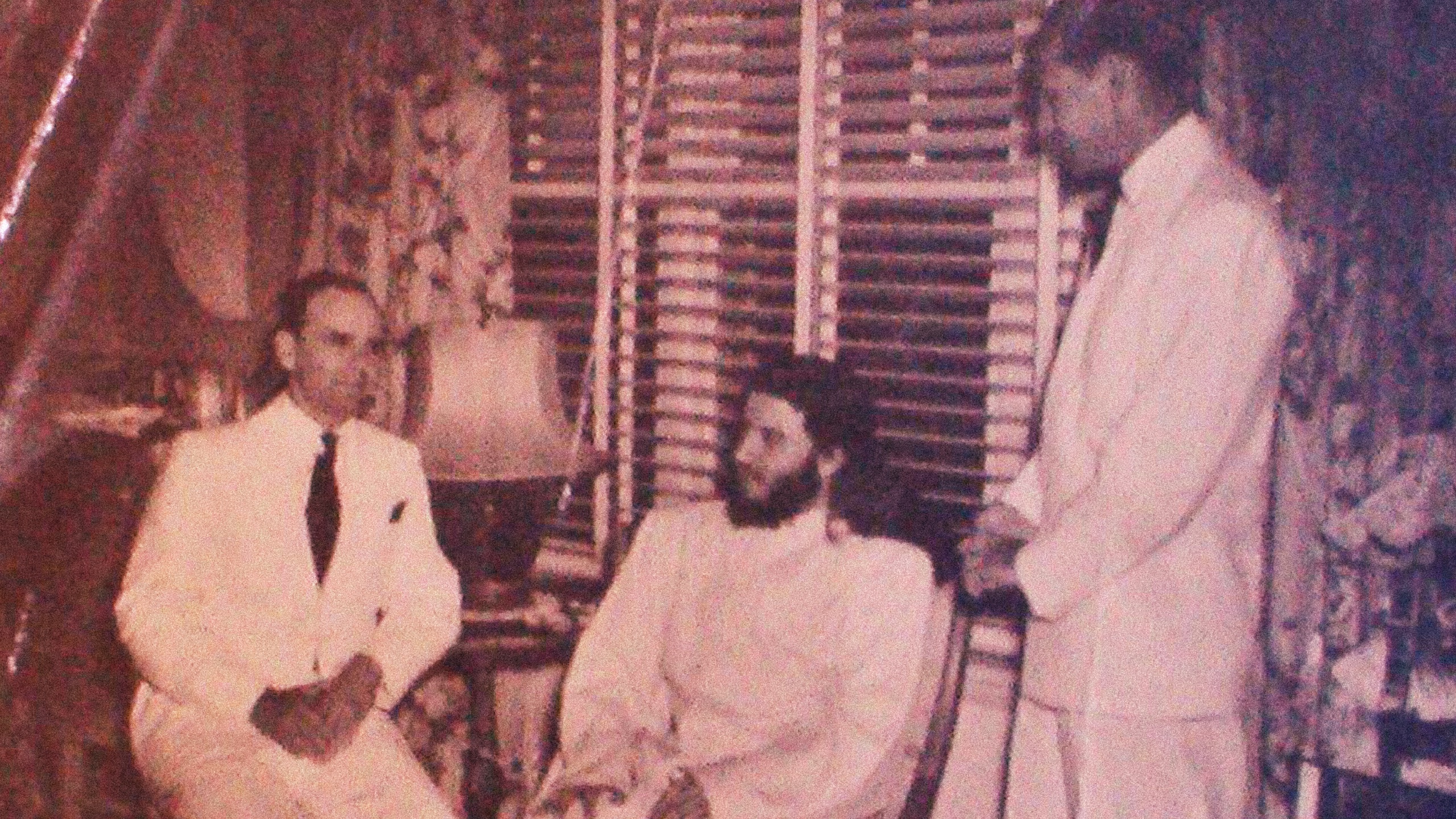
Although William Branham is widely remembered as the central figure of the postwar healing revival, his early ministry intersected with that of Avak Hagopian in ways that reveal a deeper, collaborative foundation for the movement. Both men were active in California during the same season in 1947, and contemporary accounts suggest they participated in overlapping revival campaigns organized by Armenian benefactors. A photograph from one such meeting captures Branham, Avak, and evangelist Raymond Hoekstra together, during the years in which Hoekstra managed Branham's revival campaigns and helped redefine Branham's stage persona.
This collaboration was confirmed by Branham himself in a 1947 sermon titled The Angel of God, in which he describes being summoned alongside Avak by members of the Armenian community in California. Although Branham did not name the Arakelian, Kardashian, or Shakarian families directly, he stated that he was supported by the same individuals who had sponsored Hagopian.
I have…going up on the…plumb from Vancouver, work down the coast as far as California, coming back to Fresno where I’m to go tomorrow, to the Armenian people. They flew a boy, who prays for the sick, by the name of Avak. They brought him from Cairo over to pray for a man by the name of Arkelian. The same time they sent for him, they sent up in Indiana and had me to come to a woman with cancer
—William Branham, 1947, The Angel of God
While their theological emphases would eventually diverge, the public healing ministries of Branham and Avak shared a strikingly similar theatrical structure. Both invoked prophetic identity, both invited highly emotional crowd responses, and both cultivated an air of divine authority rooted in personal charisma. In this context, Avak may be seen not as a fringe forerunner, but as a parallel presence whose style and mystique echoed through Branham’s own approach. The shared venues, mutual sponsors, and early associations between these two figures suggest that the foundations of the revival were laid not by a single voice, but by a convergence of personalities whose collective energy galvanized the emerging movement,[15] sponsored by powerful businessmen in the developing Charismatic movement.
The Birth of the Healing Revival
The postwar Healing Revival is often narrated as an abrupt eruption of supernatural excitement, but its origins can be traced to a steady buildup of public spectacle, ethnic sponsorship, and emotional hunger—conditions exemplified by Avak Hagopian’s initial campaigns. When Avak arrived in California in 1947, he catalyzed a religious atmosphere that was already primed for charismatic display. The thousands who poured into Palm Springs and Los Angeles to witness his healings were not merely curious; they were seeking tangible demonstrations of divine power in the aftermath of war, displacement, and medical uncertainty. Newspapers fanned the flames, helping Avak to build a cult following.[16] This set the tone for what would become the Healing Revival: events charged with urgency, expectation, and emotional catharsis. Though not unique, Avak’s format—open tent meetings, dramatic testimonies, long healing lines—would be replicated by Branham and refined by Oral Roberts, A. A. Allen, and others. What differentiated Avak was his mystique: foreign, solemn, and unaligned with any specific denomination. Yet it was this very fringe "non-denominational" theme that helped establish the Revival’s inter-denominational strategy. His advertised persona as a "Christian Mystic"[17] would set the tone for the next wave of Pentecostalism.
Latter Rain and the Rise of Impartation
The Latter Rain movement, which erupted in 1948 in North Battleford, Saskatchewan, formalized doctrines of prophetic authority and the impartation of spiritual gifts through the laying on of hands. But the emotional architecture of the movement—its emphasis on supernatural healing, charismatic display, and trans-denominational mysticism—had already found public expression in Avak Hagopian's healing campaigns. Newspapers described Avak as a "Rembrandt painting of Christ," with followers collapsing, kissing his robe, and crowding to touch him as if divine power flowed from his body[18]. One Armenian disciple even claimed that "atomic energy" transmitted through Avak's hands to the sick, echoing the impartational theology later taught in Latter Rain circles[19]. Avak's message emphasized divine revelation over formal training, and his testimony of receiving a personal call from God to heal mirrors the Latter Rain belief in new apostles and prophets chosen by direct encounter. While Avak himself is rarely cited in Latter Rain histories, many of the same networks that sponsored him—especially Armenian-American businessmen—were involved in the rise of postwar charismatic structures. In this sense, Avak served as a prototype: an untrained mystic whose presence anticipated the movement's emotional excesses, supernatural claims, and radical theology of impartation.
The Formation of FGBMFI
The Full Gospel Business Men’s Fellowship International (FGBMFI) emerged in the early 1950s as a formal structure to channel the energy, testimonies, and charismatic power that had been ignited during the Healing Revival. Its founder, Demos Shakarian, came from the same Armenian Pentecostal network that had supported Avak Hagopian’s arrival in the United States[20]. FGBMFI was conceived not merely as a support group for Christian businessmen, but as a staging ground for the supernatural in professional contexts—a concept shaped by the very revivalist environment that Avak helped to catalyze. The organization’s early publications and testimonies carried the same emotional tone, expectation of healing, and prophetic affirmation that had characterized Avak’s tent meetings. In contrast to the denominational boundaries that often restricted revivalist activity, FGBMFI provided a platform for interdenominational cooperation, entrepreneurial evangelism, and international expansion. Its structure allowed charismatic experiences to be validated within business and civic spheres, normalizing tongues, prophecy, and healing among a professional class that might otherwise have been skeptical. In this sense, FGBMFI did not merely grow from the revival—it institutionalized it. And the familial, ethnic, and theological ties to Avak reveal that the charismatic explosion was seeded not just by famous names, but by overlooked pioneers whose influence reverberated through new models of ministry[21].
The Charismatic Movement and N.A.R.
Through the work of FGBMFI and its revivalist networks, the influence of Avak’s early healing ministry can be traced through the Charismatic Renewal into the present-day New Apostolic Reformation (N.A.R.). The emotional immediacy, spontaneous manifestations, and theatrical symbolism that marked Avak’s campaigns were preserved and reframed within the theological frameworks of the Charismatic movement in the 1960s and 70s. Many of the leaders who would later embrace or shape the N.A.R.—including those aligned with C. Peter Wagner’s apostolic models—emerged from environments saturated with the structures first built by Full Gospel Business Men[22]. These environments normalized ecstatic experiences, prophecy, tongues, and healing as signs of divine authority, opening the way for the acceptance of new paradigms of apostleship and impartation. While Avak’s name faded from public discourse,[23] his influence persisted in the movement that emerged: the embrace of "Christian mysticism," and the elevation of so-called gifted individuals who claimed supernatural empowerment. That legacy continues today in the N.A.R.
Avak’s Final Years and Cultic Legacy
By the 1980s, Avak Hagopian's ministry had evolved into a full-fledged cult of personality centered around his self-declared divine calling. While earlier years were marked by mass healing events and press attention, Avak later established an isolated religious commune known as the Millennial Kingdom Family Church in Hyde Park, New York. According to a 1985 investigation by the Poughkeepsie Journal, followers referred to him as "God" and lived under highly controlled conditions on a fenced 69-acre estate[25]. Former members and relatives described the group as destructive, noting that children were subjected to extreme forms of discipline, including fasting for up to 18 hours a day, with some punished this way for as long as 50 consecutive days. Members had limited contact with the outside world, and even contact between boys and girls within the group was heavily monitored. Allegations of brainwashing and authoritarian control were common among those who left the church. Despite Avak's denial of encouraging divine worship, multiple eyewitnesses reported that he accepted reverence as a deity and ruled the group as a spiritual patriarch. This period marked a stark departure from the image of a humble healer and revealed the darker trajectory of his later life as the leader of a reclusive, coercive religious sect.