
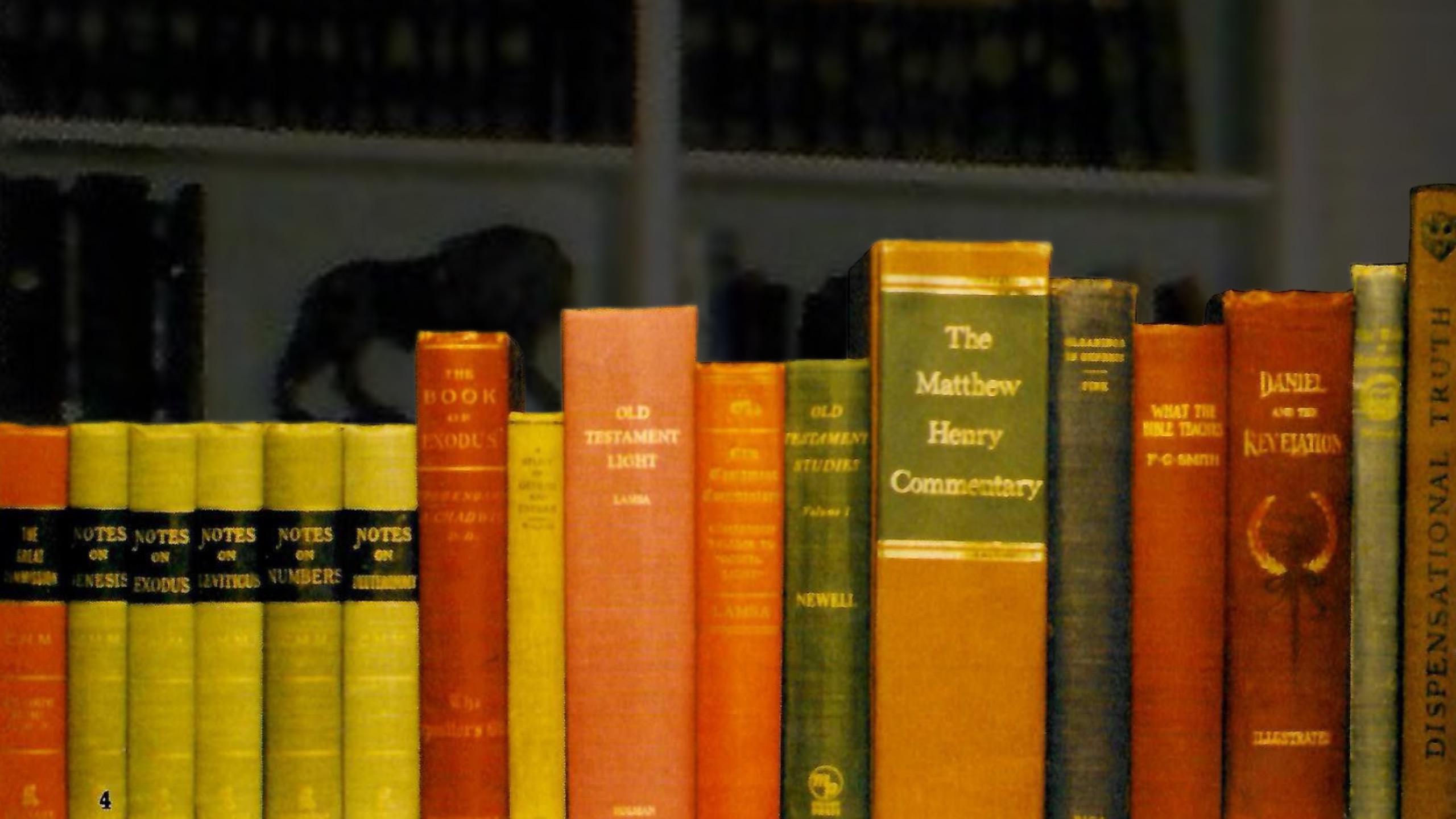
Branham's Reference Books: Sources Behind the Revelations
The William Branham Memorial in Tucson preserved a large personal library that reveals the theological and prophetic sources underlying Branham’s later teachings. An examination of these books shows extensive reliance on dispensational writers, restorationist movements, and earlier prophetic frameworks rather than independent revelation.
In March 1993, George Smith and Rebekah Branham Smith announced the opening of the “William Branham Memorial,” a museum in Tucson created from William Branham’s former home. Volume 6 of Only Believe magazine described both the conversion of the 3,200-square-foot residence into a museum space [1] and Branham’s personal library of more than 250 books [2]. Subsequent research has confirmed that a number of these volumes served as direct sources for Branham’s later claims of “divine revelation” [3]. The collection and museum were dedicated by Joseph Coleman, who later pleaded guilty to a securities fraud scheme involving several senior members of his church.
Researchers have since identified and categorized many of the most significant titles in Branham’s library based on a published inventory in Only Believe. The collection reflects a wide range of theological influences, including works by leaders of other religious movements, such as Charles Taze Russell of the Jehovah’s Witnesses. It also contains multiple volumes by Clarence Larkin, whose writings provided much of the framework for Branham’s Church Age theology, interpretation of Daniel’s Seventy Weeks, and related prophetic schemes.
Page 2:
- Matthew Poole Commentary (Old Testament in blue, New Testament in red)
- Commentary on the Epistle of Ephesians, John Eadie, 1893
- What Pastor Russell Said, Charles Russell, 1924
- The Finished Mystery, Charles Russell
- Library of Universal History, Vols. 1–16, John Ridpath, 1894
- Rightly Dividing the Word of Truth, Clarence Larkin, 1920
- What Do the Prophets Say, C. I. Scofield, 1918
- The Book of Daniel, Clarence Larkin, 1929
- No Room at the Inn, C. I. Scofield, 1941
- Cain: Son of the Serpent, David Max Eichorn, 1957
- The Glorious Reformation, S. S. Schucker, 1837
- Handbook of Denominations in the United States, Frank Mead, 1951
Page 3:
- Ridpath Library of Universal Literature, John Ridpath, 1901 edition
- Encyclopedia Judaica, Jerusalem Publishing House, 1960
Page 4:
- The Great Commission, Charles Henry MacIntosh, 1898 (Note: William Branham appears to have relied heavily on this work)
- Notes on Genesis, Charles Henry MacIntosh, 1880
- Notes on Exodus, Charles Henry MacIntosh, 1880
- Notes on Leviticus, Charles Henry MacIntosh, 1880
- Notes on Numbers, Charles Henry MacIntosh, 1880
- Notes on Deuteronomy, Charles Henry MacIntosh, 1880
- Exposition of Exodus, G. H. Chadwick, 1892
- A Study of Genesis and Exodus
- Old Testament Light, George Lamsa, 1964
- New Testament Commentary, George Lamsa, 1945
- Old Testament Studies, Vol. 1, William Newell, 1950
- The Matthew Henry Commentary, Matthew Henry
- Gleanings in Genesis, Arthur Pink, 1922
- What the Bible Teaches, F. G. Smith, 1945 (Note: William Branham appears to have relied heavily on this work)
- The Prophecies of Daniel and the Revelation, Uriah Smith, 1944 (Note: William Branham appears to have relied heavily on this work)
- The Book of Revelation, Clarence Larkin, 1919
- Dispensational Truth, Clarence Larkin, 1918
Page 5:
- Three-volume set of Strong’s Concordance
- Encyclopedia of the Bible, Walter Ewell, 1971
- Cruden’s Concordance, Alexander Cruden, 1976
- Illustrated Dictionary and Concordance of the Bible, 1986
- Ridpath Library of Universal Literature, John Ridpath, 1923
- The Select Works of John Bunyan, John Bunyan, 1866