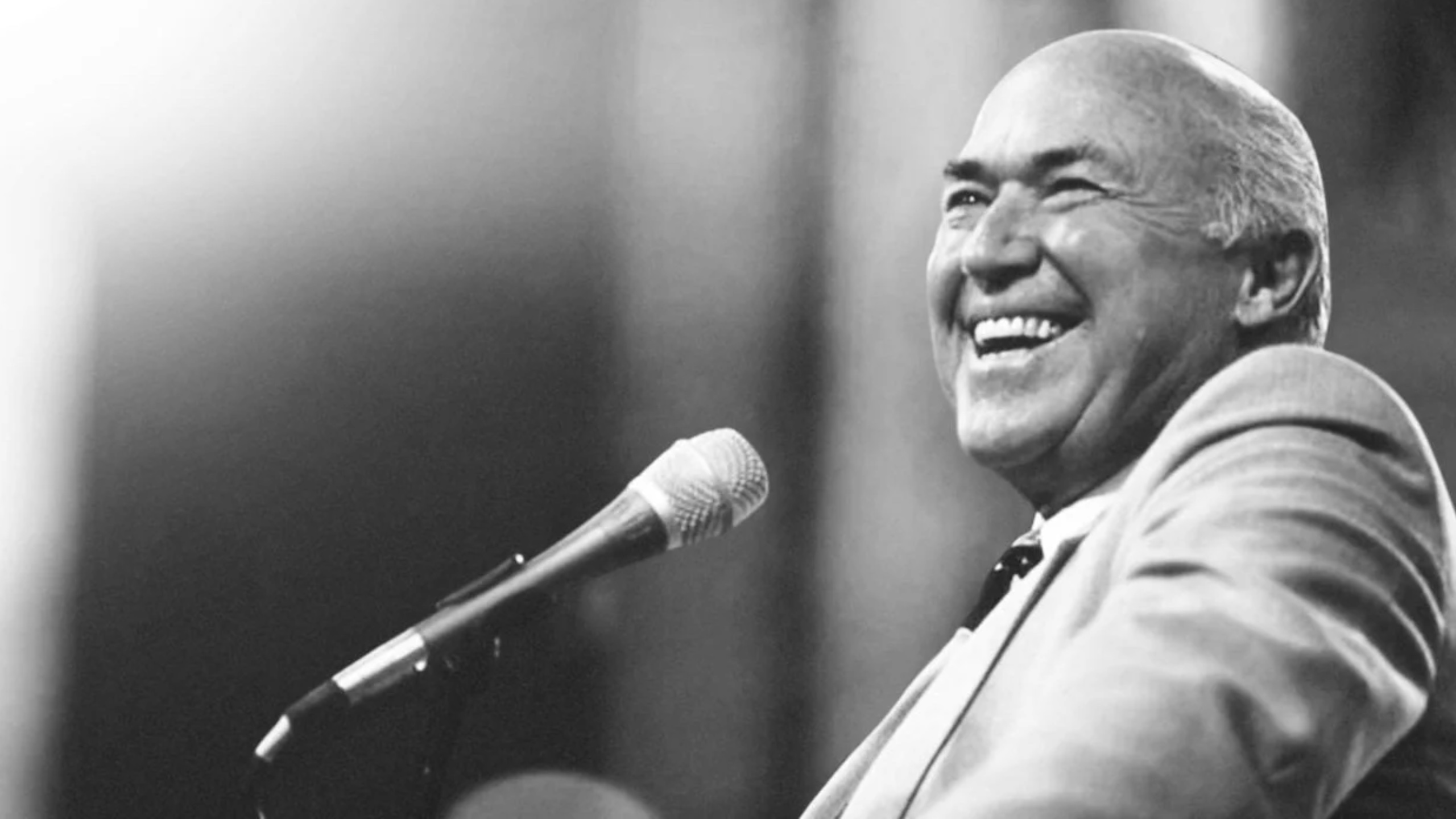
Chuck Smith
Chuck Smith, founder of Calvary Chapel, helped shape the Jesus People Movement while carrying forward influences from Foursquare Pentecostalism, Latter Rain revivalism, and figures connected to William Branham, Paul Cain, Lonnie Frisbee, and John Wimber.
Chuck Smith was an influential American pastor, best known as the founder of Calvary Chapel, a worldwide network of evangelical churches. Born on June 25, 1927, Smith began his ministry as a pastor within the Foursquare denomination before breaking away to found Calvary Chapel in 1965 in Costa Mesa, California. Smith is perhaps most remembered for his role in the Jesus People Movement of the late 1960s and early 1970s, which attracted thousands of disillusioned youth from the hippie counterculture to Christianity. His message of God's love, grace, and the accessibility of salvation resonated deeply with this generation.
Although Calvary Chapel embraced some elements of charismatic Christianity, like belief in the gifts of the Holy Spirit, Smith distanced himself from what he considered the extremes of the charismatic movement, such as prosperity gospel teachings or overemphasis on speaking in tongues. This gave Calvary Chapel a unique position—open to spiritual gifts. Under Smith's leadership, Calvary Chapel grew rapidly, eventually becoming a network of over 1,000 affiliated churches worldwide. His impact extended beyond church planting, influencing contemporary Christian worship music and evangelical culture.
Chuck Smith was raised in the Four Square Gospel movement[1] during the years in which Aimee Semple McPherson was pushing the Christian Identity agenda. Key figures in British Israelism and Christian Identity, such as Wesley Swift[2] and Gordon Lindsay,[3] emerged from the Foursquare Church. In 1938, just days after Kristallnacht, when tens of thousands of Jews were displaced, McPherson invited "Kansas Hitler" Gerald Burton Winrod to speak at Angelus.[4] Winrod, a self-professed American Fascist, was one of the most active distributors of the antisemitic Protocols of the Learned Elders of Zion, which detailed a fictitious plot of global domination by Jews.[5] This led to a strong outcry among Jewish community members and its supporters, putting Angelus Temple at the center of attention. Winrod and his Defenders of the Christian Faith organization were later named in the Great Sedition Trial of 1944. On January 3, 1944, the Defenders of the Christian Faith and twenty-nine other opponents of American involvement in the war against Germany went to trial for conspiracy to undermine troop morale and to spread fascism in the United States.[6]
It was during the height of the Sedition Trial that Chuck Smith entered Angelus Temple's L.I.F.E. Bible college to receive his pastoral training.[7] Upon graduating, Chuck and his wife Kay moved to Prescott, Arizona,[8] where Branham's "scribe" Leo Mercier and his destructive sect would later prey upon women and small children.[9] It was also the origin city of L.I.F.E. graduate Waymon Mitchell's Potter's House Church.[10] In 1948, during the height of the Latter Rain Movement, Smith was appointed for his first pastoral position as head pastor of the Foursquare Church in Prescott.[11] His second pastoral position, which was in Tucson, experienced rapid church growth.[12] Overconfident, Smith migrated to Corona, California, where he assumed he would be just as successful. When it was not, Smith left ministry altogether and became a truck driver.[13]
In the early 1950s, as the Latter Rain movement began producing countless new "faith healing" ministries, Smith was contacted by L.I.F.E. Bible college professor Dr. Richard Van Cleave. Van Cleave convinced Smith to rejoin the ministry, and Smith applied for a pastorate at Huntington Beach, California.[14]
In Huntington Beach, Smith became very close friends with William Branham's protege, Paul Cain. Cain worked with Branham in the Latter Rain Revivals and advertised himself as "a second Branham."[15] Smith allegedly told Cain that God was going to punish Cain if he did not use his "gifts" for the Church. According to Cain, he and Smith would lie on the carpet alone together to discuss religion. Smith apparently began working closely with Cain, allegedly sponsoring his meetings at Madison Square Garden in Phoenix and working as Cain's worship leader and campaign manager for the Latter Rain healing revivals.[16][17]
At that time, I could see all of the fallacies, all of the failures in the Pentecostal movement. I was moving away from that, and he was still very much Foursquare, the Huntington Beach Foursquare Church, and so he said, "Paul, the Lord's gonna punish you if you don't use your gifts for the church, you know, and then he had a green carpet and we were just lying on a carpet talking or sitting down on the carpet and so we were the best of friends."
- Paul Cain
As it relates to the New Apostolic Reformation (NAR), Chuck Smith's link to William Branham's teachings through Paul Cain had a significant impact. Cain, a devoted follower of Branham until his death, strongly promoted Branham and Branham's publicist, Lee Vayle, in his revivals.[18] Cain was advertised as "Another William Branham"[19] endorsed by Branham himself at the meeting with Smith at Madison Square Garden.[20] Unlike others associated with Branham in the Latter Rain movement, such as Oral Roberts, who embraced the emerging Prosperity Gospel, Smith gravitated toward Branham's emphasis on spiritual gifts rather than wealth.
The revival of Paul Cain's ministry was not the only destructive religious force connected to Branham that would come out of Huntington Beach. In 1968, at the epicenter of the hippie counterculture's turn towards Christianity, "Moses" David Berg began forming what would eventually become the Children of God cult.[21] The group, which lured new converts using prostitution,[22] also heavily promoted William Branham. Berg, who was a Latter Rain evangelist with roots in the Christian and Missionary Alliance, received his "prophetic" commission directly from Branham[23] a few years prior and continued advertising Branham's ministry long after being forced to flee the country.
HE THREW HIS ARMS AROUND ME & HUGGED ME & kissed me & said, "Don't worry, son, don't worry. Everything's going to be all right." Then he quoted that same little verse from the Philadelphia Prophecy. (See Letter No.695.) He said, 52. "THE LORD IS GOING TO OPEN UNTO YOU A GREAT DOOR THAT NO MAN CAN CLOSE. He's going to close all these other doors that no man can open. Don't even try to open them. The Lord's going to open unto you a great door, greater than anything you ever dreamed of!--A door that no man can close!"[24]
- David Berg
Around the same time, Lonnie Frisbee latched onto the charismatic Pentecostal style of preaching and joined the developing Jesus Movement. Evidence suggests that Frisbee had come in contact with the Latter Rain doctrines, which would have made him appealing to Smith. Frisbee cited the Old Testament Prophet Joel for his ministry,[25] the foundational text for the Latter Rain Revival and Movement. Frisbee also had a religious fixation with UFOs,[26] which was a key element of the end-time prophecies of William Branham,[27] David Berg,[28] and other Latter Rain leaders. In 1965, shortly before the Jesus Movement began, Branham taught that the rapture would involve a flying saucer that would drop "right out of space" and take Christians home.
Skeptics of the Jesus movement often point to Berg as the movement's darker, more sinister underbelly. However, Berg's influence on the broader Jesus Movement was limited. Smith instead chose to work closely with Frisbee, and the combination of the two became the catalyst that turned the movement into a revolution. Frisbee, however, had many issues of his own. Like Paul Cain, Frisbee lived a homosexual lifestyle, which was considered to be an unpardonable sin by many in the Latter Rain movement. Also, like many of the extremists in Latter Rain,[29] Frisbee practiced hypnotism and various spiritualist and occultist practices.
Frisbee was not only using hallucinogenic drugs but was still living a homosexual lifestyle, practicing hypnotism, and dabbling in various occultic and mystical practices ("The Son Worshipers," video documentary edited by Bob Cording and Weldon Hardenbrook). In this condition Frisbee joined a Jesus People commune in 1967. He never had a clear new birth conversion that involved a definite understanding of the gospel and clear repentance and faith. He never gave up homosexuality and partying. Even after he joined Calvary Chapel he would "party on Saturday night" and "preach on Sunday." He would "go out and boogie down." It was alleged that Frisbee's ministry was accompanied by "signs and wonders" but the devil can do miracles, and when measured by the standard of Scripture, Frisbee's ministry was dangerously heretical. Even so, Smith put Frisbee in charge of a Wednesday night Bible study, which soon attracted thousands.[30]
- Way of Life
When Frisbee connected with Smith in 1968, he helped transform Calvary Chapel in Costa Mesa into a central hub of the Jesus Movement. Frisbee's unique blend of charismatic preaching and supernatural manifestations attracted thousands of disillusioned youth seeking spiritual fulfillment. His ministry contributed to the rapid growth of Calvary Chapel, making it a prominent influence within the broader evangelical and charismatic movements. The spread of the movement was further accelerated when Smith and Frisbee began working with John Wimber. Wimber referred to Frisbee in his book "Power Evangelism," describing Frisbee's work as a "dramatic move of the Holy Spirit."[31] Frisbee's focus on Signs and Wonders, which were a main theme within the Latter Rain movement,[32] was adopted by Wimber as the inspiration for his "Power Evangelism,"[33] referred to as "doing the stuff."[34]