

Church Ages: From Dispensational Diagrams to “THUS SAITH THE LORD”
William Branham claimed that his teaching on the seven church ages came by divine revelation, even describing an angel supernaturally drawing the timeline before witnesses. A close comparison with Clarence Larkin’s dispensational charts reveals that Branham adopted Larkin’s structure almost wholesale, altering only minor dates and details while recasting borrowed material as prophetic authority.
William Branham's teaching on the "Church Ages" rests on the assertion that the seven churches addressed in Revelation chapters 1-3 were not merely first-century congregations but prophetic periods spanning all of church history. Branham insisted that this framework was revealed to him by divine means and that its interpretation carried the authority of supernatural disclosure rather than theological construction [1]. He repeatedly framed his conclusions as the product of vision and revelation, asserting that the interpretation of the church ages was "THUS SAITH THE LORD," blending Scripture, history, and visionary experience into a single revelatory claim [2].
- Ephesus (A.D. 53-170), Messenger: Apostle Paul
- Smyrna (A.D. 170-312), Messenger St. Irenaeus
- Pergamos (A.D. 312-606), Messenger St. Martin
- Thyatira (A.D. 606-1520), Messenger Columba
- Sardis (A.D. 1520-1750), Messenger Martin Luther
- Philadelphia (A.D. 1750-1906), Messenger John Wesley
- Laodicea (A.D. 1906-Rapture), Messenger " Elijah"(himself)
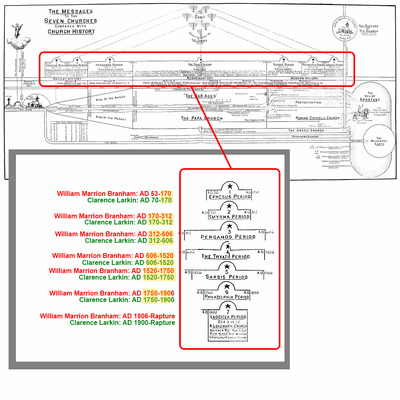
At the same time, Branham acknowledged that his historical scaffolding relied on earlier writers and commentators. In his own sermons, he admitted that many of his dates were drawn from "authentic historians" and that he was indebted to prior dispensational teachers, including Clarence Larkin [3]. He also openly referenced his use of the Scofield Reference Bible, a cornerstone text of dispensational theology, which already popularized the concept of dividing biblical history into discrete, progressive eras [4]. These admissions sit in tension with Branham's later claims that an angelic being physically drew the church ages before an audience, reinforcing the idea that the framework itself originated from direct revelation rather than literary dependence [5].
This tension between acknowledged sources and asserted revelation forms the foundation of concerns regarding plagiarism and rebranding. While Branham presented the church ages as a divinely revealed structure unique to his ministry, the underlying model closely parallels established dispensational charts and timelines that predated his sermons by decades. Understanding this contradiction is essential for evaluating whether Branham's church ages represent original revelation or a repackaging of existing theological material presented under prophetic authority.
Clarence Larkin’s Dispensational Framework and Visual Charts
Clarence Larkin’s dispensational system provided one of the most influential visual and chronological frameworks for interpreting biblical history in the early twentieth century. In his work Dispensational Truth, Larkin presented detailed charts mapping the progression of redemptive history, including a diagram titled “The Messages to the Seven Churches compared with Church History,” which aligned the seven churches of Revelation with successive historical periods [6]. These charts were not presented as speculative illustrations but as authoritative teaching tools, designed to make dispensational theology accessible through timelines, labeled eras, and clearly defined transitions.
Larkin’s approach rested on the assumption that the letters to the seven churches in Revelation represented more than their immediate first-century context. Instead, he argued that they prophetically outlined successive stages of church history, each marked by distinctive spiritual characteristics and historical developments [7]. This interpretive move required adding conceptual language—such as the notion of “ages”—that does not appear in the biblical text itself, thereby extending Revelation beyond its explicit audience “to the seven churches which are in Asia” [8].
The influence of Larkin’s work extended far beyond his own publications. His charts were widely circulated among dispensational teachers and were reinforced by the Scofield Reference Bible, which embedded similar assumptions directly into its marginal notes [9]. By the mid-twentieth century, Larkin’s visual schema had become a standard reference point within dispensational circles, shaping expectations about church history, apostasy, restoration, and the imminence of the end times. Any later claim to have independently “revealed” an identical chronological structure must therefore be evaluated against the established presence and widespread use of Larkin’s charts long before such claims were made.
William Branham’s Adoption of the Church Ages Model
William Branham did not present the church ages as a theological hypothesis developed through study, debate, or historical analysis. Instead, he framed his adoption of the model as the result of divine revelation, repeatedly asserting that God Himself disclosed the meaning and structure of the ages directly to him [10]. In his sermons, Branham described the interpretation of the church ages as a supernatural unveiling rather than an inherited interpretive tradition, positioning his teaching beyond the realm of ordinary doctrinal development.
Despite these claims, Branham made several admissions that reveal his familiarity with—and reliance upon—existing dispensational sources. He acknowledged reading the Scofield Reference Bible during the formative period of his ministry and credited prior dispensational thinkers for shaping his understanding of prophetic history [11]. Most notably, Branham explicitly expressed gratitude to Clarence Larkin, signaling not only awareness of Larkin’s work but a level of dependence incompatible with later claims of independent revelation [12]. These acknowledgments place Branham squarely within the established dispensational lineage rather than outside it.
The tension deepened over time as Branham’s narrative shifted. In earlier statements, he conceded that the historical dates associated with the church ages were borrowed from recognized historians and commentators [13]. Later accounts replaced this admission with dramatic descriptions of an angelic being physically drawing the church ages on a wall before witnesses, transforming borrowed chronology into a miraculous event [14]. This evolution suggests a conscious reframing of sources, moving from studied dependence toward prophetic originality.
By adopting Larkin’s framework while increasingly detaching it from its documented origins, Branham re-presented a well-established dispensational system as a unique, end-time revelation. This transformation did not alter the substance of the model but changed its claimed source of authority, laying the groundwork for later assertions that disagreement with Branham’s church ages was tantamount to rejecting divine revelation itself.
Direct Parallels Between Larkin’s Charts and Branham’s Timeline
When Branham’s church ages chronology is placed alongside Clarence Larkin’s chart titled “The Messages to the Seven Churches compared with Church History,” the structural dependence becomes immediately apparent. Both systems divide church history into seven sequential periods, each corresponding to one of the churches named in Revelation, and both assign approximate beginning and ending dates that follow the same historical progression [15]. The order of the ages, the overall span of centuries, and the movement from apostolic purity to end-time apostasy are not merely similar in theme but aligned in sequence and scope.
The strongest evidence of borrowing lies in the dating itself. Larkin’s chart places the close of the apostolic era near the end of the first century and proceeds through clearly demarcated periods that mirror Branham’s later framework almost exactly [16]. Branham’s timeline reproduces Larkin’s structure wholesale, diverging only at two points: the repositioning of the opening date of the first church age and the adjustment of the transition into the sixth age. These deviations do not represent an alternative historical theory but minor alterations layered onto an existing model, leaving the foundational chronology intact [17].
Such parallels are difficult to reconcile with Branham’s claim that the church ages were revealed independently through supernatural means. Had the chronology originated from revelation rather than study, one would expect substantial divergence from preexisting dispensational charts. Instead, Branham’s version preserves Larkin’s conceptual architecture while altering a small number of dates—changes insufficient to obscure the underlying source but effective in creating the appearance of originality.
The replication of Larkin’s timeline, combined with Branham’s later insistence on revelatory origin, suggests a process of adaptation rather than discovery. The church ages, as taught by Branham, function as a near facsimile of Larkin’s dispensational model, rebranded through prophetic language while remaining dependent on its original framework.
Altered Dates and Trivial Adjustments to Create Apparent Originality
Although William Branham’s church ages framework mirrors Clarence Larkin’s dispensational chart in structure and progression, Branham introduced a small number of chronological adjustments that allowed him to present the system as distinct. The most significant alteration appears at the beginning of the first church age. While Larkin placed the start of the Ephesian period at approximately A.D. 70, aligning it with the destruction of Jerusalem and the close of the apostolic era, Branham shifted this date backward to A.D. 53, tying it to the beginning of Paul’s missionary activity [18]. This change did not alter the sequence or meaning of the age but subtly repositioned its starting point.
A second adjustment occurs in the transition to the sixth church age. Larkin’s chart marks the beginning of the Philadelphia period around the year 1900, whereas Branham moved this boundary to 1906, aligning it with the Azusa Street revival and the rise of Pentecostalism [19]. This revision allowed Branham to connect his framework to contemporary charismatic history, reinforcing the sense that his interpretation was prophetically attuned to modern spiritual developments rather than inherited from an earlier dispensational schema.
These modifications function rhetorically rather than substantively. They do not challenge Larkin’s underlying historical logic or his division of church history into seven successive eras. Instead, they operate as surface-level changes that obscure direct dependence while preserving the original framework intact. By adjusting dates at key symbolic moments—apostolic beginnings and modern revival—Branham was able to claim divine insight while maintaining continuity with Larkin’s chart.
The cumulative effect of these trivial alterations is a system that appears personalized but remains fundamentally derivative. The church ages as taught by Branham are not the result of an alternative historical reconstruction but a lightly modified version of Larkin’s dispensational timeline, re-presented under the authority of revelation rather than scholarship.
Claims of Supernatural Revelation Versus Documented Literary Dependence
As William Branham’s teaching on the church ages matured, his explanation of how the framework originated shifted markedly from study and historical borrowing to direct supernatural intervention. In multiple sermons, Branham asserted that the interpretation of the church ages was not derived from books, charts, or theological systems but was revealed to him through visions and angelic activity [20]. He described an event in which a supernatural light entered the room and visibly drew the church ages on the wall before hundreds of witnesses, presenting the chronology as an act of divine authorship rather than human construction [21].
These claims stand in sharp contrast to Branham’s own earlier acknowledgments. Prior to advancing the angelic-drawing narrative, Branham openly stated that he consulted numerous historical works and commentaries and that his dates were taken from recognized historians rather than revealed independently [22]. He also admitted to reading dispensational literature and credited Clarence Larkin for his insights into prophetic history, statements that firmly situate his church ages teaching within an existing interpretive tradition [23].
The contradiction is not merely rhetorical but substantive. If the church ages chronology had been revealed supernaturally, its close alignment with Larkin’s charts—including identical sequencing, comparable date ranges, and parallel theological conclusions—would be coincidental at best. Instead, the evidence points to a gradual reframing process in which previously acknowledged sources were minimized or reinterpreted as secondary confirmations of a revelation already claimed to have occurred.
This reframing served a strategic purpose. By relocating the origin of the church ages from published works to supernatural experience, Branham insulated the doctrine from critique. Challenges to the framework could be dismissed as unbelief rather than scholarly disagreement. The result was a theological system rooted in documented literary dependence but defended through claims of direct revelation, making critical evaluation increasingly difficult for adherents.
The Role of Scofield and Dispensational Sources in Branham’s Teaching
William Branham’s church ages doctrine did not emerge in isolation but reflects a broader dispensational ecosystem shaped by the Scofield Reference Bible and its interpretive assumptions. Scofield’s notes popularized the division of biblical and church history into progressive eras, conditioning readers to expect discrete periods marked by decline, restoration, and transition [24]. Branham explicitly acknowledged his engagement with Scofield’s Bible during the formative years of his ministry, situating his theological development within a framework already structured by dispensational categories [25].
The Scofield system itself drew heavily from John Nelson Darby’s dispensational theology, which emphasized prophetic timelines, successive administrations, and an overarching narrative of apostasy and restoration. By the time Branham began preaching the church ages, these ideas were not novel but well established among fundamentalist and evangelical circles [26]. Clarence Larkin’s charts functioned as a visual amplification of the same system, translating Scofield’s marginal notes into accessible timelines and diagrams that visually reinforced the concept of historical “ages.”
Branham’s teaching absorbed these elements while reassigning their source of authority. Instead of presenting the church ages as an interpretive tradition inherited from dispensational theology, he reframed them as truths newly unveiled for the end time. The Scofield and Larkin materials thus operated as scaffolding rather than acknowledged foundations, providing the structure upon which Branham built his prophetic claims while increasingly distancing himself from their authorship.
This reliance on established dispensational sources complicates Branham’s insistence that his church ages doctrine was revealed independently. The convergence of Scofield’s notes, Darby’s theology, and Larkin’s charts within Branham’s sermons demonstrates continuity rather than innovation. The doctrine’s content aligns with preexisting dispensational teaching, even as its presentation was transformed into a prophetic mandate unique to Branham’s ministry.
Historical and Chronological Errors Introduced by Branham
Beyond borrowing Clarence Larkin’s dispensational framework, William Branham introduced a series of historical and chronological errors when assigning individual “church age messengers” to each period. These errors are not minor interpretive disagreements but demonstrable conflicts with established historical facts. By attaching specific figures to rigid date ranges inherited from Larkin’s chart, Branham created contradictions that expose a lack of independent historical verification [27].
One of the clearest examples involves Columba, whom Branham designated as the messenger of the Thyatira church age spanning from A.D. 606 to 1520. Historical records establish that Columba died in A.D. 597, nearly a decade before Branham’s proposed age even begins [28]. This misalignment demonstrates that Branham’s selection was driven by the need to populate a preexisting timeline rather than by historical coherence. The same pattern appears with Martin Luther, assigned to an age extending from 1520 to 1750, despite Luther having died in 1546 and thus being active for only a fraction of the designated period [29].
These inconsistencies suggest that Branham did not reassess Larkin’s chronology when adding his own interpretive layer. Instead, he overlaid symbolic figures onto fixed dispensational segments, producing an internally inconsistent system. The problem is compounded by Branham’s claim that these assignments were revealed supernaturally, as such revelations would presumably not conflict with basic historical timelines.
The presence of these errors further undermines the assertion that Branham’s church ages represent divine revelation. Rather than correcting or refining Larkin’s framework, Branham preserved its structure and introduced new inaccuracies through uncritical adaptation. The result is a doctrine that depends on borrowed chronology while simultaneously distorting historical reality, reinforcing the conclusion that the church ages were adapted for theological effect rather than derived from careful historical or revelatory insight.
Theological Consequences of Recasting Larkin's Work as Revelation
By presenting Clarence Larkin's dispensational framework as a supernatural revelation rather than an inherited interpretive system, William Branham fundamentally altered the theological weight of the church ages doctrine. What functioned in Larkin's work as a pedagogical model—useful for organizing prophetic interpretation—was transformed into a test of spiritual legitimacy. Agreement with the church ages, as Branham taught them, became intertwined with acceptance of his prophetic authority [30].
This shift carried significant consequences. Once the church ages were framed as divinely revealed rather than historically reasoned, disagreement was no longer a matter of theological debate but of spiritual resistance. Branham explicitly linked revelation to obedience, suggesting that truth was progressively unveiled only to those willing to receive it in the appointed age [31]. Under this framework, earlier reformers such as Luther and Wesley were portrayed as faithful within their limited eras but ultimately superseded by the fuller revelation allegedly delivered through Branham himself.
The recasting of Larkin's work as revelation also reinforced Branham's self-identification with the final "Laodicean" messenger. By placing himself at the culmination of the church ages, Branham positioned his ministry as uniquely authoritative, beyond correction by history or tradition [32]. The borrowed dispensational timeline thus became a theological ladder, elevating Branham's role while diminishing the legitimacy of competing interpretations.
In this context, the issue of plagiarism is not merely academic. The theological consequences of rebranding derivative material as revelation include the consolidation of authority, the suppression of dissent, and the insulation of doctrine from external critique. What began as a borrowed chart evolved into a closed theological system, defended not by evidence or argument but by appeals to divine mandate.