
The Thyatira Mistake: Columba, Chronology, and Branham’s False Revelation
William Branham claimed divine revelation for his church age system, yet his chronology and structure closely mirror the earlier dispensational charts of Clarence Larkin. The assignment of St. Columba as the Thyatira church age messenger collapses under historical scrutiny, as Columba died before the age supposedly began and is known primarily through later hagiographical legend rather than doctrinal leadership.
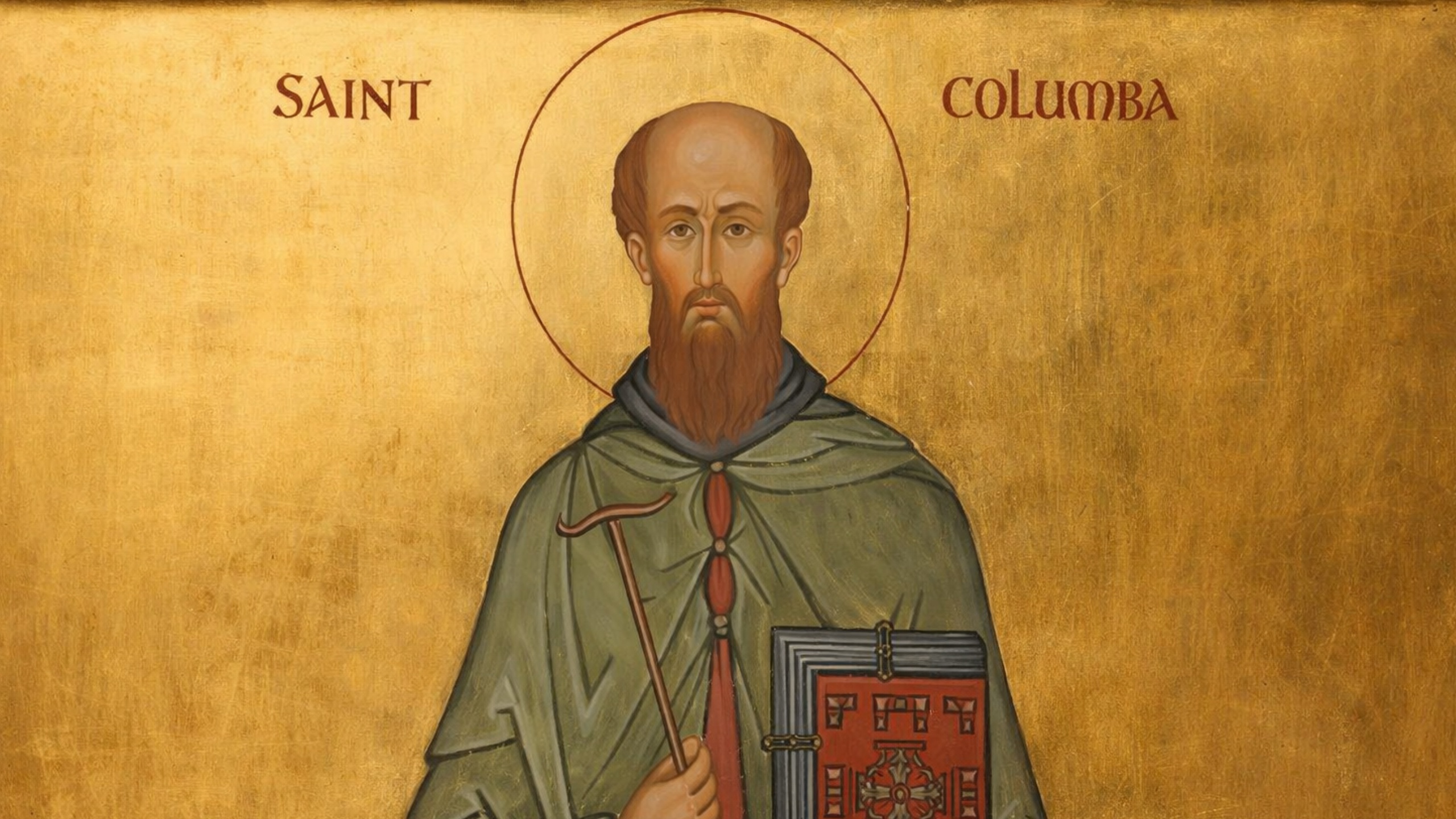
St. Columba was a sixth-century Irish monk, missionary, and abbot best known for founding the monastery of Iona and for his role in the spread of Christianity in Ireland and parts of Scotland. Born in 521 and dying in 597, Columba lived entirely within the early medieval Irish monastic world, a setting defined by localized missionary activity, ascetic discipline, and the preservation of Christian learning rather than by universal ecclesiastical authority or systematized theology [1]. His historical influence, while genuine, was regional and monastic, not trans-historical or doctrinally determinative for the wider Christian church.
Much of Columba's posthumous reputation derives not from contemporaneous documentation but from later hagiographical sources, most notably Adomnán's Vita Columbae, written more than a century after Columba's death. These writings emphasize miracle stories, visions, and legendary encounters rather than theological leadership or ecclesiastical oversight [2]. Among these accounts is what is widely recognized as the earliest written version of the Loch Ness monster legend, in which Columba is said to have confronted and commanded a water beast in the River Ness [3]. Such material illustrates the legendary and devotional character of the sources shaping Columba's image, rather than providing evidence of doctrinal authority or historical oversight of the church.
William Branham's assignment of Columba as the "messenger" of the Thyatira Church Age depends on a category foreign to both Columba's life and historical Christianity. The concept of a single divinely appointed individual functioning as the spiritual "angel" of a multi-century church era is absent from early Christian sources and unknown to Columba himself. More decisively, Columba's death in 597 predates the beginning of the Thyatira age as defined by Branham (beginning in 606), making it chronologically impossible for him to function as a living messenger for that period [4]. Whatever Columba's personal devotion or missionary zeal, the role assigned to him by Branham rests on an anachronistic framework and a selective use of legendary material rather than on verifiable historical or theological grounds.
Everyone on the shore cried out hoping to warn the monk of his impending doom. However, Columba was unmoved. Instead, the saint stepped forward boldly to the edge of the loch and, making the sign of the cross while invoking the Name of the Lord, spoke in a commanding voice."You will go no further!" he demanded of the monster. 'Do not touch the man! Leave at once!'[3]
- St. Columba and the Loch Ness Monster
Clarence Larkin’s Church Age Chronology and Its Structure
Clarence Larkin was a Baptist pastor and draftsman whose influence rested not in prophetic utterance but in visual systematization. In his work Dispensational Truth, Larkin presented a schematic view of church history divided into successive eras, each defined by fixed date ranges and symbolic characteristics [5]. These charts did not emerge from patristic exegesis or historical consensus but from late nineteenth- and early twentieth-century dispensational assumptions that history unfolds in clearly demarcated divine administrations.
Within Larkin’s framework, the churches addressed in the Book of Revelation were reinterpreted as prophetic symbols of extended historical periods rather than first-century congregations in Asia Minor. This structural move allowed later interpreters to map large swaths of church history onto Revelation’s imagery, assigning beginning and ending dates to each “age” without reliance on contemporary historical actors or lived ecclesial realities [6]. Larkin’s charts thus functioned as an abstract chronological scaffold rather than a historically grounded narrative.
Crucially, Larkin did not assign named historical figures as divinely appointed “messengers” ruling over these eras. His charts provided timelines and symbols, not personalized prophetic authorities. The system itself was flexible enough to invite later customization, particularly by figures seeking to add revelatory specificity or personal authority to the framework [7]. This distinction is central, because it shows that the act of inserting individual “messengers” was not inherent to the system but a later interpretive layer imposed upon it.
The importance of Larkin’s work lies in how it normalized the idea that Revelation encoded a hidden chronology of church history. Once this premise was accepted, it became possible for later teachers to claim special insight into the identities, boundaries, and spiritual leaders of each age. The structural clarity of Larkin’s charts thus made them an ideal substrate for subsequent claims of revelation, even when those claims departed sharply from historical chronology or evidence [8].
William Branham’s Adoption of Church Age Dates and Framework
William Branham did not present his church age teachings as an inherited theological model but as the result of direct divine revelation. Nevertheless, the chronological structure he used mirrors the dispensational framework popularized earlier by Clarence Larkin, including the same general sequencing and date ranges for the successive church ages [9]. This parallel is especially evident in Branham’s treatment of the Thyatira age, which he consistently placed beginning around A.D. 606, a boundary already established in Larkin’s charts.
Branham adopted this framework selectively, retaining its chronological scaffolding while altering its explanatory purpose. Where Larkin offered charts as visual aids for understanding prophecy, Branham recast the same structure as evidence of supernatural insight, asserting that the division of history into church ages had been revealed to him directly by God [10]. The dates themselves were not defended through historical argumentation or primary sources but were assumed as fixed points within the revealed system.
This adoption is significant because it undermines Branham’s claim that his church age teaching originated independently of prior theological systems. The reuse of an existing dispensational chronology suggests dependency rather than revelation, particularly when the same historical boundaries appear without acknowledgment or justification [11]. Instead of deriving dates from biblical exegesis or church history, Branham treated the inherited framework as authoritative and immutable.
By presenting a borrowed chronological model as revelatory truth, Branham shifted the burden of verification away from historical evidence and onto personal authority. Once the framework was accepted as divinely revealed, challenges to its accuracy—such as chronological conflicts or historical impossibilities—could be dismissed as unbelief rather than evaluated on their merits [12]. This move set the stage for later errors, including the assignment of historical figures to periods in which they did not live.
The Insertion of Named “Messengers” into the Church Ages
A critical departure between Clarence Larkin’s dispensational framework and William Branham’s system occurs with the introduction of named historical “messengers” assigned to each church age. Larkin’s charts did not identify individual figures as divinely appointed angels presiding over successive eras. His work supplied dates and symbolic transitions, but it stopped short of personalizing authority within the system. The identification of specific men as exclusive representatives of entire church ages is therefore not inherited from Larkin but added later [13].
Branham asserted that each church age had a single “angel” or “messenger,” understood not merely as a prominent teacher but as God’s chosen conduit of revelation for that era. This claim elevated these figures beyond historical influence into a quasi-prophetic role, granting them singular authority over doctrine, spiritual life, and divine truth for centuries at a time [14]. Such a construct has no parallel in early Christian historiography, medieval ecclesiology, or Reformation theology.
The selection of these messengers reveals a pattern driven more by narrative utility than historical coherence. Figures were chosen who could be portrayed as opposing Rome, associated with miracle traditions, or positioned as spiritual precursors to modern restorationist theology. This method allowed Branham to retroactively project Pentecostal and anti-institutional ideals onto figures who lived in radically different theological and cultural contexts [15].
By inserting named messengers into an already borrowed chronological framework, Branham transformed an abstract dispensational chart into a personalized lineage of authority. This move functioned rhetorically to legitimize his own claims, positioning him implicitly as the final messenger in the sequence. Once accepted, the system discouraged critical examination, since challenging any individual messenger threatened the integrity of the entire revelatory structure [16].
The Thyatira Church Age and the Assignment of Columba
Within William Branham’s church age system, the Thyatira Church Age was defined as spanning roughly from A.D. 606 to the early sixteenth century. Branham repeatedly asserted that the divinely appointed “messenger” or “angel” of this period was St. Columba, presenting this assignment as revealed truth rather than historical conjecture [17]. In doing so, he treated the identification as fixed and authoritative, not open to verification or correction.
Branham’s own descriptions reveal that the assignment depended entirely on the previously adopted chronological framework. Once the Thyatira age was set to begin around A.D. 606, a historical figure had to be fitted into that slot who could be portrayed as spiritually pure, opposed to Roman authority, and associated with miracle traditions. Columba, already enveloped in hagiographical legend and geographically distant from Rome, was presented as an ideal candidate despite the chronological conflict [18].
In Branham’s sermons, Columba is depicted as a proto-Pentecostal reformer who rejected Roman doctrine, taught supernatural signs, and carried the true light of the Gospel through a dark ecclesiastical age. These attributes are asserted without reference to primary historical sources and rely instead on selective readings of later legendary material [19]. The result is not a historically grounded portrait but a theological retrofitting designed to sustain the integrity of the messenger system.
The assignment of Columba to Thyatira thus illustrates a structural flaw in Branham’s method. Rather than allowing historical data to shape the framework, the framework dictated the selection of the historical figure. When chronology, context, and source material conflicted with the system, those conflicts were ignored. This inversion of method set the stage for the most obvious failure of the claim: Columba was not alive during the period he was said to govern [20].
The Historical Life of St. Columba
St. Columba was born in A.D. 521 in Ireland and died in 597, placing his entire life within the sixth century [21]. He belonged to a noble Irish family and was trained in the monastic tradition under prominent teachers such as Finnian of Clonard. His vocation and influence were rooted in the Irish monastic movement, which emphasized ascetic discipline, manuscript preservation, missionary activity, and the establishment of local religious communities rather than centralized ecclesiastical authority.
Columba is best known for founding the monastery of Iona, which became an important center for missionary outreach into parts of Scotland. His authority derived from his role as an abbot within a monastic network, not from episcopal office or doctrinal leadership over the broader Christian world [22]. The scope of his influence was therefore regional and institutional, tied to specific communities rather than to Christendom as a whole.
The primary sources for Columba’s life are hagiographical in nature, especially Adomnán’s Vita Columbae, written more than a century after Columba’s death. These accounts focus heavily on miracles, visions, prophecies, and legendary encounters, reflecting the devotional aims of medieval saint literature rather than modern historical standards [23]. While such texts testify to Columba’s reputation for holiness, they do not present him as a theological innovator or as a singular voice guiding the doctrine of the church across centuries.
Nothing in the historical record suggests that Columba understood himself as standing in opposition to a fully developed “Roman system,” nor that he functioned as a reformer in the later Protestant sense. The ecclesiastical conflicts and institutional structures implied by Branham’s narrative belong to later historical periods and cannot be retrojected into Columba’s context without distortion [24]. Columba’s historical identity is therefore incompatible with the role assigned to him as a church age messenger.