
Doomsday Predictions and Cold War Politics in William Branham’s Message
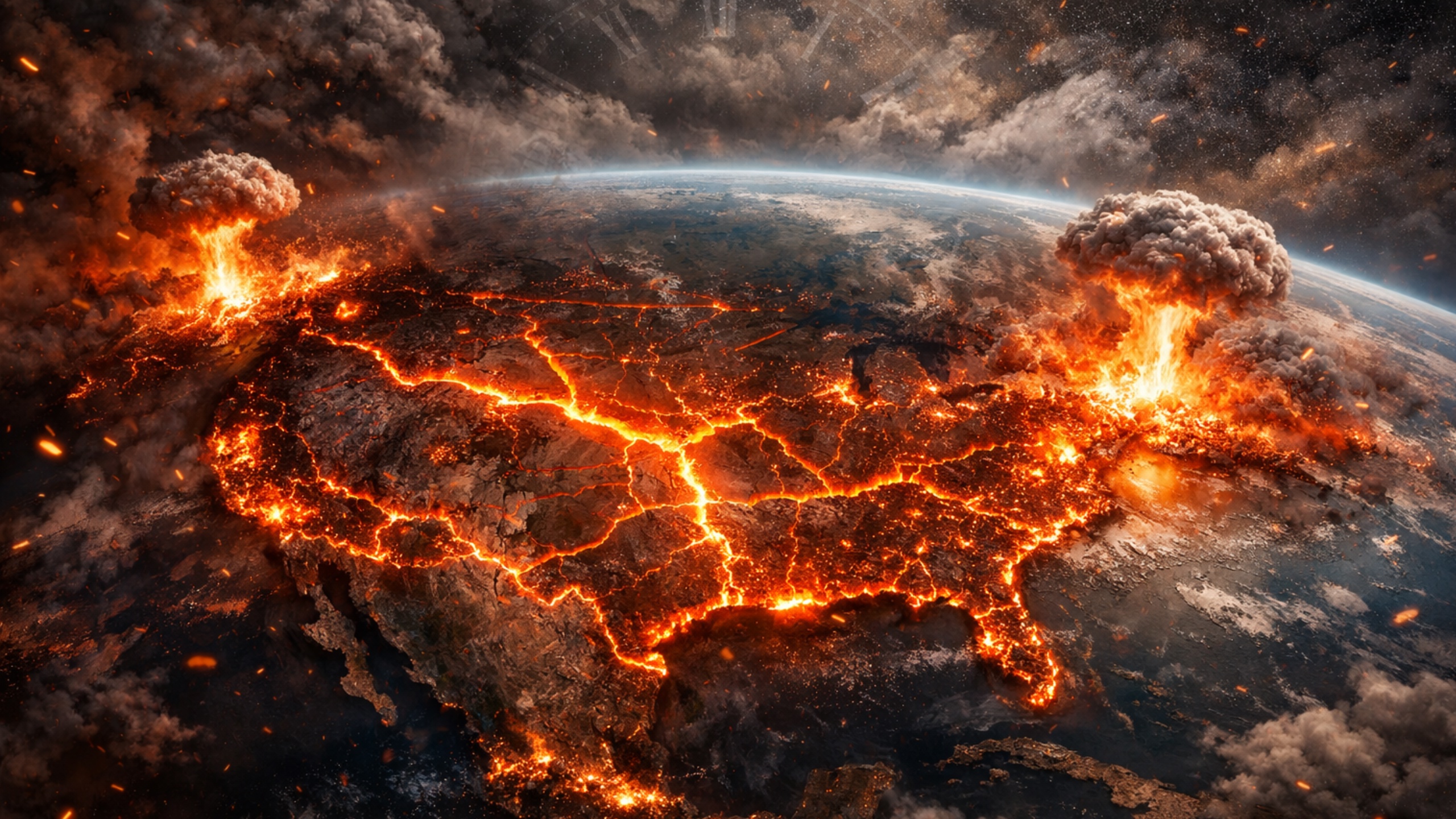
William Branham’s doomsday predictions consistently aligned with moments of geopolitical crisis, transforming Cold War fear, nuclear anxiety, and concerns about American decline into proof that history itself was ending. When specific predictions failed, political instability was recycled as renewed confirmation, allowing prophetic authority to survive without accountability.
William Branham’s doomsday predictions did not arise in a political vacuum. From the late 1940s through the mid-1960s, his prophetic timelines consistently intensified during periods of global instability, nuclear anxiety, and American political upheaval. Rather than forecasting specific future events with verifiable precision, Branham repeatedly reframed contemporary geopolitical crises as evidence that history itself was about to end. When earlier predictions failed, they were not abandoned as errors but recalibrated through new mathematical schemes, calendar adjustments, or symbolic interpretations, allowing the movement to preserve prophetic authority while maintaining a constant state of urgency.
This framework positioned modern political developments—war, democracy, communism, and national decline—not as historical processes subject to change, but as irreversible countdown markers toward destruction. In Branham’s rhetoric, American political survival was tied directly to divine approval, and global conflict functioned as proof that humanity had reached the final boundary of time. His apocalyptic language thus merged religious prophecy with Cold War fear, reinforcing obedience and loyalty among followers while discouraging long-term planning, historical accountability, or institutional scrutiny.
Cold War Anxiety and the 1948 “World In Prophecy” Claims
The first documented doomsday prediction associated with William Branham’s ministry emerged in 1948, explicitly framed through contemporary geopolitical instability. In the aftermath of World War II, Branham and his associates argued that global political realignment and international tension were not temporary conditions but proof that the world had entered its final phase. Writing as publisher of The Voice of Healing, Branham promoted articles asserting that unfolding world events demonstrated that destruction was imminent and unavoidable [1].
Rather than identifying a singular catastrophic trigger, the 1948 prediction relied on the cumulative weight of postwar fear. The collapse of wartime alliances, the rise of Cold War hostilities, and widespread anxiety over future conflict were presented as self-evident confirmation that history itself could not continue. This approach allowed Branham to position existing political conditions as prophetic fulfillment without risking falsification tied to a specific event. When 1948 passed without the predicted destruction, the failure was not acknowledged as error; instead, the framework itself remained intact, ready to be reapplied to new political crises [1].
Atomic Age Fear and the 1954–1956 End-Time Timetables
By the mid-1950s, Branham’s doomsday framework became more explicit and more tightly connected to global political anxiety. Drawing on a popular prophetic scheme that divided history into successive two-thousand-year periods, Branham asserted that the world had reached the end of its allotted time and that modern conditions proved it. He argued that the first two thousand years ended in destruction by water, the second concluded with the coming of Christ, and that the current era was likewise terminating, leaving no expectation of historical continuity beyond the present generation [2].
This prophetic certainty was reinforced by direct political application. In 1956, Branham framed the United States as standing at a decisive national crossroads, asserting that the country would either accept his message or face rejection and judgment within that year [3]. This rhetoric mirrored the broader Cold War atmosphere in which communism, nuclear weapons, and ideological conflict were widely portrayed as existential threats. Political instability was not treated as contingent or reversible, but as confirmation that divine patience had expired. When neither the global end nor national collapse occurred, the predictions were not repudiated; instead, they were absorbed into an expanding narrative of delayed but inevitable judgment, ready to be recalibrated as new political fears emerged.
Nuclear Tension and the 1962 “End of History” Rhetoric
During the 1960s, Branham’s doomsday language escalated alongside the most acute phase of Cold War nuclear tension. In this period, global politics were dominated by the threat of immediate annihilation, and Branham’s preaching increasingly reflected the belief that history itself was about to cease. Rather than framing the end as a distant or symbolic event, he asserted that the conclusion of human history was imminent and irreversible, leaving no meaningful future beyond the present moment [4].
This rhetoric went beyond warning of destruction and moved toward the erasure of historical continuity altogether. Branham insisted that the world had reached a point where there was no longer any purpose in recording history, because no one would remain to read it [5]. Such claims transformed contemporary geopolitical fear into theological finality. Nuclear crisis and global instability were not portrayed as extreme but survivable dangers; they were treated as definitive proof that humanity had reached the terminus of time itself. When history continued beyond these predictions, the failure was absorbed by shifting emphasis to later dates, reinforcing expectation without acknowledging error.
American Democracy, National Decline, and the 1975 Prediction
As Branham’s prophetic framework developed through the mid-1960s, his doomsday claims became increasingly entangled with explicit commentary on American political survival. Rather than presenting the end of the world as a purely global event, he argued that the lifespan of the United States itself provided measurable proof that history was nearing its conclusion. Citing the Declaration of Independence and the supposed historical limit of democratic governments, Branham asserted that the United States had only a fixed number of years remaining and could not continue beyond that boundary without violating historical precedent [6].
This claim reframed American democracy as a prophetic timepiece rather than a political system subject to reform, conflict, or resilience. National decline was portrayed as inevitable, not contingent on policy or leadership, and the failure of democracy became a sign that divine judgment had reached its terminal phase. By embedding his doomsday expectation within American political history, Branham transformed patriotism, fear of national collapse, and distrust of democratic institutions into theological evidence. When the predicted window passed without national destruction, the narrative did not collapse; instead, the emphasis shifted forward, allowing political anxiety to continue functioning as confirmation rather than contradiction [6].
Jubilee Mathematics, Israel, and the 1977 Doomsday Narrative
After earlier timelines failed to materialize, Branham introduced a more elaborate prophetic structure centered on biblical jubilee calculations and sacred chronology. Rather than abandoning prior expectations, he reframed the approaching end through numerology, asserting that history itself was governed by divinely fixed cycles that culminated in the year 1977. By counting jubilees from Leviticus and aligning them with modern chronology, he claimed that the present generation stood at the exact terminus of God’s dealings with humanity [7].
This recalibration allowed political and geopolitical uncertainty to be absorbed into a seemingly unassailable mathematical framework. The argument did not depend on a specific war or political collapse, but on the claim that divine time had expired regardless of human action. In this way, international tension, Cold War rivalry, and ongoing conflict in the Middle East functioned as supporting signs rather than necessary triggers. When 1977 arrived without the predicted end, the failure did not dissolve the movement’s expectations; instead, the emphasis on hidden calendars and disputed chronologies provided a mechanism for continued belief, insulating prophetic authority from empirical falsification [7].
Media Coverage, Cult Identity, and the Publicization of the 1977 Prediction
By the mid-1970s, Branham’s doomsday expectations had moved beyond sermon rhetoric and into public view through the actions of his followers. After Branham’s death, adherents continued to promote the 1977 prediction as an imminent and literal end of the world. This belief was sufficiently visible to attract newspaper coverage, where followers openly described their expectation that global history would soon conclude and defended their strict separatist practices as necessary responses to the approaching end [8].
Public reporting revealed how apocalyptic belief had become central to group identity rather than a single prophetic claim. Followers framed outside criticism as persecution and interpreted interventions by concerned families or authorities as confirmation that they alone possessed truth. Political and social alienation thus reinforced theological certainty. Even as 1977 passed without fulfillment, the prior publicity did not collapse belief; instead, it demonstrated how the doomsday narrative had become self-sustaining, no longer dependent on Branham’s direct authority but embedded in communal expectation and fear of the outside world [8].
Failed Prophecy Recycling and Political Recalibration
After the collapse of the 1977 expectation, Branham’s prophetic framework did not disappear; it was absorbed into a broader pattern of recycled urgency. Earlier sermons already provided mechanisms for extending the timetable by appealing to disputed calendars, shortened days, or divine mercy delaying judgment. By invoking alternative chronologies and claims that modern calendars were inaccurate, Branham had already laid the groundwork for deferring finality without conceding error [9]. These explanations allowed political and global instability to remain central, even as specific dates failed.
This recycling process ensured that geopolitical anxiety could always be reinterpreted as confirmation rather than contradiction. War, political corruption, and social unrest were no longer tied to a single deadline but became ongoing signs that the end was perpetually imminent. The prophetic narrative thus shifted from prediction to posture: followers were trained to live in a permanent state of expectation, distrustful of institutions and skeptical of historical continuity. Political developments functioned as raw material for renewed urgency, while failed dates were quietly absorbed into an elastic eschatology that preserved authority by never allowing the present moment to become ordinary [9].
Patterns of Political Exploitation in Branham’s Apocalyptic Messaging
Across multiple decades, Branham’s doomsday predictions reveal a consistent pattern in which contemporary political events were not merely referenced but actively exploited as prophetic evidence. Rather than responding to changing geopolitical realities, his message absorbed them into a closed interpretive system where instability itself functioned as proof. Communism, war, the perceived moral decline of America, and the fragility of democratic institutions were repeatedly framed as indicators that divine judgment had reached its final stage [10].
This pattern ensured that political fear could never falsify the prophecy. If a specific prediction failed, the surrounding political turmoil remained, allowing the message to persist unchanged in substance while shifting in form. Apocalyptic urgency thus became detached from verifiable outcomes and reattached to emotional perception. Politics served not as a domain of human responsibility or historical complexity, but as a symbolic register signaling inevitable collapse. The result was a worldview in which engagement with society was discouraged, trust in institutions was eroded, and obedience to prophetic authority was reinforced through constant exposure to unresolved political anxiety [10].