
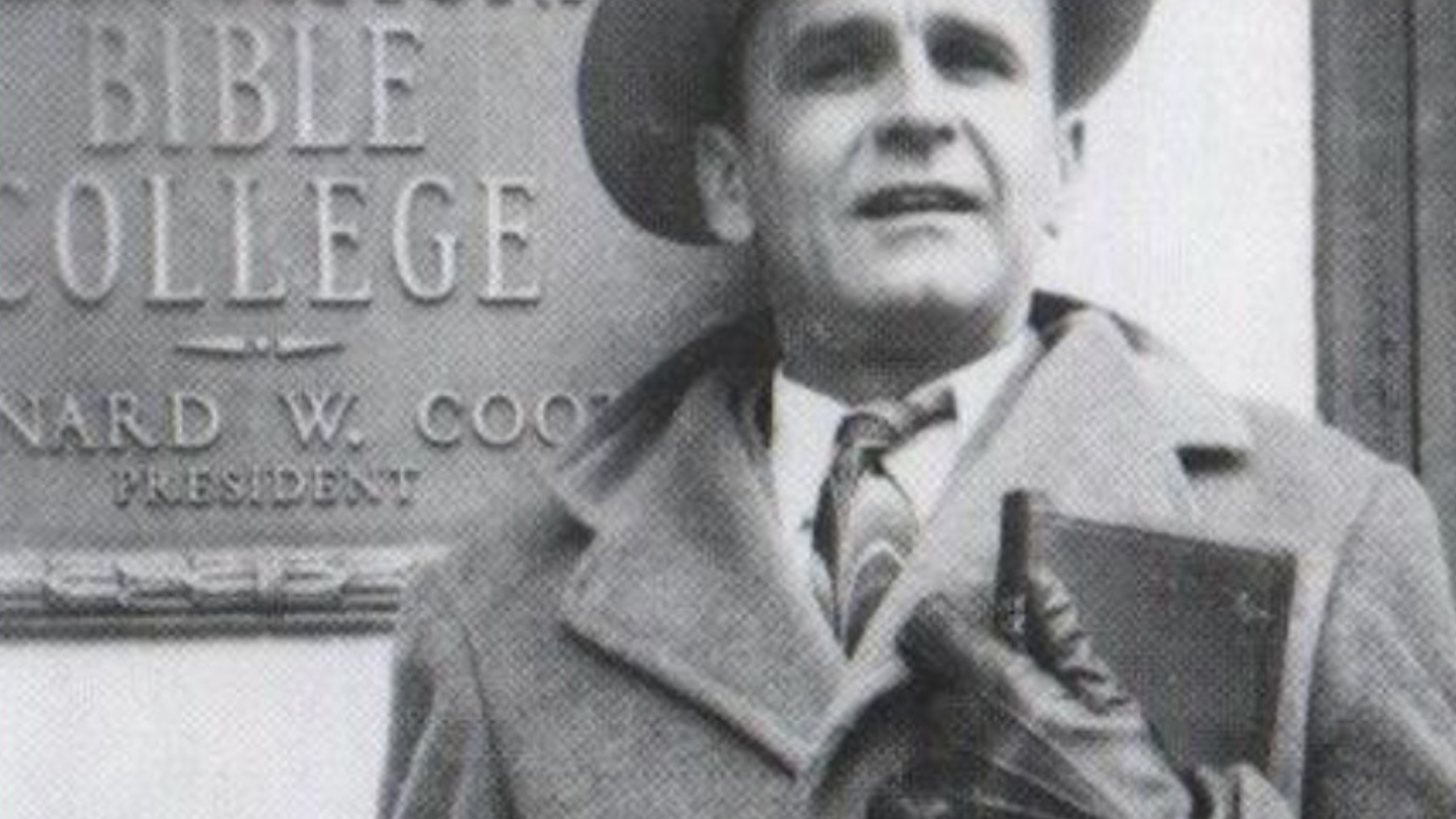
The Anti-Education Prophet: How William Branham Turned Ignorance into Authority
William Branham publicly condemned education as satanic while simultaneously editing, publishing, and managing multiple religious publications that required literacy and organizational skill. This contradiction reveals how anti-education theology functioned as a tool of authority, insulating Branham’s movement from scrutiny while aligning with segregationist and authoritarian structures.
William Branham's doctrine against education did not emerge as a single theological position but developed gradually as part of his evolving stage persona. Early in his ministry, education was framed as unnecessary rather than inherently evil. Over time, especially as his authority increasingly rested on claims of supernatural revelation rather than doctrinal coherence, Branham reframed education as a spiritual threat. By the mid-1960s, he was openly teaching that education, civilization, and modern intellectual life originated from satanic influence rather than from God [1]. This doctrinal shift allowed Branham to elevate personal revelation above scripture, scholarship, and accountability, positioning himself as uniquely qualified to interpret divine truth despite rejecting formal learning.
Oh, you see, it’s this intellectual day that we’re living in. Education, civilization, and the modern trend of the day, is all of the devil. "Civilization of the devil?" Yes, sir! The Bible said it is.
Branham, William. 1965, December 7. Leadership (65-1207).
This anti-education posture also functioned defensively. As Branham's sermons accumulated theological errors, fabricated statistics, and altered biblical citations, discouraging education among followers reduced the likelihood of critical examination. By teaching that intellectual inquiry itself was corrupt, Branham insulated his message from scrutiny and normalized contradictions between his claims and verifiable evidence. The doctrine thus served not merely as a belief about schooling, but as a structural mechanism for maintaining authority and control within his movement [2].
Education as Satanic: Sermons, Rhetoric, and Scriptural Distortion
As Branham's doctrine hardened, education was no longer portrayed as merely unnecessary but as actively satanic. He repeatedly taught that intellectual development, scientific progress, and formal learning belonged to "the devil," framing them as part of an end-times deception designed to undermine faith [1]. This rhetoric inverted traditional Christian views that regarded learning as a gift or tool to understand scripture, replacing them with a binary in which revelation and obedience were opposed to study and reason.
Look at this teen-age insane! Why, we had a…I told you the other day, they was taking an analysis there of the schools in Arizona where I live, and eighty percent of the children in school is mentally retarded. What will their children be? We can’t have another generation. We’re at the end."
Branham, William. 1965, April 25. God's Provided Place Of Worship (65-0425).
To support this claim, Branham regularly distorted biblical texts. Most notably, he reworked Genesis 2:16 by omitting the qualifying phrase “of good and evil,” recasting the Tree of Knowledge itself as symbolic of education rather than moral discernment [2]. In other sermons, he asserted that unnamed scriptures condemned schooling outright, yet never read or cited any actual passage. These rhetorical techniques allowed Branham to present his doctrine as biblical while avoiding verifiable textual engagement. The result was a theological framework in which education became synonymous with rebellion against God, and ignorance was reframed as spiritual purity [3].
Alignment with Segregation and White Supremacist Resistance to School Integration
Branham's most aggressive denunciations of education coincided with the national conflict over school integration in the 1950s and 1960s. As federal desegregation orders challenged segregated public schools, opposition movements frequently framed education itself as corrupt, dangerous, or ungodly. Branham's sermons during this period mirrored that rhetoric, portraying public schooling as morally degenerate and spiritually poisonous rather than addressing race directly. By declaring education "of the devil," he provided a theological justification for withdrawal from integrated institutions without explicitly naming segregation as the motive [6].
This alignment becomes clearer when examined alongside Branham's close association with Roy E. Davis, a prominent segregationist who actively opposed racial integration in schools. As Davis publicly fought desegregation, Branham intensified his attacks on education, particularly state-run systems. The effect was to sacralize resistance to integration, reframing it as obedience to God rather than defiance of civil authority. Within Branham's following, rejecting education became both a religious duty and a means of preserving racial and cultural separation, embedding white supremacist assumptions beneath overtly spiritual language [7].
The Illiterate Prophet Persona: Claims of Seventh-Grade Education
Central to Branham’s authority was the repeated construction of an “illiterate prophet” persona. Across decades of sermons, he emphasized that he had only a seventh-grade education, frequently describing himself as uneducated, illiterate, or barely able to read. These claims were not incidental; they were strategically deployed to frame his ministry as divinely empowered rather than intellectually derived. By contrasting himself with trained ministers, theologians, and academics, Branham presented his success as proof that God deliberately bypasses education in favor of supernatural calling [8].
This persona also functioned as insulation against critique. When confronted with grammatical errors, historical inaccuracies, or doctrinal contradictions, Branham framed such deficiencies as evidence of humility rather than incompetence. He repeatedly taught that education was unnecessary for truth and even dangerous, reinforcing the idea that challenges from educated critics were spiritually suspect. The result was a closed interpretive system in which Branham’s lack of formal education was not a liability but a credential—proof that his message originated from God alone and should not be tested by scholarly or institutional standards [9].
Evidence of Literacy and Intellectual Competence in Early Writings
Contrary to Branham’s repeated claims of illiteracy and minimal education, his early written record demonstrates functional literacy, rhetorical ability, and editorial competence well beyond what would be expected from a seventh-grade education. During the 1940s, Branham authored letters to newspaper editors, promotional tracts, and doctrinal statements that required clarity, argumentation, and familiarity with public discourse. A December 1944 letter published in the Jeffersonville Evening News shows Branham composing a structured moral argument intended for a general readership, contradicting later assertions that he could barely read or write [10].
Additional evidence appears in Branham’s involvement with religious publications during the same period. By 1947, he was publicly engaging with periodicals, referencing newly issued magazines from the pulpit, and demonstrating awareness of publication schedules and editorial processes [11]. These activities indicate not only literacy but also active participation in written media. The contrast between this documented competence and his later portrayal of himself as illiterate suggests that the “uneducated prophet” persona was selectively constructed after his authority no longer depended on transparency or accountability, but on the rejection of education itself as spiritually corrupt [12].
Editorial Control and Publishing Leadership in Herald of Truth
Branham’s documented role in religious publishing further undermines claims of illiteracy and hostility to education as an inherent limitation. By 1947, William Branham was formally listed as an associate editor of Herald of Truth, the official publication of W. E. Kidson’s ministry and affiliated Pentecostal organizations. Editorial responsibility required reviewing written material, coordinating content, and maintaining consistency with doctrinal messaging, tasks incompatible with Branham’s later portrayal of himself as barely able to read or write [13].
This editorial involvement also places Branham within institutional religious structures he would later disavow. At the time of his association with Herald of Truth, the publication operated within established Pentecostal networks and was tied to denominational leadership. Branham’s subsequent rejection of denominationalism, intellectual engagement, and theological training stands in tension with his earlier participation in exactly those systems. The shift suggests not ignorance, but a strategic reorientation of persona: once independent authority and supernatural claims replaced institutional credibility, education and publishing were reframed as corrupt influences rather than essential tools of ministry [14].
Creation and Management of The Voice of Healing Publication
Branham’s role in founding and directing The Voice of Healing further contradicts his later claims of illiteracy and hostility to organized intellectual work. Beginning in 1948, The Voice of Healing was launched as an inter-evangelical publication explicitly designed to organize, promote, and coordinate the Branham Healing Campaigns. Branham was not a passive figurehead; he was identified as the original publisher, participated in policy decisions, and approved the structure that governed both the magazine and the revival network it represented [15]. Such responsibilities required sustained engagement with written correspondence, editorial review, and administrative planning.
As the publication matured, The Voice of Healing became a central mechanism for shaping stage personas, managing public narratives, and responding to criticism. Editorial content addressed failed healings, doctrinal disputes, and internal controversies, often reframing criticism as a lack of faith rather than a failure of claims [16]. This institutional publishing work stands in sharp contrast to Branham’s later rhetoric condemning education and intellectual labor. Rather than evidence of incapacity, the record shows a leader who used education, publishing, and organization when they served his authority, and denounced them only after his movement no longer depended on transparency or shared oversight [17].
Suppression of Education Among Followers and Gendered Impact
Branham’s anti-education doctrine was not limited to abstract theology; it produced concrete behavioral expectations within his following. As education was framed as satanic and corrupting, many adherents were encouraged to withdraw their children from formal schooling or to limit education to the bare minimum. This pressure fell most heavily on families deeply embedded in the movement, where questioning the doctrine was equated with spiritual rebellion. Education ceased to be a neutral life choice and became a test of loyalty, reinforcing dependence on Branham’s interpretations rather than external sources of knowledge [18].
The impact was especially pronounced for female members. Branham’s teachings emphasized submission, domestic roles, and obedience, and discouraging education functioned to narrow acceptable paths for female autonomy. By framing higher education as dangerous, worldly, or prideful, the doctrine restricted women’s access to economic independence and critical thought. This gendered suppression of education reinforced hierarchical authority structures within the sect, ensuring that leadership, interpretation, and doctrinal control remained concentrated among men aligned with Branham’s message, while women were socialized to accept limitation as spiritual virtue [19].
Long-Term Effects on Sect Identity and Authority Structures
Branham’s doctrine against education reshaped the long-term identity of his movement by normalizing ignorance as a spiritual virtue and framing external knowledge as a threat to faith. Over time, this produced an insular culture in which loyalty was measured not by ethical accountability or doctrinal coherence, but by rejection of outside authority. Education, scholarship, and historical inquiry were recast as tools of deception, ensuring that Branham’s interpretations remained insulated from challenge even after his death [20].
This legacy also stabilized authoritarian control. By discouraging education, Branham’s movement reduced the likelihood that followers would critically evaluate leadership claims, trace doctrinal origins, or compare teachings against historical Christianity. Authority flowed downward from prophetic assertion rather than upward from communal discernment or scriptural study. The result was a sect structure in which obedience replaced understanding, and inherited beliefs were preserved through social pressure rather than informed conviction. The anti-education doctrine thus functioned as a self-perpetuating mechanism, preserving Branham’s authority posthumously by ensuring that the tools needed to dismantle it were labeled spiritually dangerous [21].