
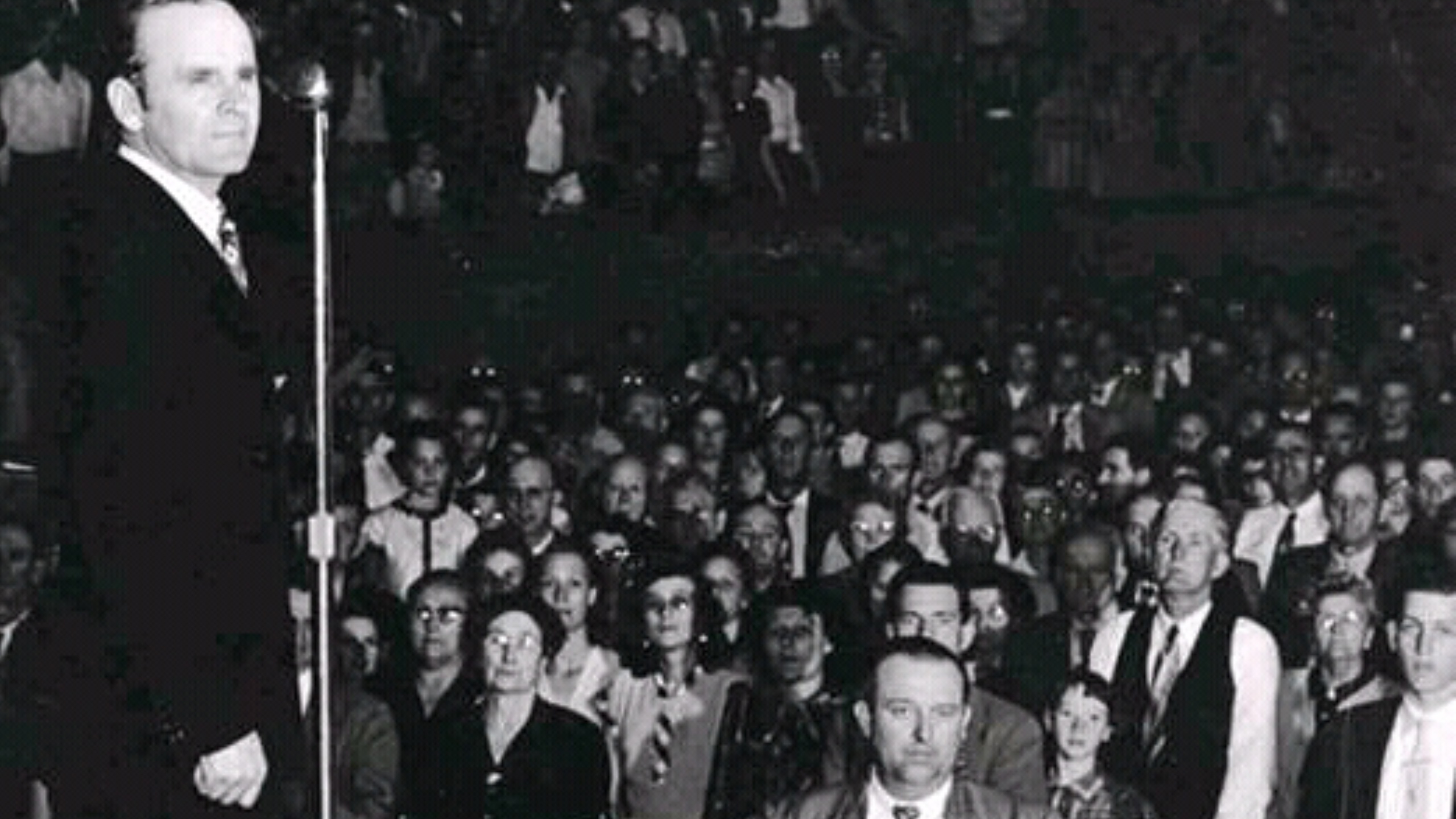
Faith Healing, Authority, and Control in William Branham’s Revival Campaigns
William Branham emerged as a prominent figure in the post–World War II healing revival, drawing together Pentecostal groups that eventually coalesced into the Latter Rain movement. His evolving commission stories, healing practices, and disputed claims—along with warnings from close associates—reveal a ministry marked by shifting narratives and growing controversy.
William Branham is recognized by some as a foundational leader of the post—World War II Healing Revival.[1] Presenting himself as a Baptist minister sympathetic to Pentecostal faith, Branham traveled throughout the United States and parts of Canada, fostering a movement that drew participation from multiple Christian sects and persisted for decades. In its earliest years, various Pentecostal groups united in support of the revival, which ultimately coalesced into a distinct movement known as the New Order of the Latter Rain, commonly called the Latter Rain.[2]
During the initial years of his ministry, Branham traveled with other ministers who preached prior to his so-called healing lines. These associates ranged from Ern Baxter[3] to the ten-year-old boy preacher known as “Little” David Walker[4], and to Fred Francis Bosworth, a nationally recognized faith healer and founder of the Assemblies of God.[5] Branham aligned himself with ministers and evangelists who already possessed established followings. Several of these associates, including Gordon Lindsay and Ern Baxter, urged Branham not to teach[6], but instead to confine his role to praying for the sick while others handled the preaching. Bosworth, whose teachings would significantly influence Branham, had himself been trained under the cult leader and internationally known faith healer John Alexander Dowie.[7]
In later versions of his public persona, Branham claimed that he received his gift of healing “the very day Israel became a nation,” which he incorrectly dated as May 6, 1946.[8] The modern nation of Israel was in fact established on May 14, 1948.[9] Earlier portrayals of Branham’s ministry, however, assigned the origin of his healing gift to other periods, and early publications describe a ministry that was already active and publicly promoting healing claims. A 1945 pamphlet titled I Was Not Disobedient To The Heavenly Vision, for example, presents a markedly different narrative, including an alternative start date and a distinct divine commission.[10] In that pamphlet, Branham asserted that his healing ministry began after a vision of people dressed in white robes, whom he interpreted as representing his followers. In later iterations of his persona, he instead attributed the origin of his healing gift to an angelic visitation.[11] Notably, healing was advertised as a component of Branham’s ministry as early as September 1936.[12]
In 1947, Branham formally revised his commission narrative in a recorded sermon to include the story of an angelic visitation,[13] which he then began to identify as the beginning of his faith-healing ministry. By 1954, he further adjusted the timeline of this account, placing the event on May 6, 1947, one year closer to the actual date of Israel’s formation.[14] This revised chronology was retained throughout the remainder of his career and repeated across subsequent versions of his public persona.[15] Over time, the description of the angel and the surrounding circumstances shifted considerably. In some accounts, Branham stated that he did not see the angel’s face,[16] while in others he described the figure as a clean-shaven man.[17] According to his earliest accounts, the encounter occurred in his room and involved a light.[18] Later versions relocated the event to a cave, a cabin with a window,[19] Green’s Mill or Tunnel Mill,[20] or a path leading to the cave.[21] Despite these variations, the central narrative remained consistent: an angel appearing as a man instructed Branham to direct the people’s faith toward himself.[22] Branham frequently quoted the angel as saying, If you can get the people to believe in you, then nothing will stand in your way, not even cancer.
As part of his campaigns, Branham’s team distributed prayer cards to those seeking healing, requesting their name, address, and a description of their illness.[23] Ushers collected these cards and presented them to Branham prior to the services. Branham would then call out the card numbers, and as individuals approached the platform, he claimed that God had revealed to him the personal details written on the cards, a practice he described as a gift of discernment. Although Branham asserted that this discernment was infallible, documented errors did occur.[24]
In the early phase of his ministry, Branham also claimed to experience physical vibrations in his hand that allegedly detected disease. According to his account, these vibrations caused changes in the color and temperature of a patient’s hand, and their absence indicated that healing could not occur.[25] Branham further asserted that his use of a luxury Longines watch was necessitated by these vibrations.[26]
Several individuals who worked closely with Branham later alleged that while his healing claims were viewed as genuine, his preaching was harmful. Ern Baxter, who played a key role in launching Branham’s career through the Baxter-Branham campaigns, ultimately concluded that Branham should not have been teaching.
Branham as a teacher was outside of his calling. The fruits of his teaching ministry are not good. — Ern Baxter [27]
One of the reasons for my leaving him was that he was starting to say some seriously wrong things. When that, coupled with other circumstances, eventually became unbearable, I resigned. — Ern Baxter [28]
Gordon Lindsay, Branham’s campaign manager and long-time promoter, expressed similar concerns. According to Jim and Marie Watt, who corroborated Baxter’s testimony, Lindsay repeatedly attempted to persuade Branham to refrain from teaching while continuing his healing ministry.
I agree with the general insights expressed by Baxter in this interview. Branham had a true Gift of Healing but was a terrible teacher. I walked out on two of his meetings while he was teaching. Gordon Lindsey prior to Baxter tried to get Branham not to teach but was unable to do so. I believe it was for this reason that God took him home in 1965 before he could do more harm with his teaching. — Jim and Marie Watt [29]