
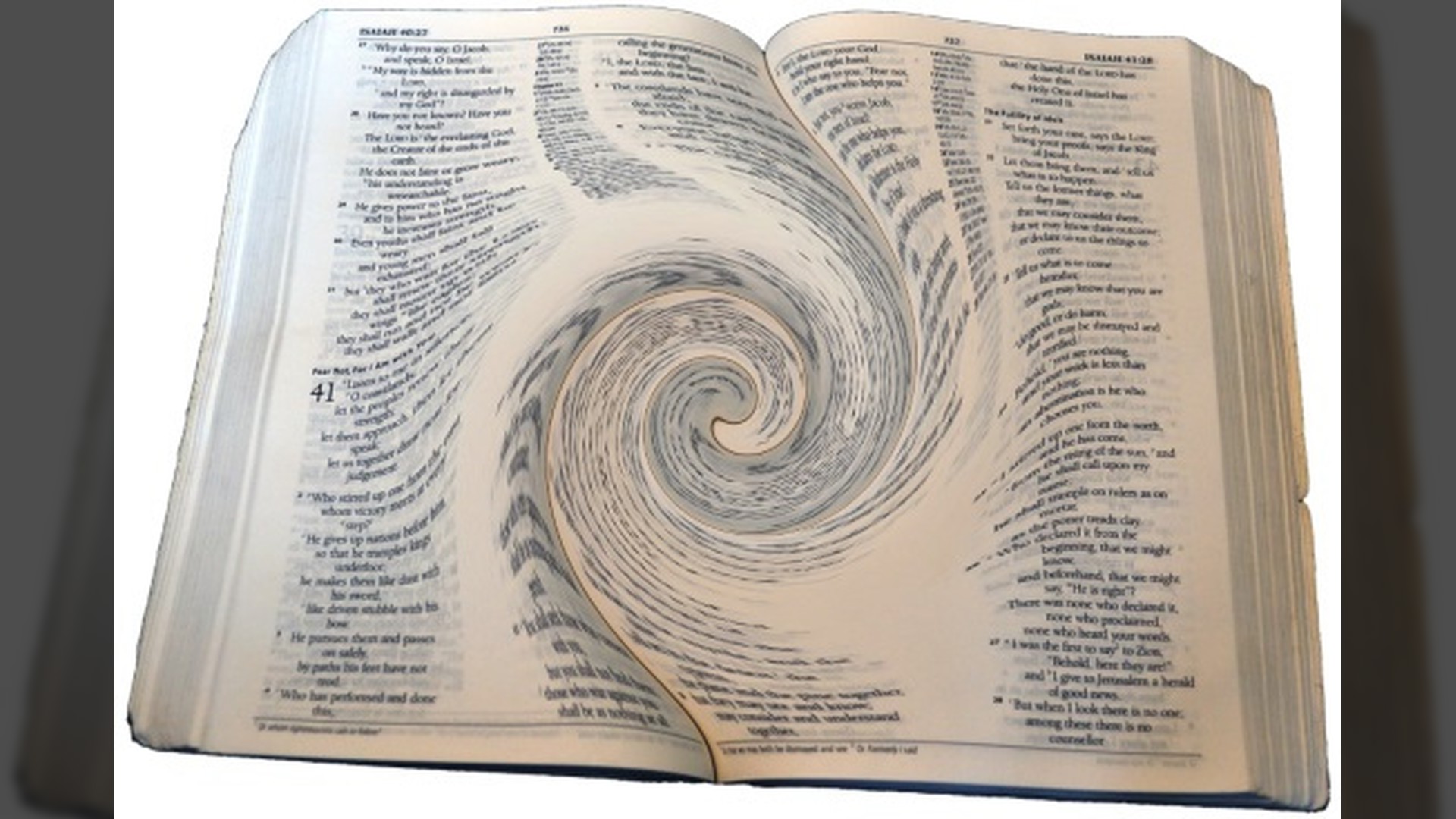
Twisted Scripture
The Book of Revelation ends with a solemn warning to all who might consider altering, adding, or removing words from the Holy Writ: If any man shall take away from the words of the book of this prophecy, God shall take away his part out of the book of life. [1] In some versions of his stage persona, William Branham affirmed his belief in this passage,[2] though he frequently alleged that he was "God's Voice" to the people,[3] a living or spoken Word, [4] and frequently used a single verse for the context of a sermon rather than the full context of Scripture.[5]
The Book of Revelation ends with a solemn warning to all who might consider altering, adding, or removing words from the Holy Writ: If any man shall take away from the words of the book of this prophecy, God shall take away his part out of the book of life. [1] In some versions of his stage persona, William Branham affirmed his belief in this passage,[2] though he frequently alleged that he was "God's Voice" to the people,[3] a living or spoken Word, [4] and frequently used a single verse for the context of a sermon rather than the full context of Scripture.[5]
Throughout his ministry, however, William Branham used verses that sound like Biblical text but are either not from the Christian Bible or that were altered by adding words or combining words from other verses. Of Branham's alterations to Scripture, three invented verses were used most frequently as a foundation for Branham's extra-biblical doctrine:
I will be with you even in you until the end of the world. [6]
This is my beloved son in whom I am well pleased to dwell in. [7]
As it was in the days of Noah wherein eight souls were saved, so shall it be at the coming of the son of man [8]
William Branham frequently added the words, "even in you" to the last verse from the Book of Matthew. Matthew 28 ends with the words "Teaching them to observe all things whatsoever I have commanded you: and, lo, I am with you always, even unto the end of the world. Amen." [9] This alteration of Scripture was used by William Branham as the foundation from which to build his Manifested Sons of God doctrine and ultimately as the basis for his claim to be the manifested Jesus Christ [10] of the 20th century.[11]
Similarly, Branham added the words "to dwell in" to the end of Matthew 3:17 to further support the Manifested Sons of God theology - specifically to promote his own deity. The versions of Branham's stage persona that promoted that doctrine also alleged that Jesus Christ was only a prophet with God "manifested" inside of him, [12] and claimed that God was doing the same in the 20th century.
In the fall of 1957 as Branham's following began to decrease in size and his speaking engagements were starting to become more limited, Branham attempted to resolidify his stance against "cold formal denominations" position that there would only be a small number of Christians saved. [13] He did so by combining two passages from the Bible into one single (invented) verse. The two passages he chose, one from Matthew 24 and one from 1 Peter 3, had different contextual meanings. The first, Matthew 24, is describing the sudden coming of Christ that will catch many unaware. Branham injected the words "wherein eight souls were saved" immediately before the words "so also shall the coming of the Son of Man be", making it sound as if only eight people would be saved when Christ returns.
Verily I say unto you, this generation shall not pass, till all these things be fulfilled. Heaven and earth shall pass away, but my words shall not pass away. But of that day and hour knoweth no man, no, not the angels of heaven, but my Father only. But as the days of Noah were, so shall also the coming of the Son of man be. For as in the days that were before the flood they were eating and drinking, marrying and giving in marriage, until the day that Noe entered into the ark, And knew not until the flood came, and took them all away; so shall also the coming of the Son of man be. Then shall two be in the field; the one shall be taken, and the other left. Two women shall be grinding at the mill; the one shall be taken, and the other left. Watch therefore: for ye know not what hour your Lord doth come.
The second, 1 Peter chapter 3, describes God's patience and faithfulness to even a select few:
For Christ also hath once suffered for sins, the just for the unjust, that he might bring us to God, being put to death in the flesh, but quickened by the Spirit: By which also he went and preached unto the spirits in prison; Which sometime were disobedient, when once the longsuffering of God waited in the days of Noah, while the ark was a preparing, wherein few, that is, eight souls were saved by water. The like figure whereunto even baptism doth also now save us (not the putting away of the filth of the flesh, but the answer of a good conscience toward God,) by the resurrection of Jesus Christ: Who is gone into heaven, and is on the right hand of God; angels and authorities and powers being made subject unto him.
Of the other "Bible verses" that William Branham invented, the most interesting when examining the many claims made by Branham's stage persona appears to be an excuse for not telling the truth. Branham frequently referenced another "Bible verse" that was the result of combining two different verses: "You're borned in sin, shaped in iniquity, come to the world speaking lies." [14]
This newly invented verse was the result of combining Psalm 51:5 with Psalm 58:3, and were describing two separate groups of people - the good and the bad. Psalm 51:5 describes a righteous person; the author states that he was conceived in the sin of his mother, but asks for wisdom. Psalm 58:3 explicitly states who the author believes go astray from birth speaking lies: the wicked:
Behold, I was brought forth in iniquity, and in sin my mother conceived me. Behold, thou desirest truth in the inward parts: and in the hidden part thou shalt make me to know wisdom
- Psalm 51:5-6
The wicked are estranged from the womb: they go astray as soon as they be born, speaking lies
- Psalm 58:3