
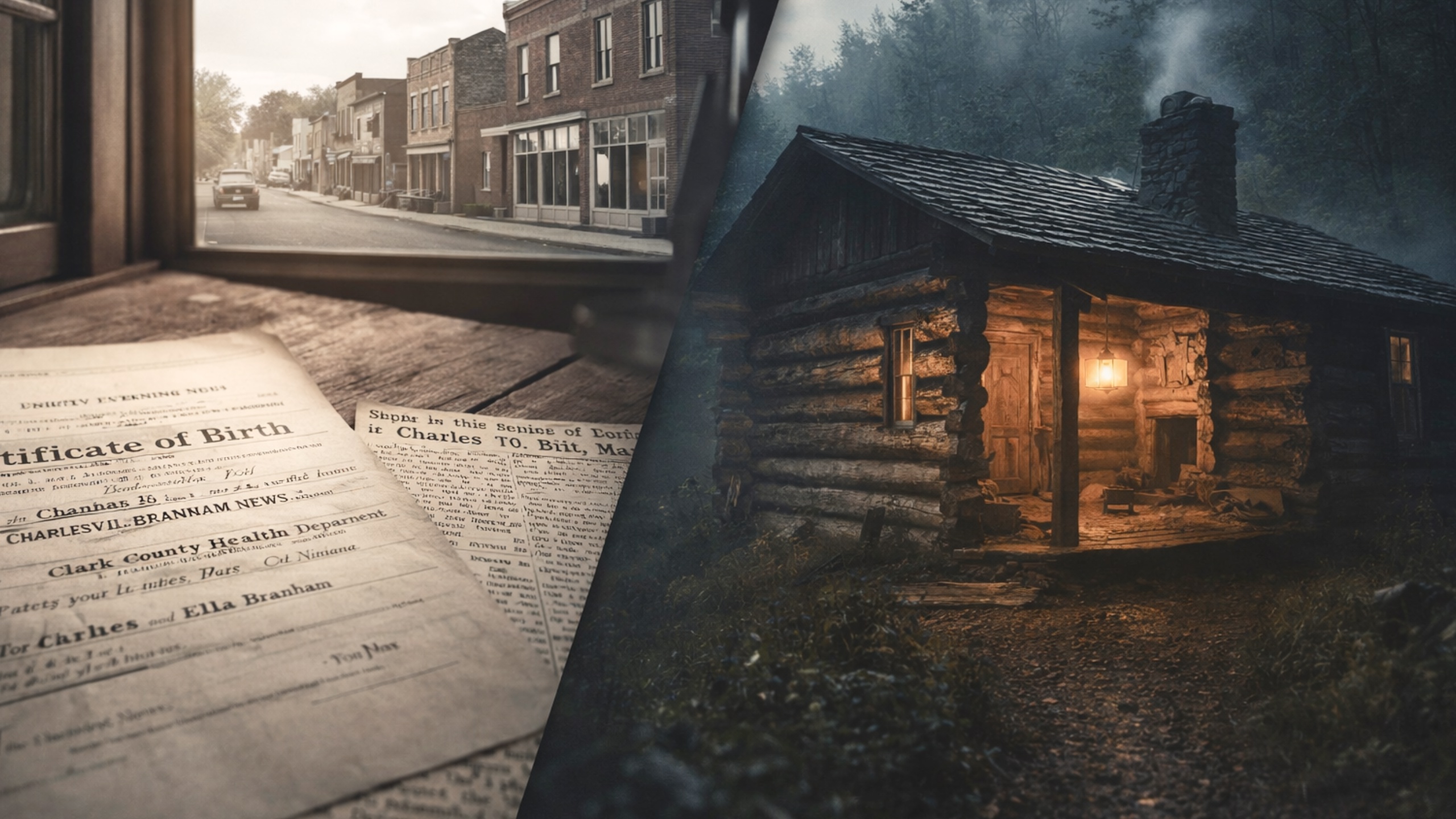
Charles Branham, Jr: History That Rewrites Branham's Life Story
Charles Branham Jr.’s documented birth, life, and death in Clark County, Indiana directly contradict William Branham’s later claims of a prolonged Kentucky log-cabin upbringing and a delayed encounter with Pentecostalism. Contemporary records show the Branham family firmly rooted in Indiana during the very years later recast as frontier hardship, revealing how Branham’s origin story evolved into a constructed stage persona rather than a sustained lived reality.
Charles Branham Jr., William Branham's brother, occupied a brief but crucial place in the Branham family narrative, one that directly challenges William Branham's later stage persona centered on a prolonged childhood in an isolated Kentucky log cabin and conversion to Pentecostalism after the 1937 flood of the Ohio River. While Branham repeatedly described his upbringing as in a primitive one-room cabin in the hills of Kentucky, surviving evidence indicates that key family events—including births, deaths, and extended residence—occurred in Clark County, Indiana. Charles Branham Jr.'s life, from his documented Indiana birth to his accidental death as a teenager, anchors the Branham family firmly in Indiana during years that Branham later portrayed as dominated by frontier hardship in Kentucky.
The next one to go was Charles. I was...He went quickly, suddenly. He was...I was preaching down here at the little, colored, Pentecostal church that night, when Charles was killed up on the highway, by an automobile.
- William Branham. Nov. 5, 1961. The Testimony Of A True Witness
The importance of Charles Branham Jr. lies not only in his short lifespan but in how his existence disrupts a carefully constructed autobiographical arc. Official records identify him as born in Clark County, Indiana, in 1919, contradicting claims that the Branham children were primarily born and raised in Kentucky. His death in 1935, recorded in Jeffersonville, further confirms the family's continued presence in Indiana during the interwar years. These records collectively undermine the notion that William Branham's formative years were spent in uninterrupted rural isolation, instead revealing a family rooted in Indiana well before the emergence of Branham's revival-era narratives [1][2].
This contrast between record and recollection is not incidental. Branham's later sermons increasingly emphasized poverty, rustic simplicity, and Appalachian imagery as markers of spiritual authenticity. The documented life of Charles Branham Jr. provides a fixed historical reference point against which these evolving claims can be measured, exposing how the Kentucky cabin story functioned as a stage persona rather than a sustained lived reality [3].
Birth in Clark County, Indiana
The birth of Charles Branham Jr. provides one of the clearest fixed points for reconstructing the Branham family's actual geographic history. Official records from the Clark County Health Department document that Charles K. Branham was born in Clark County, Indiana, on February 22, 1919, to Charles and Ella Branham [4]. This record is unambiguous in both location and date, placing the family in southern Indiana rather than rural Kentucky at the time of his birth. The birthplace information directly contradicts later claims that the Branham children were born and raised primarily in a Kentucky log cabin environment.
This Indiana birth record carries particular weight because it is contemporaneous governmental documentation rather than retrospective memory. Unlike autobiographical sermons delivered decades later, the birth certificate reflects administrative data recorded at the time of the event and filed locally in Clark County. It therefore establishes that by 1919 the Branham household was already settled in Indiana, a fact that disrupts narratives suggesting that the family remained in Kentucky throughout William Branham's early and middle childhood.
The implications extend beyond Charles Branham Jr. himself. If one of the younger children was born in Indiana in 1919, then the family's relocation from Kentucky must have occurred earlier than later stage-persona stories imply. This aligns with census evidence showing the Branhams living in Indiana by 1920 and undermines claims of a prolonged upbringing in isolated Kentucky conditions. Charles Branham Jr.'s documented Indiana birth thus functions as a chronological anchor that forces a reassessment of the broader family timeline and exposes inconsistencies in Branham's later autobiographical framework [5].
Early Childhood Accidents and Survival Narratives
Newspaper coverage from the early 1920s documents a serious childhood accident involving a young Branham child, providing additional evidence of the family's residence near Jeffersonville during this period. In May 1921, the Jeffersonville Evening News reported that two-year-old Charles Branham, identified as the son of Mr. and Mrs. Charles F. Branham living one mile east of the city, was hospitalized at Norton Infirmary in Louisville after suffering a broken neck when struck by an out-of-control motor truck [6]. Physicians reportedly believed the child's recovery was likely, and the article notes that he was not taken to the hospital until several days after the accident.
This report is significant for several reasons. First, it places the Branham family geographically in close proximity to Jeffersonville rather than in an isolated Kentucky hills setting. Second, it demonstrates routine interaction with urban infrastructure, including paved roads, motor vehicles, and regional hospitals, conditions inconsistent with later portrayals of extreme rural isolation. The description of the accident near the city and involving motor traffic underscores that the family was living in a developed area connected to Louisville, rather than in a remote log cabin scene described in Life Story accounts.
Later in his ministry, William Branham frequently referenced childhood suffering, accidents, and near-death experiences as part of a broader narrative that emphasized divine preservation and hardship. However, contemporaneous newspaper documentation shows that these events occurred within a settled Indiana context. The child's survival after such a severe injury fits within a pattern of later storytelling, but the historical setting contradicts the frontier imagery that Branham later adopted. These early reports, therefore, reinforce the conclusion that Indiana, not rural Kentucky, formed the backdrop of the Branham children's formative experiences [7].
Sibling Deaths and Family Losses
The Branham family experienced repeated, well-documented losses that later became central to William Branham's preaching and self-presentation. Contemporary newspaper accounts confirm the death of Edward W. Branham in June 1929 at the age of nineteen. The Jeffersonville Evening News reported that Edward, the son of Mr. and Mrs. Charles Branham of 401 Graham Street, died at Clark County Memorial Hospital and that funeral services were held at the family home, with burial in Eastern Cemetery [8]. This report fixes the family's residence at a specific Jeffersonville address and places the loss squarely within an Indiana urban setting.
William Branham later incorporated Edward's death into his testimony narratives, often emphasizing visions, spiritual insight, and divine awareness surrounding the event. However, the newspaper record presents the death in ordinary terms, without any reference to extraordinary religious circumstances. The contrast highlights how later retellings reframed family tragedy to serve theological and experiential claims, while the historical documentation situates the event within conventional social and medical contexts.
The accumulation of loss continued into the 1930s. In July 1937, the Jeffersonville Evening News reported the death of Sharon Rose Branham, the infant daughter of William Branham, noting that she died only days after the death of her mother, Hope Branham [9]. The article identifies William Branham as pastor of the Pentecostal Tabernacle and again lists a Jeffersonville address, further reinforcing his established presence and ministerial role in Indiana during this period.
These documented deaths are significant not only for their emotional weight but for what they reveal about the continuity of place. Rather than depicting a family moving through remote Appalachian regions, the records consistently return to Jeffersonville institutions, hospitals, cemeteries, and newspapers. The pattern demonstrates that the losses later woven into Branham's revival-era testimony occurred within a stable Indiana environment, not within the Kentucky log-cabin world emphasized in his stage persona [10].
The Death of Charles Branham Jr. in 1935
The life of Charles Branham Jr. ended abruptly in the summer of 1935, an event preserved in official county records and later retold by William Branham in markedly different terms. The Clark County death certificate records that Charles Branham died on August 5, 1935, in Jeffersonville, Indiana, at the age of sixteen, with the cause of death listed as an automobile accident [11]. The certificate further identifies Jeffersonville as the place of death and Eastern Cemetery as the place of burial, firmly situating the event within the same Indiana setting repeatedly documented throughout the family's history.
This contemporaneous record establishes both the timing and circumstances of Charles's death with precision. It also confirms that the Branham family remained in Jeffersonville through the mid-1930s, contradicting any implication that the family had returned to, or remained in, Kentucky during these years. The manner of death—an automobile accident—aligns with the increasing presence of motor traffic in the region and further underscores the family's residence in a modern, connected environment rather than an isolated rural setting.
In later sermons, William Branham recalled Charles's death as occurring suddenly while he himself was preaching at a Pentecostal church. In a 1961 sermon, Branham stated that he was "preaching down here at the little, colored, Pentecostal church that night, when Charles was killed up on the highway, by an automobile" [12]. This claim introduces two significant elements absent from the death certificate: Branham's active involvement in Pentecostal preaching by 1935 and the framing of the event within a spiritually charged narrative context.
The juxtaposition of these sources is instructive. The death certificate provides a neutral administrative account, while the later sermon embeds the tragedy within a theological testimony and introduces details that carry broader implications for Branham's religious timeline. Charles Branham Jr.'s death thus becomes not only a documented family loss but a focal point for evaluating the accuracy of Branham's later claims regarding his early ministerial affiliations and the shaping of his public religious identity .