
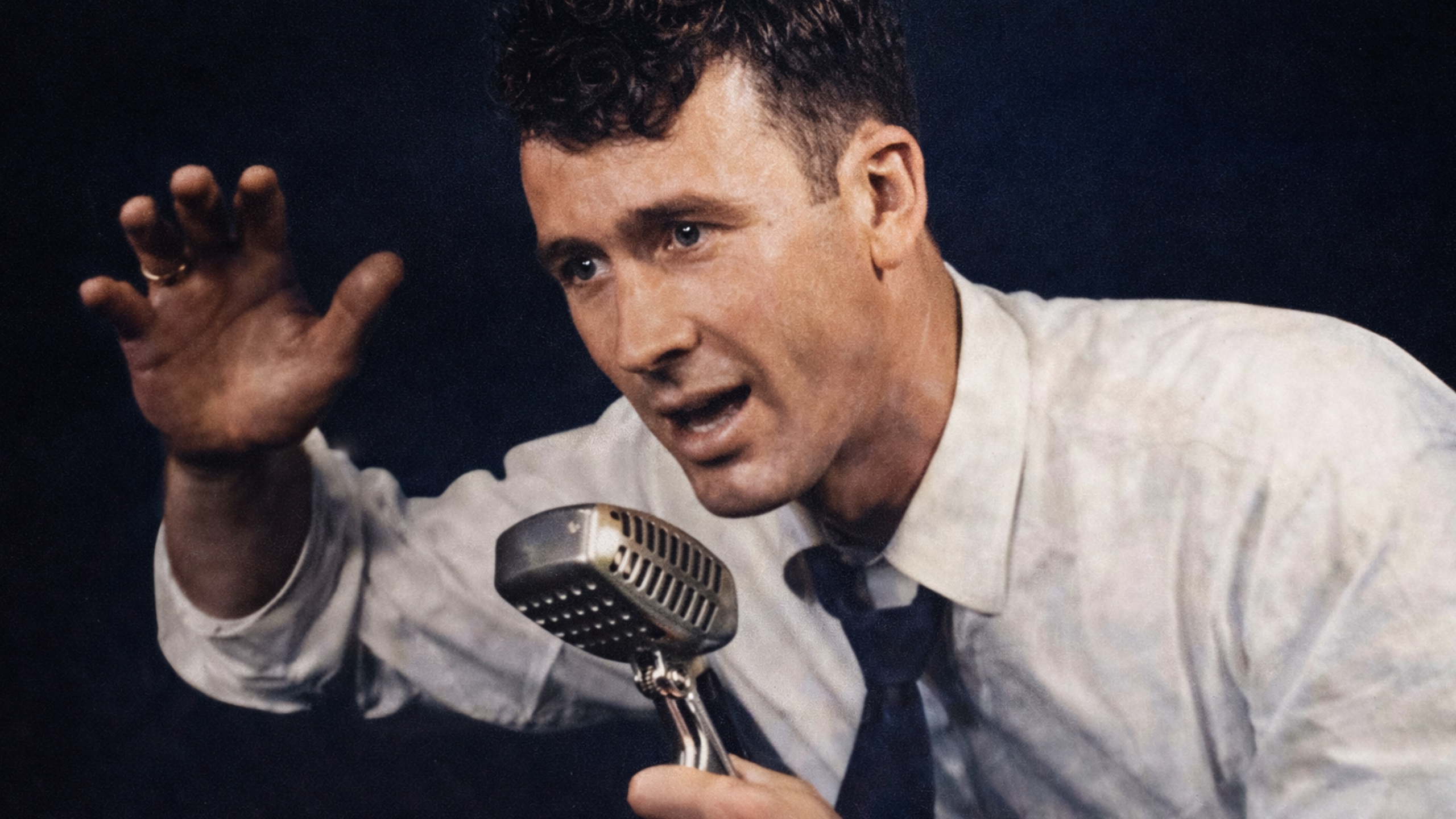
David Epley: The “Son of Thunder” and the Business of Faith Healing
David Epley was a mid-twentieth-century faith-healing evangelist who built wealth and recognition by adopting the methods, rhetoric, and prophetic claims popularized by William Branham and the postwar healing revival. Documentary evidence, court records, scholarly investigations, and exposés reveal a ministry defined less by originality than by the transmission of Branhamite techniques, emotional manipulation, and unverified claims of divine discernment.
David Epley emerged as a mid-twentieth-century revivalist whose ministry combined healing revival theatrics, prophetic self-presentation, aggressive promotion, and tightly managed revival infrastructure. Operating at the intersection of Holiness, Pentecostal, and postwar healing-revival networks, Epley built his public identity through newspapers, advertisements, and mass-meeting campaigns that emphasized supernatural authority, national crisis, and urgent calls to repentance. His work illustrates how revivalist figures leveraged media, music, and cultural anxiety to construct legitimacy and sustain momentum beyond local congregations.
Across multiple decades, Epley functioned less as an innovator than as a skilled disseminator of existing revival ideologies. He absorbed and replicated the language, methods, and authority structures popularized by earlier healing evangelists, while adapting them to regional revival centers and later to major urban crusades. His ministry reveals the mechanics of revival culture at the secondary level: how prophetic claims were normalized through repetition, how financial appeals were spiritualized, how music amplified emotional response, and how political fears were reframed as theological imperatives.
Taken together, the documentary record presents Epley as a representative figure within the healing-revival ecosystem rather than a singular anomaly. His career offers a case study in how revival movements sustained themselves through promotion, spectacle, and institutional hosting, and how charismatic authority could persist even amid legal scrutiny and public criticism.
Early Ministry and Public Persona
By the mid-1950s, David Epley had already cultivated a highly theatrical revivalist persona marked by aggressive rhetoric, prophetic self-presentation, and emotionally charged preaching. Newspaper advertisements portrayed him in elevated terms, describing him as a “Son of Thunder” and explicitly likening him to John the Baptist, a framing designed to convey prophetic authority and urgency rather than conventional pastoral leadership [1]. These promotions emphasized confrontation with sin, dramatic altar appeals, and divine healing, situating Epley within the postwar healing-revival milieu that blurred evangelism with spectacle.
At the local level, Epley was presented not merely as a guest evangelist but as a resident spiritual authority. Notices and revival advertisements identified him as pastor of regional revival centers, reinforcing his image as both organizer and spiritual leader, while inviting big names in the gospel entertainment business to attract crowds [2]. His sermons were advertised with provocative titles and topical urgency, including warnings tied to contemporary political fears, reflecting a deliberate strategy to merge spiritual anxiety with current events [3]. Together, these elements show that Epley’s early public identity was carefully constructed through print media to project charisma, prophetic legitimacy, and cultural relevance, laying the foundation for his later national revival campaigns.
Revival Centers and Pastoral Leadership
By the mid-1950s, David Epley was operating not only as an itinerant revivalist but as a resident pastor over fixed revival institutions, a role that gave him sustained influence over local congregations and programming. Newspaper advertisements consistently identified him as pastor of the Hopkins County Revival Center and the Goodwill Tabernacle in Madisonville, Kentucky, indicating a permanent leadership position rather than a temporary evangelistic assignment. At these centers, he promoted William Branham's ministry [4]. The centers functioned as hubs for extended revival meetings, musical programs, and guest appearances, anchoring Epley’s ministry within a regional religious infrastructure.
The revival centers under Epley’s leadership regularly hosted nationally known gospel performers, most notably the Happy Goodman Family, whose repeated appearances were advertised as evidence of popularity and spiritual vitality [5]. These collaborations reinforced Epley’s legitimacy within Southern Holiness and Pentecostal circles while simultaneously broadening his audience through music-driven revival culture. Promotional language emphasized packed services, nightly meetings, and emotional intensity, suggesting that Epley’s pastoral authority was closely tied to his ability to sustain momentum through continuous events rather than conventional congregational life.
In this setting, Epley’s pastoral identity merged administrative control with revival theatrics. He curated sermon topics, selected musical partners, and controlled the rhythm of services, effectively positioning himself as both spiritual gatekeeper and revival entrepreneur [6]. This structure allowed Epley to cultivate loyalty, manage offerings, and maintain long-running campaigns, creating a model that blurred the boundaries between church leadership and revival promotion.
Promotional Rhetoric and Healing Claims
David Epley’s revival campaigns relied heavily on promotional rhetoric that framed him as a uniquely gifted healing evangelist endowed with supernatural insight. Newspaper advertisements and mailers asserted that Epley possessed extraordinary spiritual perception, with claims that he “sees with the eyes of God” and functioned as a prophetic intermediary for divine power [7]. Such language was not incidental but central to the appeal of his meetings, positioning Epley above ordinary clergy and inviting audiences to expect miraculous intervention rather than conventional preaching.
Promotional materials frequently paired healing claims with emotionally charged testimonies. Advertisements described dramatic physical recoveries, financial reversals, and life transformations attributed to Epley’s prayers, often without independent verification [8]. These narratives were designed to establish credibility through repetition and scale, presenting isolated claims as representative outcomes. The use of photographs, crowd imagery, and emphatic slogans reinforced the impression of widespread success and divine endorsement.
This rhetorical strategy extended beyond healing into identity formation. Epley was promoted as a prophet, a modern-day John the Baptist, and a divinely sent figure, categories that carried implicit authority and demanded submission rather than discernment . By embedding these claims in widely circulated newspapers, Epley normalized extraordinary assertions within mainstream media spaces. The result was a public image in which healing claims, prophetic identity, and promotional exaggeration became inseparable, shaping audience expectations and insulating the ministry from ordinary standards of accountability.
Fundraising Practices and Legal Scrutiny
Alongside healing claims and prophetic rhetoric, David Epley’s ministry employed aggressive fundraising practices that eventually drew legal attention. Promotional materials routinely tied financial giving to promised spiritual or material returns, framing donations as acts of faith that would be divinely multiplied [9]. This linkage between giving and blessing was presented not as symbolic devotion but as a transactional expectation, reinforcing the idea that participation in Epley’s meetings carried tangible rewards.
These practices became a matter of public record in January 1962, when Epley was convicted in a Cincinnati police court for soliciting without a license [10]. Newspaper coverage reported that the case centered on the sale of a substance promoted in connection with his healing ministry. Under examination, Epley admitted that the potion sold was merely scented oil and did not possess miraculous properties in itself, contradicting the spiritual implications conveyed to audiences [11]. The conviction marked a rare moment in which revivalist fundraising methods were subjected to formal scrutiny rather than internal religious oversight.
Despite the conviction, there is no indication that Epley’s public ministry ceased immediately. Instead, the episode illustrates the structural tension within healing-revival movements, where charismatic authority and financial appeals often operated beyond conventional accountability. In Epley’s case, legal intervention briefly exposed the mechanics underlying faith-based fundraising, offering a documented counterpoint to the supernatural claims promoted in his revival campaigns.
Media Coverage and Public Criticism
As David Epley’s ministry expanded beyond regional revival centers into larger urban campaigns, media coverage increasingly framed his activities with skepticism rather than celebration. Investigative reporting and eyewitness accounts documented the mechanics of his healing services, highlighting discrepancies between advertised claims and observed outcomes [12]. Rather than focusing on dramatic miracles, these reports described tightly controlled environments in which only select individuals were engaged publicly, while those with obvious physical disabilities remained unaddressed [13].
Pastor Epley then called me out. Like many other faith-healers, he claims to have God-given "word of knowledge" about patients' names, diseases, and other personal data. When I had come to the front of the center stage just below where he stood, he gestured for me to stop and said I'd had an "enlarged heart" for about ten years. I nodded in affirmation (an untruth)
- James Randi, The Faith Healers
Academic observers and journalists attending Epley’s meetings noted patterns common to other contemporary faith healers, including suggestive questioning, affirmation cues, and generalized statements that could be easily accepted by participants [14]. These critiques challenged the premise of supernatural knowledge by demonstrating how ordinary psychological techniques could produce the appearance of prophetic insight. Such observations contrasted sharply with promotional portrayals of Epley as uniquely gifted, exposing a gap between media advertising and lived experience within the services.
Public criticism intensified when these observations were published in national forums, situating Epley within a broader critique of televised and touring faith healers rather than treating him as an isolated case [15]. This shift in framing marked a turning point in his public perception. While supportive audiences continued to attend his meetings, critical media coverage introduced alternative narratives that questioned the authenticity of his healing claims and reframed his ministry as part of a wider pattern of revivalist excess.
Associations with Popular Gospel Music Figures
David Epley’s revival meetings frequently incorporated well-known gospel music acts, a strategy that broadened his appeal and reinforced the emotional intensity of his services. Newspaper notices and advertisements regularly highlighted appearances by the Happy Goodman Family, whose popularity within Southern gospel circles functioned as a draw independent of Epley’s preaching [16]. Their inclusion signaled alignment with established Holiness and Pentecostal networks and lent cultural legitimacy to Epley’s revival centers.
These musical collaborations were not peripheral but structurally integrated into revival programming. Advertisements emphasized repeated engagements “by popular demand,” suggesting that music-driven enthusiasm was central to sustaining attendance across multiple nights [17]. The presence of nationally recognized performers helped normalize extended revival campaigns, framing them as celebratory events rather than singular preaching services.
By embedding his ministry within gospel music culture, Epley benefited from shared audiences and overlapping reputations. This association also mirrored broader revivalist practices of the period, in which evangelists leveraged musical acts to amplify emotional response and reinforce spiritual authority [18]. The result was a mutually reinforcing dynamic: music heightened expectancy and participation, while revival preaching provided a narrative framework for interpreting emotional experiences as evidence of divine activity.
Cold War Themes and Anti-Communist Preaching
David Epley’s revival preaching frequently incorporated Cold War anxieties, blending theological urgency with contemporary political fear. Newspaper advertisements explicitly promoted sermons addressing communism, framing global ideological conflict as a spiritual battle rather than a geopolitical issue [19]. By presenting communism as an existential threat to Christian faith and American identity, Epley aligned his ministry with broader mid-twentieth-century revivalist rhetoric that equated religious devotion with patriotism.
These themes functioned as more than topical commentary. Sermon titles and promotional copy suggested that revival attendance was a form of resistance, positioning Epley as a defender of both faith and nation [20]. This framing intensified emotional engagement by linking personal salvation to national survival, a strategy that resonated strongly in regions shaped by postwar insecurity and anti-communist sentiment.
Within the revival setting, such rhetoric reinforced Epley’s prophetic posture. By interpreting current events through an apocalyptic lens, he cast himself as a spiritual interpreter of history, capable of diagnosing hidden threats and prescribing repentance as the solution [21]. The integration of Cold War ideology into revival preaching thus strengthened Epley’s authority while embedding his ministry firmly within the political theology of the era.
National Expansion and Major City Crusades
By the late 1960s and early 1970s, David Epley’s ministry had moved decisively beyond regional revival centers into large-scale urban crusades. Newspaper advertisements in major metropolitan papers announced his arrival in cities such as Detroit, framing the meetings as nationally significant events rather than local revivals [22]. Venues like the Henry and Edsel Ford Auditorium were promoted as proof of both scale and legitimacy, signaling that Epley’s campaigns were intended to attract mass audiences rather than niche religious gatherings.
Promotional copy emphasized nationwide reach, repeatedly asserting that people traveled “thousands of miles” to attend Epley’s meetings and that his influence extended “across America” [23]. These claims functioned rhetorically to normalize extraordinary expectations by presenting them as already validated elsewhere. The language of national momentum suggested inevitability and success, encouraging local audiences to participate in what was portrayed as a movement rather than a single event.
This phase of expansion also coincided with increased reliance on print media, mailers, and radio to cultivate anticipation prior to each crusade. Invitations promised healing, prophecy, and transformation on a scale commensurate with the size of the venues themselves [24]. The shift from regional revival halls to prominent civic auditoriums marked a turning point in Epley’s career, reflecting both ambition and the maturation of a revival model designed for national circulation.
Relationship to William Branham and Healing Revival Networks
David Epley’s ministry developed in direct proximity to the postwar healing revival networks associated with William Branham, and documentary evidence shows that Epley actively participated in promoting and hosting Branham’s campaigns. Newspaper advertisements identified Epley as pastor of the Hopkins County Revival Center while simultaneously promoting Branham as a divinely sent healing evangelist, placing Epley in the role of local sponsor and facilitator rather than a neutral observer [25]. This association linked Epley to Branham’s distinctive theology of prophetic authority, divine healing, and supernatural revelation.
By lending his revival infrastructure to Branham’s meetings, Epley functioned as a transmission point for Branham’s message at the regional level. Hosting such campaigns required alignment with Branham’s claims and methods, and the advertising language used in these notices mirrored Branham’s exalted self-presentation as “a man sent from God” [26]. Through this cooperation, Epley helped normalize Branham’s prophetic status among local congregations, effectively extending the reach of Branham’s influence beyond major crusade circuits.
This relationship situates Epley within the broader healing revival ecosystem rather than as an isolated evangelist. His later use of prophetic rhetoric, healing claims, and revival branding closely parallels the patterns established by Branham and his associates, suggesting continuity rather than innovation [27]. In this sense, Epley’s ministry can be understood as both a beneficiary and a propagator of Branhamite revival theology, contributing to its diffusion through local churches and revival centers.
Later Career and Legacy
By the early 1980s, David Epley’s public presence had shifted from localized revival advertising toward broader but less centralized visibility, marked by periodic media coverage rather than sustained revival infrastructure. Newspaper reporting from this period referenced his inclusion among nationally recognized evangelists drawing sizable crowds, suggesting that his name still carried residual recognition even as the peak intensity of his revival campaigns had passed [28]. Unlike earlier decades, this phase of his career was characterized less by continuous revival centers and more by episodic appearances within a crowded evangelical marketplace.
Retrospective assessments of Epley increasingly situated him within a lineage of faith healers whose methods and claims followed established patterns rather than representing unique innovation. Comparative commentary grouped him alongside other revival figures who relied on similar healing narratives, audience management techniques, and media strategies [29]. In this framing, Epley’s ministry was remembered less for doctrinal distinctiveness and more for its participation in a recognizable revivalist formula that had become familiar to critics and observers alike.
Epley’s legacy therefore rests primarily in his function as a conduit rather than a founder. He absorbed and reproduced the rhetoric, theology, and promotional practices of mid-twentieth-century healing revivalism, including the transmission of Branhamite prophetic themes through local and regional platforms [30]. The documentary record portrays a minister whose significance lies not in originality but in dissemination, illustrating how revival ideologies were sustained and extended through secondary figures long after their initial emergence.