
Deloris Branham: The Sister Who Breaks the Kentucky Childhood Myth
Deloris Branham Filer’s documented birth, residence, and adult life in Indiana directly contradict William Branham’s repeated claims of a unified Kentucky mountain childhood shared by all his siblings. Census records, vital certificates, and marriage documents establish a fixed historical timeline that exposes the Kentucky cabin narrative as a constructed stage persona rather than a lived reality.
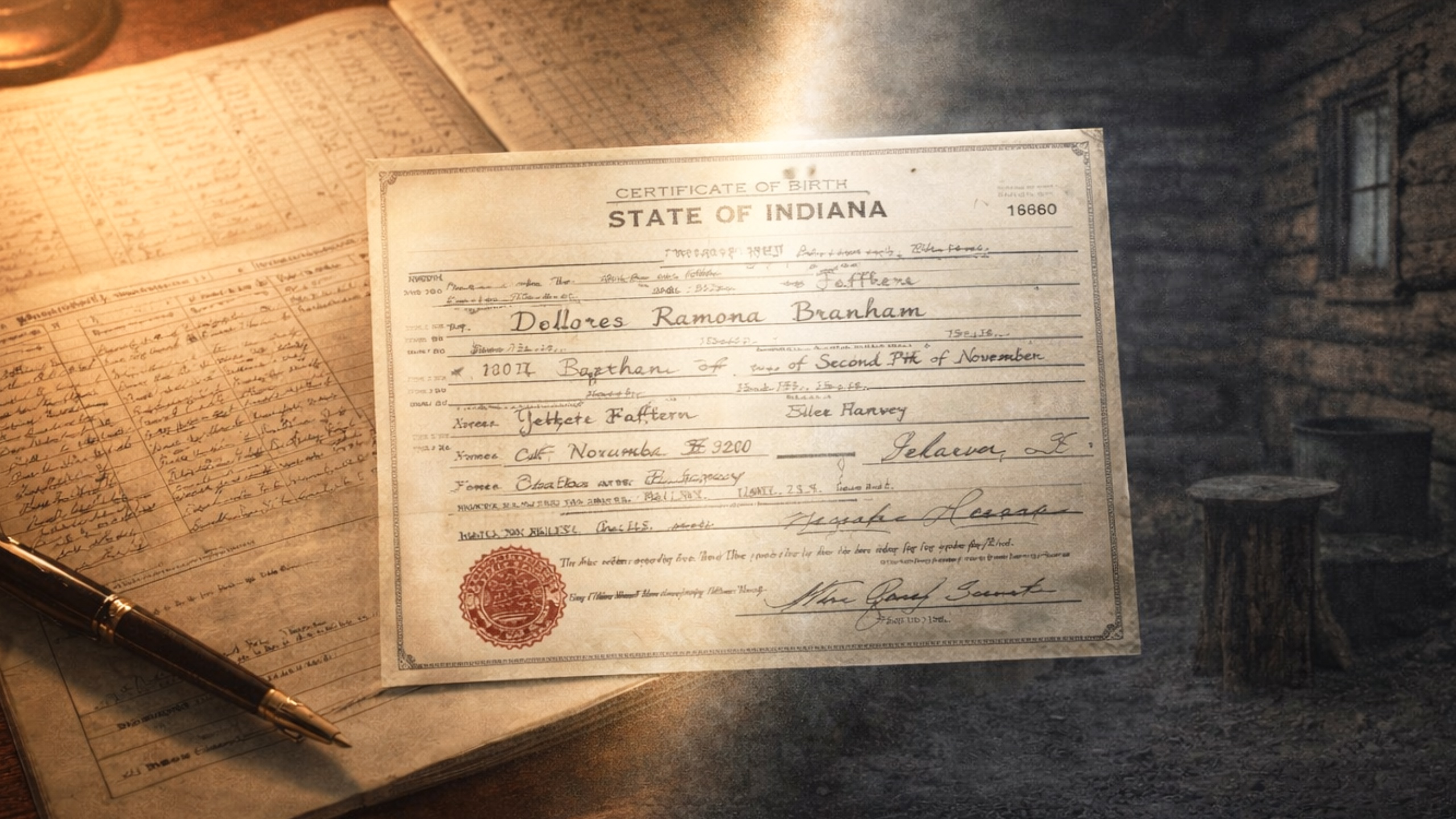
Deloris Branham Filer was William Branham's youngest sister, born on November 2, 1929, in Jeffersonville, Clark County, Indiana [2]. Her documented existence presents a direct problem for the autobiographical narrative William Branham repeatedly presented on stage, in which he claimed to have been raised in a one-room mountain cabin in Kentucky with a widowed mother and ten children surviving through trapping and fishing [4]. In that narrative, Branham consistently described "nine boys and one little girl" growing up together in extreme rural poverty, portraying the family as isolated from civic life and formal institutions.
I was born in a little mountain cabin, way up in the mountains of Kentucky. They had one room that we lived in, no rug on the floor, not even wood on the floor, it was just simply a bare floor. And a stump, top of a stump cut off with three legs on it, that was our table. And all those little Branhams would pile around there, and out on the front of the little old cabin, and wallowed out, looked like where a bunch of opossums had been wallowing out there in the dust, you know, all the little brothers. There was nine of us, and one little girl, and she really had a rough time amongst that bunch of boys.[2]
- William Branham
Government records demonstrate that this account cannot accommodate Deloris’s life history. The Branham household was enumerated in Jeffersonville Township, Clark County, Indiana, in the 1920 census—nearly a decade before Deloris’s birth—placing the family firmly in Indiana during the period Branham later depicted as his Kentucky childhood [1]. Deloris’s Indiana birth certificate confirms that she was born to Charles Branham and Ella Harvey in Jeffersonville, not Kentucky, in 1929 [2]. This places her birth at a time when William Branham was already an adult engaged in revival activity rather than a child surviving alongside siblings in an Appalachian cabin.
The omission of Deloris from Branham’s public life story is not incidental. Unlike a vague or unverifiable claim, Deloris remained alive until 2011, married, raised children, and maintained residence in southern Indiana throughout her life [3]. Her documented birth, family relationships, and later adult life directly contradict the geographic and chronological framework of Branham’s staged autobiography. As a result, Deloris Branham Filer represents a fixed historical reference point that exposes the constructed nature of William Branham’s Kentucky childhood narrative rather than merely challenging isolated details.
Indiana, Not Kentucky: The Documentary Record of the Branham Family
The claim that William Branham spent his formative years in the hills of Kentucky is not supported by contemporaneous government documentation. Census and vital records consistently place the Branham family in southern Indiana during the period later portrayed as an isolated Appalachian childhood. The 1920 census enumerates the household in Jeffersonville Township, Clark County, Indiana, well before Deloris Branham’s birth and prior to the timeframe Branham associated with extreme rural poverty in Kentucky [1].
Deloris’s birth in 1929 further anchors the family’s location in Indiana. Her Indiana birth certificate records Jeffersonville as her place of birth and identifies Charles Branham and Ella Harvey as her parents, establishing the family’s residence there at the end of the 1920s [2]. This is significant because Branham’s autobiographical narrative implies that the “nine boys and one little girl” were raised together in Kentucky as a single, continuous childhood experience. The documentary record instead shows that the youngest child was born in Indiana when William Branham was already an adult.
Additional confirmation comes from Deloris’s later life records. Her marriages were recorded in Clark County and Floyd County, Indiana, identifying her residence as Clarksville and other southern Indiana communities across decades [5][6]. These records demonstrate continuity of place rather than migration from Kentucky. There is no documentary evidence placing Deloris, or the Branham household as a unit, in Kentucky during her childhood or adulthood.
Taken together, census data, birth records, marriage records, and death documentation form a consistent paper trail that situates the Branham family in Indiana across multiple generations. This body of evidence does not merely challenge the details of Branham’s Kentucky narrative; it replaces it with a verifiable geographic history rooted in Indiana civic life rather than an isolated mountain upbringing.
Deloris Branham’s Birth and the Collapse of the Kentucky Cabin Story
Deloris Branham was born on November 2, 1929, in Jeffersonville, Indiana, a date that critically destabilizes the internal chronology of William Branham’s autobiographical claims [7]. In Branham’s repeated life story accounts, the Kentucky cabin narrative is presented as a unified childhood experience in which all siblings were raised together in extreme poverty, with Branham describing “nine boys and one little girl” growing up simultaneously in a one-room mountain home. This framing depends on the assumption that the sibling group belonged to the same generational and geographic context.
The documentary record shows otherwise. Deloris’s birth occurred when William Branham was already a grown man, not a child living in a subsistence household. Regardless of whether Branham’s self-reported birth year is taken as 1909 or the earlier date indicated by government records, Deloris was born when he was in his early twenties. This alone makes it impossible for Deloris to have participated in the childhood conditions Branham described from the pulpit. She could not have been “wallowing in the dust” alongside brothers in a Kentucky cabin during Branham’s youth, because she did not yet exist.
Census documentation further confirms this chronological disjunction. In the 1940 census, Deloris appears as a ten-year-old child living in Indiana, residing within the household structure centered around her mother, Ella Branham [8]. By that time, William Branham was already an established itinerant minister, not a cohabiting sibling engaged in shared childhood deprivation. The census does not reflect a reconstructed Kentucky household or a return to Appalachian isolation but instead situates Deloris within a stable Indiana setting.
The significance of Deloris’s birth is therefore structural rather than anecdotal. Her existence introduces a fixed date that forces Branham’s Kentucky narrative to collapse under its own weight. The story depends on a compressed, mythic childhood tableau that cannot accommodate a sibling born decades later in a different state. Deloris Branham’s documented birth in Indiana transforms the Kentucky cabin account from a contested memory into a demonstrably anachronistic construction.
Household Reality in 1940: Deloris, Ella Branham, and William’s Itinerant Ministry
By 1940, the gap between William Branham’s staged childhood narrative and the documented household reality becomes unmistakable. The Sixteenth Census of the United States records Deloris Branham as a ten-year-old child living in Jeffersonville, Clark County, Indiana, within the household of her mother, Ella Branham . This record reflects a domestic arrangement shaped by adult circumstances rather than a shared childhood past. At the time, William Branham was no longer a dependent family member but an itinerant minister whose life was structured around revival campaigns rather than household continuity.
The 1940 census aligns with other documentary evidence indicating that Deloris briefly lived in proximity to William only after the death of his first wife, Hope Branham. During this period, William and his son Billy Paul resided intermittently with Ella Branham while William traveled extensively conducting healing revivals . Deloris’s presence in this household does not represent a childhood environment shared with William but a temporary family arrangement necessitated by adult responsibilities, widowhood, and ministry travel.
This distinction is critical. Branham’s Kentucky cabin story presents an image of uninterrupted sibling cohabitation during formative years, emphasizing deprivation, isolation, and mutual survival. The 1940 household reality shows none of these features. Instead, it reflects a fragmented family structure typical of the era, with adult children absent, minors residing with a parent, and economic stability sufficient to maintain a fixed Indiana residence. Deloris’s childhood was lived in a context shaped by William’s public ministry, not one that preceded it.
The 1940 census therefore functions as a corrective lens. It situates Deloris’s lived experience firmly within Indiana civic life and demonstrates that her relationship to William Branham was not that of a co-suffering sibling in an Appalachian childhood but that of a much younger sister whose upbringing occurred after William’s transition into public religious leadership.