
Winford Edward Branham
Edward Winford Branham, the younger brother often missing from William Branham's later life stories, exposes major contradictions in Branham's self-mythologized account of his childhood and family history. Records place the Branham family in Indiana by the 1910s and show Edward living and dying there, contradicting Branham's later image of all nine brothers and one sister being raised together in a remote Kentucky log cabin. Edward's brief life also intersected with the Branham family's Prohibition-era troubles, including Charles Branham's bootlegging and the 1928 shooting death of John Burse at Edward's home, for which Edward was charged with first-degree murder before dying of rheumatic heart disease in 1929. Edward's disappearance from Branham's public memory therefore becomes more than a family omission; it highlights the legal scandal, social disgrace, and narrative reinvention behind Branham's crafted ministry persona.
The Forgotten Brother: Who Was Edward Winford Branham?
Winford (Edward) Branham was the younger brother of William Branham. More than a forgotten sibling, Edward serves as a litmus test for the integrity of Branham’s evolving narratives. His death in Indiana during the 1920s contradicts Branham’s later stories of a Kentucky childhood where he and his siblings were raised in a humble log cabin.
I was born in a little mountain cabin, way up in the mountains of Kentucky. They had one room that we lived in, no rug on the floor, not even wood on the floor, it was just simply a bare floor. And a stump, top of a stump cut off with three legs on it, that was our table. And all those little Branhams would pile around there, and out on the front of the little old cabin, and wallowed out, looked like where a bunch of opossums had been wallowing out there in the dust, you know, all the little brothers. There was nine of us, and one little girl, and she really had a rough time amongst that bunch of boys.[1]
- William Branham
Edward's disappearance from family memory coincides with the period when the Branham family was enmeshed in legal troubles surrounding Prohibition-era bootlegging. These were the same years when William Branham himself vanished from public record—only to resurface under the mentorship of Roy E. Davis, a convicted criminal and Ku Klux Klan leader. This raises a provocative possibility: was Branham’s “call to ministry” a genuine spiritual transformation, or a strategic reinvention amid scandal, loss, and social disgrace? Edward’s story quickly becomes a key to unraveling the historical contradictions and hidden motives behind Branham’s self-created legacy.
Conflicting Narratives of Childhood: Kentucky or Indiana?
In later versions of his stage persona, William Branham claimed to have lived a Huckleberry Finn lifestyle in the hills of Kentucky, fishing and trapping to support his widowed mother and younger siblings. While some early accounts align more closely with documented history—acknowledging his Indiana upbringing and his father's work for millionaire Otto Wathen—his later stories placed the entire family, including his sister Deloris (born in 1929), in a Kentucky log cabin.
However, the 1920 Census paints a different picture. William and his brother Winfred (Edward) are listed as born in Kentucky, but their younger siblings—Melvin, Edgar, Jesse, and Charles Jr.—were all born in Indiana.[2] This establishes that the family had relocated to Jeffersonville, Indiana no later than 1913, several years before Deloris was born. As a result, Edward's entire life was spent in Indiana, not Kentucky—directly contradicting Branham's later claim that all his siblings were raised in a remote mountain cabin.
William Branham's evolving “Life Story” presents multiple inconsistencies that complicate any attempt to construct a reliable timeline. In early accounts from the late 1940s, he described growing up in rural Indiana near Jeffersonville, where his father worked as a chauffeur for a wealthy family and later became involved in illicit liquor production during Prohibition.[3] These accounts align with census records and court documents placing the Branham family in Indiana during the 1910s and 1920s. Yet by the 1950s, Branham began adopting a more mythicized Kentucky mountain-boy persona. He claimed to have been raised in a dirt-floor log cabin in Burkesville, Kentucky, surviving by hunting, trapping, and fishing for his family after the death of his father[4]. Records show that Charles Branham—William’s father—did not die until after 1930, and was in fact incarcerated in the Indiana State Penitentiary for bootlegging in the late 1920s.[5] The shifting timelines suggest a deliberate re-shaping of personal history to match the spiritual narrative he crafted for his ministry.
Branham's Disappearance from Public Record
William Branham’s early autobiographical accounts included candid details about his father’s involvement in illegal liquor production during Prohibition. In a 1959 sermon, Branham admitted that Charles Branham operated whiskey stills and that William himself hauled water for them as a child[6]. These operations reportedly occurred under the direction of Otto H. Wathen, a multimillionaire who owned Wathen Distilleries and maintained ties to organized crime.
Following the arrest of Charles Branham in the mid-1920s, a curious gap appears in the historical record of William Branham’s whereabouts. Between the well-documented legal troubles of his father and Branham’s later emergence as a preacher under the wing of Roy E. Davis, there exists a notable absence of public documentation. No school, work, or civic records place Branham in Jeffersonville or anywhere else with certainty during these critical years. In his sermons, Branham described this period in vague spiritual language, referencing a mysterious calling, periods of isolation, or wanderings in the woods—all motifs that conveniently deflect attention from more mundane or incriminating realities. Branham would later admit that he carried water to one of his father's stills as a boy[7]. During prohibition, it was not uncommon for teenagers of William Branham's age to be tried as adults for producing liquor.
The Death of John Burse and the Legal Shadow Over Edward Branham
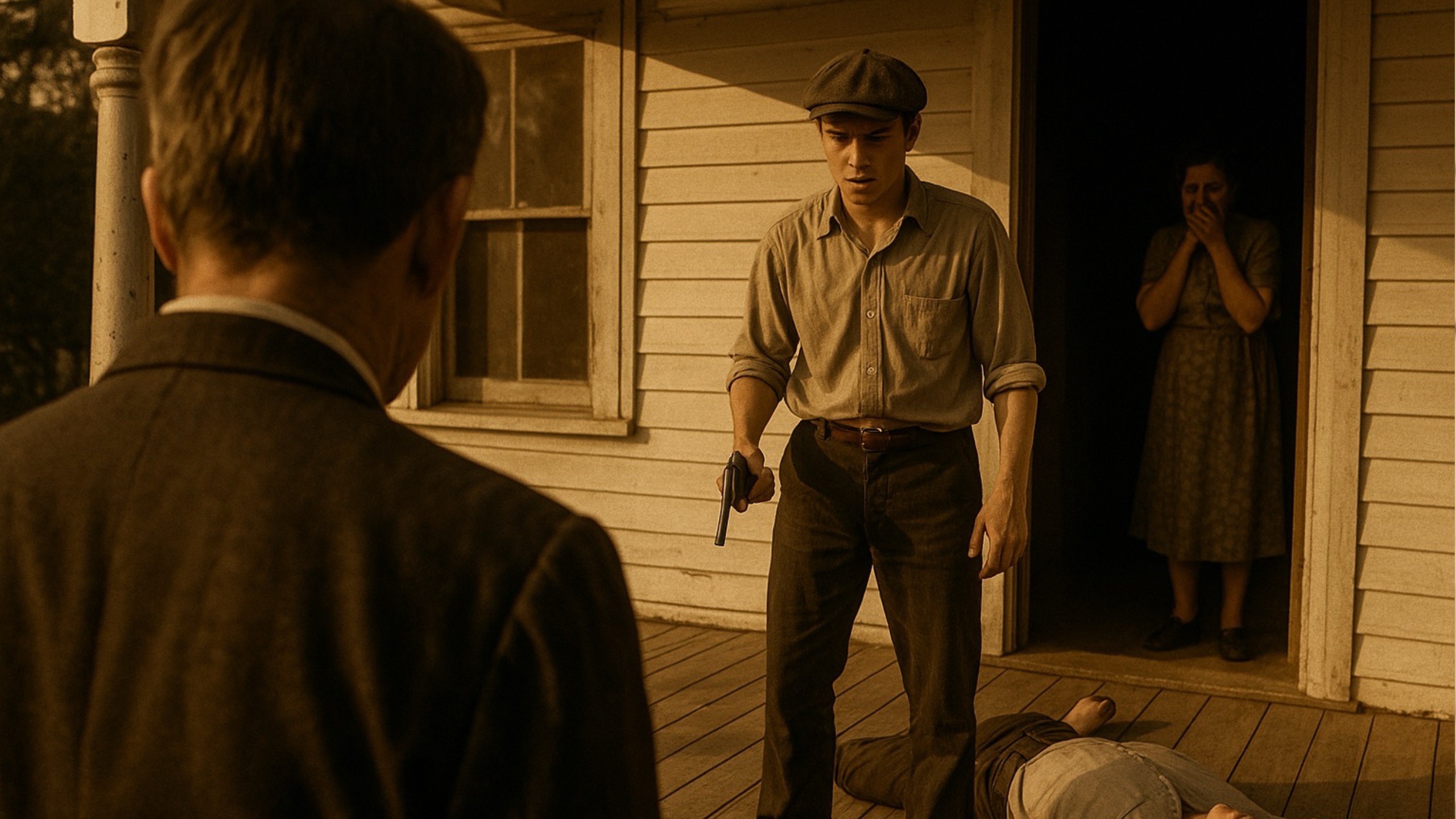
On the evening of June 2, 1928, sixteen-year-old John Burse was shot and killed at the home of Edward Winford Branham in Jeffersonville, Indiana. According to police reports, Burse was visiting the Branham home to trade his automobile for a .38 caliber revolver when the weapon discharged.[8] Multiple witnesses stated that the pistol was in Edward Branham’s hand when it fired. The bullet entered Burse's left side and caused powder burns on his forearm, leading the county undertaker, Froman M. Coots, to conclude that it would have been nearly impossible for Burse to have shot himself.
Edward Branham, 18 years old, son of Charles Branham, who was with Burse when he was killed and who was arraigned in the City Court Monday morning on a charge of first degree murder, before Mayor Harry C. Poindexter, entered a plea of not guilty and a preliminary hearing was set for 8 o'clock Tuesday morning, according to reports today.
In Branham's Hand:
Police reported that witnesses testified that the weapon was in Branham's hand when the fatal shot was fired. Branham denied that he was handling the gun, and told the police Burse was twirling it, with his finger through the trigger guard when it went off. Burse's father asked that police arrest young Branham.
Froman M. Coots, Jeffersonville undertaker, declared Sunday that the position of the wound which killed Burse, in the left side of the abdomen, and the fact that Burse's left forearm was powder burned, indicated that it would have been almost an impossibility for him to have fired the fatal shot himself.[9]
Edward Branham, then eighteen years old, was charged with first-degree murder. During the City Court hearing before Mayor Harry C. Poindexter, Edward pleaded not guilty. His defense claimed that Burse was twirling the revolver with his finger through the trigger guard when it discharged. Charles Branham, Edward's father, told police that he had heard the shot and rushed to the door just in time to see Burse collapse, but could not determine from whose hand the weapon had fallen. Despite these uncertainties, police took Edward into custody based on the testimonies of witnesses at the scene.
Edward’s indictment and the public scandal that followed added another layer of legal turmoil to a family already entangled in Prohibition-era crime. His death just over a year later, on June 20, 1929, from rheumatic heart disease,[10] cut short the case and ensured it never reached full resolution. While William Branham would later omit Edward entirely from his “life story” sermons, this episode remains one of the most revealing events in the Branham family’s history—raising difficult questions about character, accountability, and the mythology that followed.