
Keith Loker
On November 27, 1991, the headlines of newspapers were filled with news of a killer on the run. Very little was known by the man, other than the fact that he was a twenty-year-old man named Keith Loker. San Bernardino County Sun ran a large article complete with map describing the crime spree entitled, "Arizona man sought in 3-day crime spree." According to the report, Loker had killed and wounded people inside the California "Robin Hood Adult Book Store," and then made his way back into Arizona robbing, raping, and shooting. Inside the adult bookstore, Loker had proven that his motive was not simply robbery; he paused to enter the pornography stalls and shoot and kill a man engaged in self pleasure. At his trial, he was accused of shooting to death two men in the adult bookstore, wounding two others in the same location, rape, and attempting to murder another. His crime spree ended in a 49-minute high-speed chase with 20 police officers pursuing in Arizona. Loker waved at TV cameras as he ran from police.
On November 27, 1991, the headlines of newspapers were filled with news of a killer on the run. Very little was known by the man, other than the fact that he was a twenty-year-old man named Keith Loker. San Bernardino County Sun ran a large article complete with map describing the crime spree entitled, "Arizona man sought in 3-day crime spree." According to the report, Loker had killed and wounded people inside the California "Robin Hood Adult Book Store," and then made his way back into Arizona robbing, raping, and shooting. Inside the adult bookstore, Loker had proven that his motive was not simply robbery; he paused to enter the pornography stalls and shoot and kill a man engaged in self pleasure. At his trial, he was accused of shooting to death two men in the adult bookstore, wounding two others in the same location, rape, and attempting to murder another. His crime spree ended in a 49-minute high-speed chase with 20 police officers pursuing in Arizona. Loker waved at TV cameras as he ran from police.
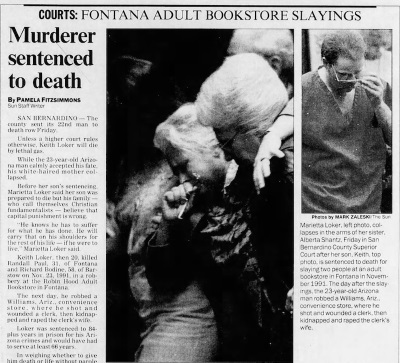
His murder trial went as expected, and sentencing trial went much the same. Convicted of murder for killing two men in the adult bookstore, the jury took less than a day to find Loker guilty of his charges and sentence him to death. But this trial was highly unusual, unlike other robbery and murder cases tried in the United States court system. Though the result of his crime spree could be compared to the outcome of any other, the motive of his crime made big news: The motive of this entire killing spree was suicide. Loker had decided that there was no hope left, and he would end his life by forcing the United States legal system to punish him by death.
The sentencing trial focused on Loker's childhood in a Prescott, Arizona trailer park that was a commune for what the newspapers called a "religious sect called The Message Church." His childhood far from normal, the result of a forced marriage that led to a family feud. Leo Mercer had ordered Roger Loker, a homosexual, to marry Marietta Daulton. According to newspapers, when it was discovered that Roger was homosexual, church elders physically assaulted Roger and forced him to have sex with his wife. The result of this forced sexual encounter resulted in Keith Loker, who many in the cult then believed to be a "demon child," marked with the evil spirit of his father. By the time Keith Loker was seventeen years old, his father refused to continue. Keith and his mother were kicked out of their home, and his father chose to replace them with his boyfriend.
The trial included testimony by several witnesses in the commune. Describing children being raped by elders of the church, the physical and sexual abuse of both children and adults, and even what appears to have been sexual slavery or the attempt of creating a sexual slave to the elders. Loker's defense attorney focused the jury's attention to not only the terrible childhood of the young killer, but also the environment that led to that terrible childhood.
"Among the mitigating factors: Loker's lack of a prior criminal record and the physical, psychological and emotional abuse he suffered during a bizarre upbringing. 'Shame, embarrassment and humiliation were common forms of punishment for even minor transgressions', Smith Said. According to family members, Loker was considered to have been 'born in perversion' in a trailer park that was home to a religious group. Loker was conceived after church elders discovered his father was homosexual, beat him up and forced him to have sex with his wife. The father never accepted his son. Although Loker clearly had severe emotional problems, there was no evidence that he received help, said his attorney Arthur Katz of the public defender's office."
San Bernardino County Sun, Feb 11, 1995
Leo Mercer, a self-proclaimed minister, ran the park. After Brother Branham's death in 1965, Mercer gradually became more authoritative, employing various forms of punishment. He would ostracize people from the community and separate families. Children were beaten for minor infractions like talking during a march or not tying their shoes. Mercer would punish girls by cutting their hair, and force boys to wear girls' clothing. There was also evidence that Mercer sexually abused children.
People vs. Loker, S045060
Doris Scott, defendant's aunt, moved to the park in 1962 when she was 18, and left in 1975. At the time of her testimony, she had recently learned that Mercer had molested one of her sons. Hugh, her youngest son, was raised in the park and had trouble with violence as an adult. Doris turned her own anger inward, and tried to commit suicide twice.
People vs. Loker, S045060