
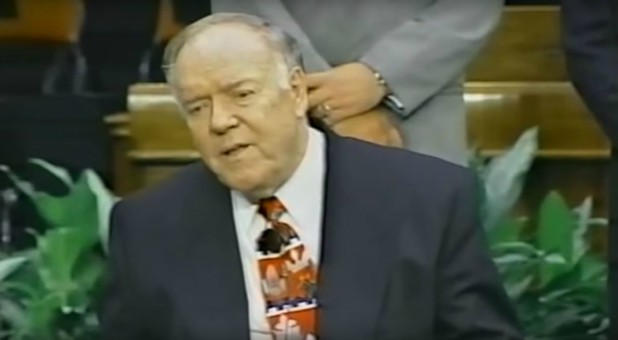
Kenneth Hagin
Kenneth Hagin, brother of mafia hitman George "Dub" Hagin, was a Pentecostal preacher who played a pivotal role in shaping modern charismatic Christianity into what it is today. Hagin is sometimes mistakenly credited as being the father of The Word of Faith Movement, which is sometimes referred to as the "Name It and Claim It Gospel".[1] One of the core teachings of the movement is that humans are "gods" that are lesser than the Almighty God Yahweh.[2] Hagin also supported Branham's position against interracial marriage, suggesting that he aligned with the Christian Identity doctrine.
Kenneth Hagin, brother of mafia hitman George "Dub" Hagin, was a Pentecostal preacher who played a pivotal role in shaping modern charismatic Christianity into what it is today. Hagin is sometimes mistakenly credited as being the father of The Word of Faith Movement, which is sometimes referred to as the "Name It and Claim It Gospel".[1] One of the core teachings of the movement is that humans are "gods" that are lesser than the Almighty God Yahweh.[2] Hagin also supported Branham's position against interracial marriage, suggesting that he aligned with the Christian Identity doctrine.
Then there are institutions such as the Rhema Bible Church in Tulsa, Okla., where the Reverend Kenneth Hagin Jr. advises his integrated congregation on how to keep their children from intermarrying. "We're friends. We play. We go together as a group, but we don't date one another. ... I don't think we ought to mix any of the races."
His words ignited an ongoing feud in Pentecostal sects, prompting the Reverend Fred Price of Compton, Calif., who is black, to declare a "holy war" against racism. Price says the world has too many hypocritical Christians, who may welcome blacks to their church but not to their fam-ilies.[3]
- Boston Globe
Hagin's ministry began in the early 1940s after claiming that God had miraculously healed him of a deformed heart and incurable blood disease.[4] On September 14, 2003, Hagin suffered cardiac arrest and was sent to the cardiac intensive care unit of a hospital in Tulsa.[5] When he died on September 19, 2003, his family stated that Hagin had "died of undisclosed causes".[6]
In the early 1970s, Hagin began to gain prominence for his teachings on faith, healing, and prosperity. He founded the Rhema Bible Training Center in 1974 in Broken Arrow, Oklahoma, which became a central hub for disseminating his teachings. Hagin's doctrine, which later came to be called the Word of Faith, emphasized the power of positive confession, the belief that spoken words have the power to influence one's reality, and that faith can lead to material prosperity and physical healing. According to Hagin, "if anybody, anywhere, will take these four steps or put these four principles into operation, he will always receive whatever he wants from Me or from God the Father."[7]
Hagin’s books, such as The Believer's Authority, and Redeemed from Poverty, Sickness, and Death, sold millions of copies worldwide. His radio program, Faith Seminar of the Air, and later television broadcasts expanded his reach even further. Hagin's teachings have influenced many well-known ministers, including Kenneth Copeland, Frederick Price,[8] and Joel Osteen.[9]
Much like Little David Walker, who gained popularity in healing revivals by claiming to have visited heaven, Hagin employed a similar showmanship tactic by claiming that he had visited hell. Hagin adopted Walker's dramatic spiritual experiences as a gimmick to captivate and convince his audience, enhancing his own credibility and appeal within the faith-healing community. According to Hagin, his trip to hell was "not a dream, nor a vision, but an actual personal experience."[10] It posed an interesting question as to how he made it back.
Influence of Latter Rain on Kenneth Hagin
The Latter Rain Movement, which began in 1948, marked a significant shift within Pentecostal Christianity, emphasizing a return to apostolic signs and wonders, spiritual gifts, and a more dynamic experience of the Holy Spirit. This movement sought to rekindle the fervor and miraculous experiences of the early church, advocating for a new outpouring of the Holy Spirit akin to the latter rain mentioned in the Book of Joel. Two key figures in Pentecostal history were largely responsible for inspiring the movement. The first was Franklin Hall, whose book, Atomic Power with God Through Fasting and Prayer, was believed to be a catalyst for the Latter Rain Revival that sparked the movement. The other catalyst was the unusual doctrine and ministry of Indiana minister William Branham.[11]
William Branham's ministry began in the late 1920s, and by the time of Kenyon’s death, Branham had gained significant fame as a faith healer. He was mentored by and toured with Rev. Roy Davis, a leader of multiple white supremacy groups[12] who also held revivals as a faith healer. This connection is critical to understand in relation to the Word of Faith. Davis, who was involved with and connected to ranking members of multiple Masonic orders,[13] held healing revivals while claiming to be a converted spiritualist. In fact, such a revival was held in Branham’s hometown of Jeffersonville shortly after Branham began working with Davis.[14] Branham, and most likely Davis, also visited Indiana’s nationally recognized spiritualist camp, Camp Chesterfield. It should come as no surprise that, like Kenyon, Branham also incorporated metaphysics and verbal commands into his early revivals.[15]
William Branham played a significant role in the formation of the Word of Faith Movement by introducing the foundational elements of the Word of Faith in his doctrinal teaching. Through his revivals and publications, those doctrines spread throughout the United States and Canada, as well as throughout Africa and South America. As the Latter Rain version of William Branham's "Message" began to spread, those doctrines quickly spread with it. It should come as no surprise that leaders in the group such as Benny Hinn give tribute to Branham.[16] The group bases this theology (loosely) on reading specific phrases or passages in the Bible as if they relate to Psalm 82 "I have said, Ye are gods; and all of you are children of the most High".[17]
All of the core elements of the Word of Faith doctrine can be traced directly to William Branham's sermons. Branham taught that "deity dwelled in us"[18] and that in the last days, humans would become gods.[19] To achieve a miracle, one must believe in the "spoken word".[20] According to Branham, Jesus was powerless to perform a miracle without having first having seen a vision, and only then could He speak with authority.[21] Branham claimed that faith could be used as a force, which he claimed to use during his stage act.[22] Branham's sermons are distributed using names that pay tribute to the Word of Faith: "Spoken Word Publications" and "Voice of God Recordings".
Influence of F. F. Bosworth on Kenneth Hagin and the Word of Faith Movement
Another connection of great importance was that of faith healer FF Bosworth. Bosworth, who had been a ranking member of John Alexander Dowie’s cult of personality in Zion, Illinois, further mentored Branham in the revivals, incorporating much of Dowie’s doctrine into the foundation from which Branham would develop his ideas. Dowie was an early prototype for many of the doctrines that would develop in the Latter Rain and subsequent movements, including the doctrine of positive confession, which would form the basis for Word of Faith.
Bosworth was a student of the works of EW Kenyon and carried Kenyon’s work forward into the Latter Rain movement after Kenyon died in 1948. In his book, Christ the Healer, Bosworth declared that he borrowed heavily from the works of Kenyon, listing nine of Kenyon’s published works as sources. Christ the Healer became a foundational text for the Latter Rain movement, as well as the healing and deliverance movements that followed.
At the height of the Latter Rain movement, Bosworth, Branham, and Gordon Lindsay, Branham’s campaign manager, made many additional connections that would strongly influence Hagin and the Word of Faith. Both Branham and Hagin were members of the Full Gospel Business Men’s Fellowship International, led by Demos Shakarian. Branham worked closely with Word of Faith leader Osborn, who edited the Voice of Healing magazine published by Branham and Lindsay.
After William Branham died in 1965, it would appear that the torch lit by EW Kenyon and John Alexander Dowie was passed to others. Osborn openly declared at Branham’s memorial service that Branham was God in human flesh, a strong indication that Osborn was a member of a Branham deity cult that had developed within the movement and that still exists today. Hagin began sharing the views of Kenyon and Dowie that Bosworth helped package as Branham’s theology in the Word of Faith magazine, and later founded Rhema Bible College to educate others in one of Branham’s central themes, which Branham called The Spoken Word.
Influence of Phineas Parkhurst Quimby on Kenneth Hagin and the Word of Faith Movement
While many people credit E. W. Kenyon as the founder of the Word of Faith doctrine,[23] the Americanized version of the Word of Faith doctrine can actually be traced to mentalist Phineas Parkhurst Quimby. Quimby combined Christianity with metaphysics.[24] Its core foundation, however, is derived from Gnosticism and Eastern mysticism. Others recognize Kenneth Hagin as the father, not realizing that Hagin both worked closely with men connected to William Branham who were influenced by Kenyon.[25] Hagin was both a Voice of Healing evangelist[26] and connected to the business side of Branham's "Message" cult as late as 1984 through a business entity called Ordinary People.[27] Branham's version that influenced Hagin appears to be a combination of both Kenyon and John Alexander Dowie.
Hagin was deeply influenced by the Latter Rain version of William Branham's "Message" sect, and the Manifest Sons of God theology[28] Branham introduced, made popular by George Warnock. Hagin believed that Jesus was an "incarnation" of God, as are members of his sect.
'Yes, sin, sickness and disease, spiritual death, poverty, and everything else that's of the devil once ruled us. But now, bless God, we rule them--for this is the Day of Dominion!'
- Kenneth Hagin, 'Rejoice! This Is the Day Which the Lord Hath Made!' The Word of Faith, Sept. 1996
'Every man who has been born again is an incarnation and Christianity is a miracle. The believer is as much an incarnation as was Jesus of Nazareth'
- Kenneth Hagin, 'The Incarnation,' The Word of Faith, Dec. 1980, p.13
After Jim Jones[29] and many of the Voice of Healing Evangelists[30] parted ways with William Branham, Branham began claiming to have a more powerful Word of Faith than before. In a sermon entitled "My New Ministry", Branham began claiming that he spoke an actual squirrel into existence for the purposes of killing it. Though it was part of the stage persona, Branham's cult following today still believes this to be an actual event that happened.[31]