
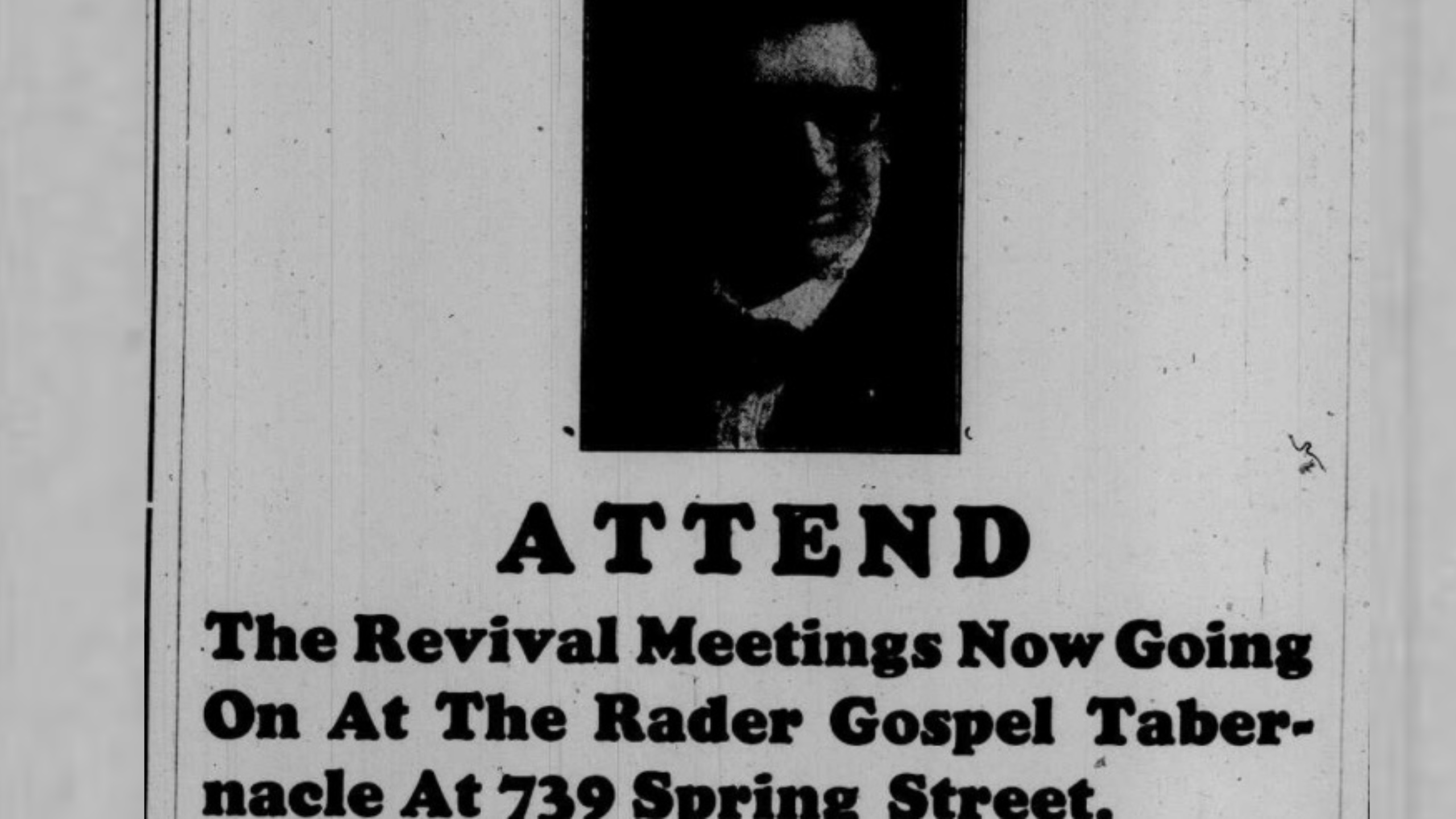
Ralph Rader
Ralph Rader was a Jeffersonville minister whose life moved from early notoriety and violence into Methodist ministry, national reform work, and eventually Pentecostal influence after time in Los Angeles. His Rader Gospel Tabernacle became an important but often overlooked setting in the religious world surrounding William Branham and Roy E. Davis, especially after Davis, fleeing scandal and fraud charges, briefly served as Rader's choir leader before being dismissed and forming his own Pentecostal Tabernacle with members drawn from Rader's congregation. That split appears to have created the foundation for Davis' Jeffersonville operation, where William Branham became one of the early elders and later assumed pastoral leadership after Davis was extradited to Arkansas, raising important questions about Branham's relationship to Rader's congregation, Davis' church plant, and the hidden origins of Branham's early ministry.
Ralph Rader was a minister in Jeffersonville, IN. His father, Thomas B. Rader, was the mayor of Jeffersonville. In his early ears, Ralph was unruly. Apparently Ralph ran with a bad crowd, one who purposefully went to administer a harsh beating from time to time. While going with a friend to give one man his second beating, Ralph was shot in the back with a pistol. It was feared that he would be completely paralyzed, but Ralph managed to escape a bedridden condition. But this didn't stop Ralph from capturing interest of the Jeffersonville news. Ralph was almost caught at gambling, but managed to avoid any trouble.
But Ralph turned his life around. He went to Chicago to study for the ministry, and in 1914, it was announced that he would become a Methodist minister in Jeffersonville, Indiana. At some point in time, Ralph moved to Los Angeles, California, and made national news speaking on behalf of the Latin-American Home Missionary conference of the Methodist Episcopal church against dance, liquor and cigarettes. Though we can't be certain, it is likely during his time in Los Angeles at the home of Aimee Semple McPherson where Ralph came in contact with the Pentecostal doctrine.
In the 1930s when Roy E. Davis fled charges of swindling and fraud in Louisville, KY, Ralph briefly joined forces with Roy. Roy left behind a congregation that was still reeling from his underaged sex scandal. Before starting a church of his own, the spokesman for the Ku Klux Klan became a choir leader in Ralph Rader's Gospel Tabernacle. Davis' time as choir leader for the Rader Gospel Tabernacle was brief, howeever. Shortly after becoming active in the services, Davis was terminated for reasons unpublished, and left Rader to start his own Pentecostal Tabernacle. When he left, Davis took several of the people away from Ralph Rader's church. Quite literally, Roy Davis' church was formed through stealing members from Ralph Rader's congregation. And worse, the funds for starting the Pentecostal Tabernacle came directly from the money swindled in Louisville. According to the newspapers, the deed to Davis' church was thus invalid. It was from this church separation that Davis set up his base of operations to promote and recruit for the Ku Klux Klan on his path to becoming the Imperial Grand Dragon of the Original Knights of the Ku Klux Klan.
Why does William Branham never mention Mayor Rader or Ralph Rader's church in Jeffersonville? When the nationally-recognized pastor of the Rader Gospel Tabernacle -- and former mayor's son -- returned to Jeffersonville, would it not have been the talk of the town? Was William Branham part of the congregation that left with Roy Davis when Rader's church split? Is this why Roy Davis chose William Branham to become one of the first elders in his church?
When Roy E. Davis was extradited to Arkansas on charges of grand theft and connection to murder shortly after his "church plant," William Branham assumed the role of pastor while the other elders in Roy Davis' church assumed roles of elders under William Branham. Branham effectively became the new pastor for a large portion of Ralph Rader's church.