
Richard Nixon
Richard Nixon's connection to William Branham and the Message movement centered on Cold War anti-communism, Full Gospel Businessmen networking, and the use of evangelical revival platforms to influence public opinion, beginning with Nixon's 1954 address to ministers and businessmen where he framed communism as a battle for the minds, hearts, and souls of humanity; Branham attended these meetings, later claimed personal knowledge of Nixon, and appears to have reshaped his 1933 prophecy narrative afterward to make communism the central doomsday threat, while Nixon's later presidency and covert action policies in Chile connected the broader anti-communist campaign to Message-linked figures such as Paul Schafer and Colonia Dignidad, where religious authoritarianism, intelligence operations, and political violence converged.
Richard Milhous Nixon (1913-1994) was the 37th president of the United States from 1969 until 1974. He had previously served as the 36th vice president of the United States from 1953 to 1961. Nixon is most famous for his Watergate scandal, but as it relates to the "Message" cult of personality, Nixon played a significant role in both William Branham's ministry and covert operations involving leaders of William Branham's "Message" sect.
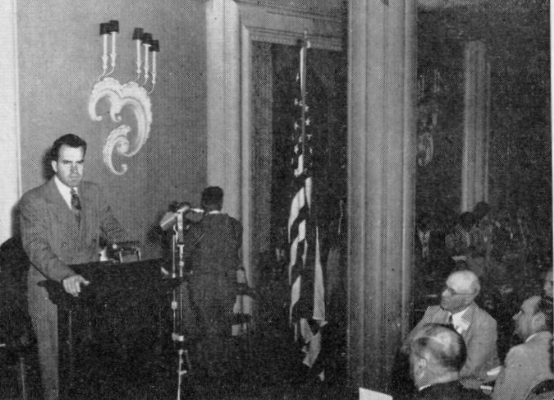
William Branham claimed that he knew President Nixon personally.[1] Branham was in attendance at the Full Gospel Business Men's Convention Breakfast organized by Demos Shakarian, and Vice President Nixon was the speaker. Nixon's speech focused primarily on Communism and the need for the Christian community to rise in opposition.
Branham, William. 1954, July 18. The Great Coming Revival And The Outpouring Of The Holy Spirit (54-0718A). "Some time ago, a few weeks ago, having breakfast or—in the room at Washington, DC, and a speaker, Mr. Nixon, the Vice President of the United States, was speaking at this time. And he was talking of how Communism was sweeping the land and the space we had to—to travel. For instance, the goal that the world faces like that…Communism has this much of it already."
In his address to the Full Gospel Businessmen's Association, Nixon described his work with the National Security Council and the rising threats posed by Communism to the United States.[2] Nixon recognized the influence of the ministers, who, "all over America, into the big cities and small towns, do very much to create in the minds and hearts of young people of America, dedication to those great ideals".[3] This, according to Nixon, would be powerful in eradicating Communism as it was a war raged in the minds.
Now in the National Security Council, we consider, of course, the military policy, the economical policy, the political policies that the United States can adopt to meet this threat. But all of us know that the great battle in which we are engated today is one which is not only military, economic, and political in character and it is that, but that in the final analysis, it is a battle for the minds, and the hearts, and the souls of men.[4]
- Richard Nixon, Full Gospel Business Men's Convention Breakfast
Prior to hearing Nixon's speech, William Branham's claim of having seven prophecies in 1933 was one of a world without peace, and Branham claimed that he did not know which "ism" (Communism, Fascism, and Nazism) would reign.[5] After the speech, however, Branham significantly changed his 1933 prophecies to include a doomsday scenario that involved Communism as the main threat.[6]
With regards to Communist threat, Nixon set many policies in motion as Vice President that would create a much deeper relationship with William Branham's cult of personality when he became the 37th President of the United States. Declassified documents and policies show that the CIA, under orders by Richard Nixon, performed covert ops in Chile to sway Chilean politics in favor of Augusto Pinochet by discrediting Marxist-leaning Salvador Allende.
The CIA worked with DINA agents in Chile to establish a very sophistocated and elaborate system of intelligence in Chile, using "Message" cult compound Colonia Dignidad as a covert ops facility. Paul Schafer, former Nazi and William Branham's security officer from Germany,[7] worked with DINA to interrogate, torture, and assassinate opponents of the Pinochet regime.
In the 1960s and the early 1970s, as part of the US Government policy to try to influence events in Chile, the CIA undertook specific covert action projects in Chile. Those hereby acknowledged are described below. The overwhelming objective—firmly rooted in the policy of the period—was to discredit Marxist-leaning political leaders, especially Dr. Salvador Allende, and to strengthen and encourage their civilian and military opponents to prevent them from assuming power.[8]
- CIA Activities in Chile. Central Intelligence Agency.
Vice President Richard Nixon's Speech to the Full Gospel Business Men's Fellowship Convention:
Thank you very much, my friend, Demos Shakarian for this much too generous introduction, and for this fine group this morning, meeting here in Washington. I want you to know I regret I haven't the time to stay here and greet all of you personally and allow people I see with cameras to get your snapshots. In any event, when I learned that this group was meeting here in Washington, our good friend Mr. Shakarian last week invited me to come. I told him that my schedule had been filled up for about three weeks before that, but that some way I would try to come. He said, "We meet every morning for breakfast." I said, "I believe I have a breakfast three mornings of that week, but on one of the mornings, I will try to get by," and this happens to be it, and I am here and I am very happy that I was able to come.
I might say that after this meeting I am going down to a meeting at the White House; it will be at 9:30 this morning. I will have to be there a little early for briefings that will occur before the meeting. I believe that will be as good a theme as any to set for the brief remarks that I will make to you this morning. The meeting which I am to attend is a meeting of an Organization called The National Security Council. You never read what the National Security Council does because it is the top advisory group for the President to deal with international policy and to deal with military policy. Its meetings are always confidential, or top secret -- either of the phrases that may appeal to you. Its meetings are one in which grave problems confronting American and the free nations are considered and in which the solutions to those problems are worked out if they can be.
I don't need to tell you today the problems that confront America, do confront the free peoples, are as great as we have ever had in our history. We look across the world to Indo-China. We look down at the situation in Guatemala. We see revolution in some areas, subversion in other areas, even in the United States as my good friend Clyde Doyle can tell you. He has rendered a fine service in many of our American activities of which he is a member. but in all of these areas of the world you see the godless, totalitarian doctrine of the communists pushing ahead and attempting to make gains against the free nations, and eventually threatening our nation as well.
Now in the National Security Council we consider, of course, the military policy, the economical policy, the political policies that the United States can adopt to meet this threat. But all of us know that the great battle in which we are engaged today is one which is not only military, economic, and political in character, and it is that, but in the final analysis it is a battle for the minds, and the hearts, and the souls of men. And I will tell you why it is.
Let us consider for the moment the problem we have in Indo-China. We have there a revolution, so called. A revolution against the existing government. But what kind of a revolution is it? It is a revolution which is greatly controlled, dominated, and inspired, not by the individuals within the country, individuals who are attempting to change their form of government, but is dominated, inspired, and controlled by the Communist rulers in Peking and Moscow, who use this method of extending their conquest all over the world. Now, what do we do to meet such a revolution?
As I pointed out in my address at Whittier College, obviously, we attempt to develop united action among our friends, other free nations in that area to see that the aggression does not go any further than it has already gone. But that meets the problem, generally too late. The major problem that we have is to find out what causes the revolution and then to meet it there. In other words, why is it that people are appealed to by this doctrine and what appeal can we offer which will be as effective? What appeal can we offer which will win the people I this battle for their minds, and their hearts, and their souls to decide for the free nations rather than to decide for the slave nations?
We are attempting, of course, to meet that appeal, not only in Indo-China, but in every other area of the world. Unless we do meet it effectively, we will be confronted with more revolution, Communist-inspired and controlled and directed. And so may I suggest that in meeting that appeal that there are a number of considerations that we must have in mind. We must of course associate ourselves with the causes people believe in, in these countries, with their aspirations. They want independence, they want equality, they want economic progress, they want peace. All those things are important to them.
There is one thing that I would emphasize above all others and that is that economic progress is part of the problem, but not all of it and that for any one to suggest, for example, that in Asia all that you have to do is keep the people from going Communist is to give them another bowl of rice is wrong. Wrong, because it is an insult to a proud an sensitive people. Wrong, because it is a false and superficial appraisal of very complex problem. Because in Asia, as in the United States, as in every other section of the world, men are interested in economic progress, they are interested in military security to protect them from enemies abroad, but they are also interested in other things.
Ideals, we call them I mention two — independence and equality, I would mention another which this organization symbolizes, and that is that it seems to me one of the greatest advantages we have over the appeal that the Communists are able to make not only here but abroad, is that this nation was founded in a belief in God. This nation has become a great nation because its great leaders have believed in God. And it seems to me that it is extremely encouraging to see all over America, what I think is sense and that is a rededication of people to those basic principles which made America great in the past: a belief in God, combined with patriotism, and a belief in America and in that connection may I just close with one note.
About the only time I got to read the newspapers is when I am riding from one place to another. I sit in the car and read the newspapers and find out what is going on. In this instance I read a very interesting story this morning which you may have picked up in which President Eisenhower came out against giving a pension to Alger Hiss, who is, you know, serving a term in the penitentiary at the present for commuting perjury, lying when he said he had not been a member of the Communist Comspiracy and had not indulged in activities which were detrimental to the United States of America. I believe the President was right when he made this statement, I think you will agree that is right.
I would like to point out to you, something that you may have not known about Alger Hiss and all the types of people that he is a symbol of. I have often been asked, as my friend Clyde Doyle has been asked, "What kind of people become Communist in the United States?" "What makes them become Communists?" So I thought in my own mind, let me analyze the ones that I know. What kind of people are they? So I went back. I remembered the histories, I remembered the other young men. They were young then, six years ago when I was participating in the investigation of that case. The other young men who came before the Committee on un-American activities. There was Alger Hiss, Lee Preston, Nathan Witt, Victor Pruell, Harry White. These men came before the Committee and proof was established either by their own testimony or by corroborating evidence that they had been members of the Communist Conspiracy.
I tried to analyze them all and said, "What was it in their make-up, that made them members of the Communist Conspiracy?" And this is what I thought. Every one of them had the best advantages that America could give them. They were graduates of our great colleges. They were not poor. They had the best government jobs that they could have, running eight to ten thousand dollars a year. They were individuals who had the advantages of coming from good families in the United States of America. They did not do what they did for money. Not one of this group that I have mentioned received money for what he did.
Then why did he do it? He did it because, somehow, somewhere, something went wrong. he lost faith in America. he lost faith in God, if he ever had it. And in losing that faith, he transferred his loyalty and his allegiance to the totalitarian doctrine of Communism, and when he did that, once he does, he was willing to do anything: engage in espionage, do things which would bring discredit to himself and to the members of his family, do anything to further that cause, a cause which will destroy his country and overthrow his government.
Now that is dedication. And whatever we say about the Communists, we must realize that they have made an appeal which makes dedicated men out of them. But on the other side, we have dedicated men too. And we need more of them men who are dedicated to America, and men who believe in the free principles of this nation, men who have faith in God.
I am sure that this group of people, meeting as you have here and then spreading your influence all over America, into the big cities and small towns do very much to create in the minds and hearts of young people of America, dedication to those great ideals. And for that reason, I particularly appreciate the opportunity to meet with you here this morning and to speak to you informally, as I have. I hope that the balance of your visit to Washington will be pleasant and that we will continue to provide for you this magnificent California weather.[9]
- Vice President Richard Nixon