
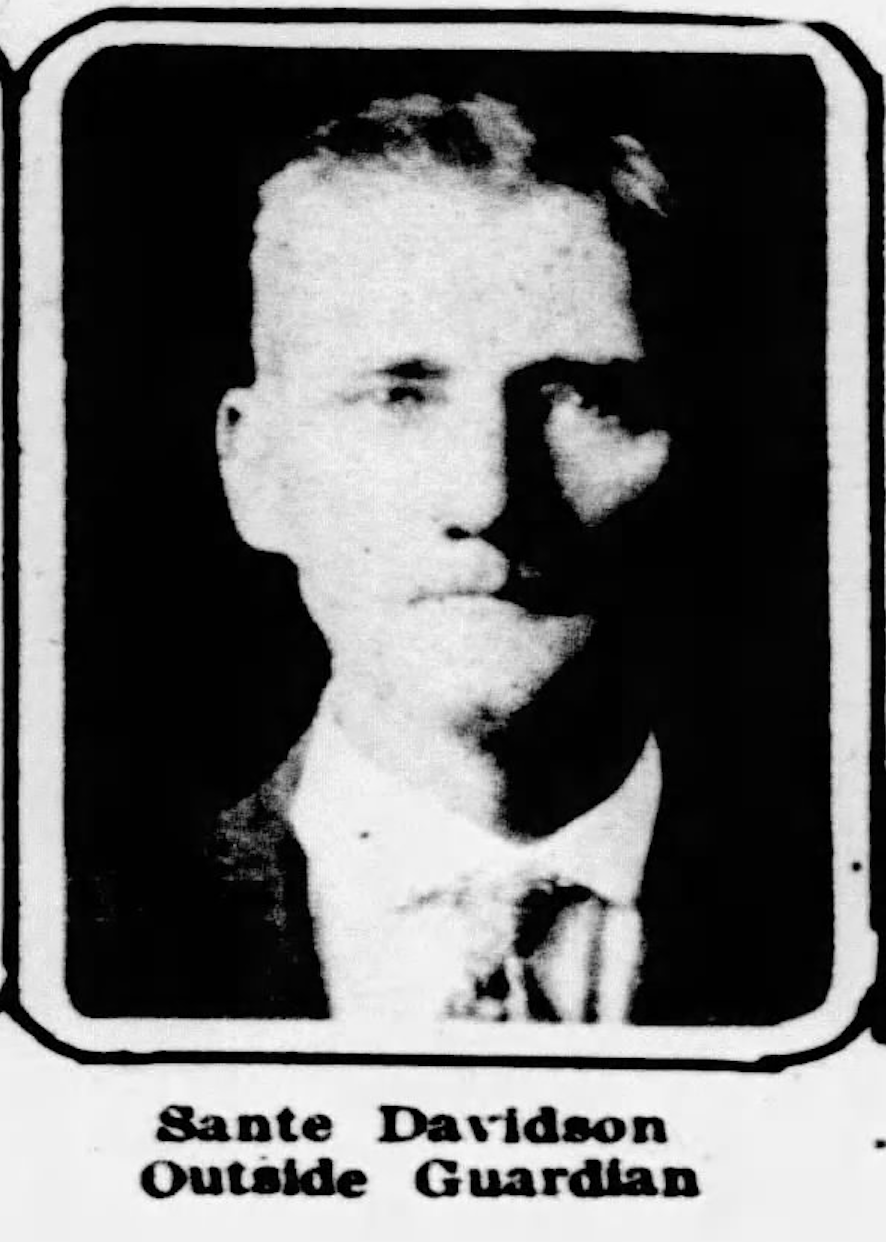
Sante Davidson
Sante Davidson led the devotional services at the Billie Branham Pentecostal Tabernacle, and was likely involved with the temporary usage of the Masonic hall for services as the church transitioned from Roy E. Davis to William Branham. He also painted the signs that were displayed in the early church.
Sammy was deeply involved with the Independent Order of Odd Fellows Masonic order, and was featured in photographs published in the Louisville Courier Journal describing members of rank. In 1925, Sante Davidson's photo was featured as rank of "guardsman", or bodyguard. Having a rank of "bodyguard" would imply that he had been involved with the secret meetings for quite some time. According to the Jeffersonville and New Albany, IN newspapers, Santa had been participating in Odd Fellows activities since as early as 1902. At that time, Sante was listed as an officer in the Tabor Lodge.
Sante was involved with more than one fraternal organization He was also a Deputy Grand Chancellor of the Knights of Pythias. In 1915, Sante was president of the "Order of the Owls". This group helped fund orphans and widows. Though a member of the Jeffersonville lodge and participating in William Branham's (and likely Roy E. Davis's Jeffersonville church), Santa lived in Salem, IN, and his role as "choir master" did not begin with Branham's "Pentecostal Tabernacle". In 1901, he was appointed choirmaster of Wall Street Sunday School. Also, his painting of signs did not begin with verses in the church beams. Sante had a business as a painter, and was part of the masonic painting union. In 1909, Sante attempted to focus solely upon painting, which apparently was a dangerous trade. At one point, Sante poisoned his eye in an accident and lost a middle finger.
In the evenings, Sante managed the Etzler Opera House. The Opera House provided vaudeville entertainment to Southern Indiana and attracted visitors from all around. Sante was also involved with band concerts and directed the band accompaniment for local events. He was a writer publishing humorous, thought-provoking articles in the local newspapers. His "The Ten Commandments" was aimed at local business owners, which would have been humorous to many. He also wrote poetry to encourage those out of work, and articles to focus on the family.
Sante operated the "Snow Drip", a restaurant with sandwiches and cold drinks. He was a shrewd businessman, wheeling-and-dealing to make his establishments become the exclusive local attraction, and he cornered more markets than just vaudeville and motion picture. Within just a few years, he grew the Opera House large enough to attract big shows. Some of the shows were large enough for 156 nights in New York and six months in Chicago.
In 1930, shortly before the time Roy E. Davis was the music minister for Ralph Rader and before Davis took a large part of Rader's congregation, the Odd Fellows attended Ralph Rader's tent revival. Sante Davidson led the singing. The Pentecostal Baptist Tabernacle -- and Roy Davis -- were there. According to William Branham, he was Davis' assistant pastor in 1930, so it is quite possible that this could have been the first time Sante Davidson met William Branham. It was the first published account of a cooperative effort between Sante Davidson, Rev Roy E Davis and (by the timeline) Rev William Branham.
The union of fraternal organizations and Christianity were not well received in the community. Rev. Ralph Rader was forced to hold his meetings at the Knights of Pythias Armory and it's safe to assume Sante Davidson was involved, simply due to his rank. Local ministers saw the non-denominational strategy as a threat, likely because Rader, Davis, and others were using that platform to grow their new churches. (At least in the case of Roy E. Davis and Ralph Rader, they were growing their churches by persuading members from other congregations to leave their home church. Two days after Roy E. Davis was arrested for violation of the Mann Act, and was arrested at the ongoing church revival in Jeffersonville, a resolution to prevent this practice was passed.
Sante Davidson would have met Rev. Roy Davis for the first time, met William Branham, who was Davis' assistant pastor at the time, and witnessed federal agents taking Davis away for underaged sex with a minor from another state. After Roy Davis' Pentecostal church was burned and the Davis brothers left town in 1934, leaders of Roy Davis' Pentecostal church (ex: George DeArk) became elders in Branham's Pentecostal Tabernacle. Sante Davidson joined them as Branham's "choir master". His first publicized appearance in the Billie Branham Pentecostal Tabernacle was October 2, 1935. It was not advertised on 8th and Penn streets, however. Sante's participation in Branham's church in 1935 was at the "8th and Graham street tabernacle", 2 and 1/2 blocks away from the "Branham Tabernacle" that exists today.
Sammy was deeply involved with the Independent Order of Odd Fellows Masonic order, and was featured in photographs published in the Louisville Courier Journal describing members of rank. In 1925, Sante Davidson's photo was featured as rank of "guardsman", or bodyguard. Having a rank of "bodyguard" would imply that he had been involved with the secret meetings for quite some time. According to the Jeffersonville and New Albany, IN newspapers, Santa had been participating in Odd Fellows activities since as early as 1902. At that time, Sante was listed as an officer in the Tabor Lodge.
Sante was involved with more than one fraternal organization He was also a Deputy Grand Chancellor of the Knights of Pythias. In 1915, Sante was president of the "Order of the Owls". This group helped fund orphans and widows. Though a member of the Jeffersonville lodge and participating in William Branham's (and likely Roy E. Davis's Jeffersonville church), Santa lived in Salem, IN, and his role as "choir master" did not begin with Branham's "Pentecostal Tabernacle". In 1901, he was appointed choirmaster of Wall Street Sunday School. Also, his painting of signs did not begin with verses in the church beams. Sante had a business as a painter, and was part of the masonic painting union. In 1909, Sante attempted to focus solely upon painting, which apparently was a dangerous trade. At one point, Sante poisoned his eye in an accident and lost a middle finger.
In the evenings, Sante managed the Etzler Opera House. The Opera House provided vaudeville entertainment to Southern Indiana and attracted visitors from all around. Sante was also involved with band concerts and directed the band accompaniment for local events. He was a writer publishing humorous, thought-provoking articles in the local newspapers. His "The Ten Commandments" was aimed at local business owners, which would have been humorous to many. He also wrote poetry to encourage those out of work, and articles to focus on the family.
Sante operated the "Snow Drip", a restaurant with sandwiches and cold drinks. He was a shrewd businessman, wheeling-and-dealing to make his establishments become the exclusive local attraction, and he cornered more markets than just vaudeville and motion picture. Within just a few years, he grew the Opera House large enough to attract big shows. Some of the shows were large enough for 156 nights in New York and six months in Chicago.
In 1930, shortly before the time Roy E. Davis was the music minister for Ralph Rader and before Davis took a large part of Rader's congregation, the Odd Fellows attended Ralph Rader's tent revival. Sante Davidson led the singing. The Pentecostal Baptist Tabernacle -- and Roy Davis -- were there. According to William Branham, he was Davis' assistant pastor in 1930, so it is quite possible that this could have been the first time Sante Davidson met William Branham. It was the first published account of a cooperative effort between Sante Davidson, Rev Roy E Davis and (by the timeline) Rev William Branham.
The union of fraternal organizations and Christianity were not well received in the community. Rev. Ralph Rader was forced to hold his meetings at the Knights of Pythias Armory and it's safe to assume Sante Davidson was involved, simply due to his rank. Local ministers saw the non-denominational strategy as a threat, likely because Rader, Davis, and others were using that platform to grow their new churches. (At least in the case of Roy E. Davis and Ralph Rader, they were growing their churches by persuading members from other congregations to leave their home church. Two days after Roy E. Davis was arrested for violation of the Mann Act, and was arrested at the ongoing church revival in Jeffersonville, a resolution to prevent this practice was passed.
Sante Davidson would have met Rev. Roy Davis for the first time, met William Branham, who was Davis' assistant pastor at the time, and witnessed federal agents taking Davis away for underaged sex with a minor from another state. After Roy Davis' Pentecostal church was burned and the Davis brothers left town in 1934, leaders of Roy Davis' Pentecostal church (ex: George DeArk) became elders in Branham's Pentecostal Tabernacle. Sante Davidson joined them as Branham's "choir master". His first publicized appearance in the Billie Branham Pentecostal Tabernacle was October 2, 1935. It was not advertised on 8th and Penn streets, however. Sante's participation in Branham's church in 1935 was at the "8th and Graham street tabernacle", 2 and 1/2 blocks away from the "Branham Tabernacle" that exists today.