
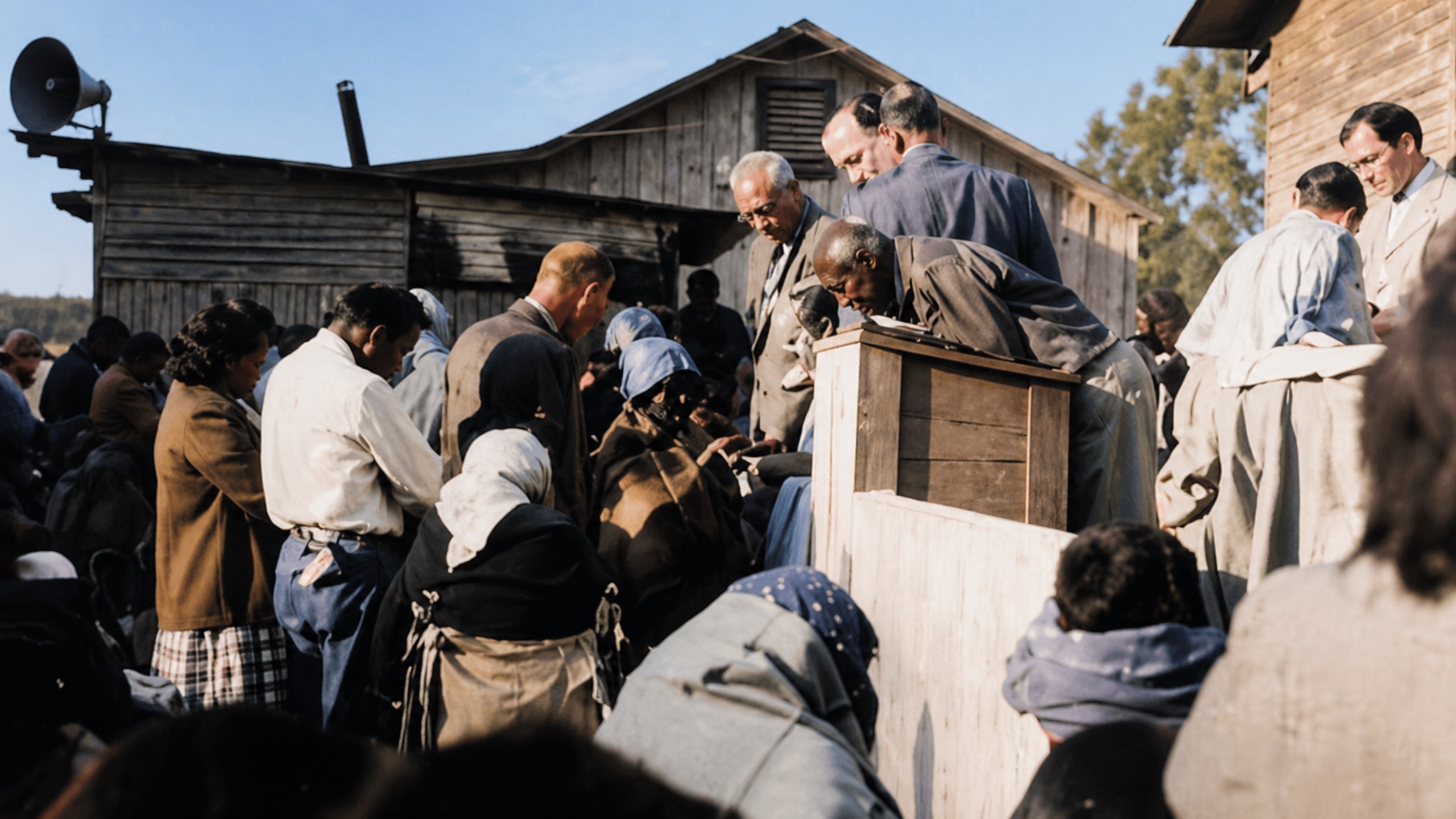
From Pentecost to Pentecostalism: The Biblical Invitation Versus the Modern Altar Call
William Branham's condemnation of altar calls reveals a striking contradiction between his anti-revivalist rhetoric and his own revival practice, since he denounced altar calls as unbiblical, emotionally manipulative, and merely Methodist in origin while continuing to use them from the earliest surviving recordings through the final weeks of his ministry; by claiming that his attack on altar calls came under "anointing," then defending the statement after backlash while still calling people forward in increasingly harsh and rebuking appeals, Branham exposed the tension between his desire to reject broader Pentecostal and revivalist tradition and his continued dependence on the very ritual machinery that sustained his healing campaigns and shaped the religious experience of his followers.
In the biblical canon, public invitations to repentance function primarily as proclamations addressed to the gathered community rather than as ritualized acts requiring physical movement toward a designated sacred space. In the Old Testament, prophets routinely issued corporate summons to return to covenant faithfulness--calls delivered in public forums, city gates, or assemblies (e.g., Joel 2:12-17). In the New Testament, the closest analogue to a modern "invitation" occurs at Pentecost, where Peter's preaching elicits the response, "What shall we do?" (Acts 2:37). His reply--"Repent and be baptized" (Acts 2:38)--constitutes a theological summons, not a procedural altar ritual. Nowhere does Scripture portray a structured moment in which respondents walk forward to a dedicated altar space for the purpose of conversion. Instead, the normative pattern of response in the apostolic era is baptism, understood as the public marker of incorporation into the Christian community.
The emergence of the modern altar call in American revivalism represents a significant departure from these biblical patterns. First developed in the early nineteenth century and popularized by Charles Finney's "anxious bench," the altar call sought to create a visible, emotionally charged moment of decision by inviting converts to physically move forward in response to preaching. Early Pentecostal and later charismatic movements, inheriting revivalist culture, adopted altar calls as central liturgical events--sites for conversion, Spirit baptism, healing, and manifestations of charismatic gifts. In these contexts, the altar became not merely symbolic but performative: a ritual space where spiritual crises were resolved, identity was reconstituted, and communal expectations shaped individual religious experience. Thus, while public appeals to repentance have deep biblical roots, the altar call as practiced in Pentecostal and charismatic traditions is a distinctly modern innovation, shaped by revivalist psychology and ecclesial pragmatism rather than scriptural precedent.
This historical distinction provides essential context for understanding William Branham's later condemnations of altar calls, issued despite his own reliance on them from the earliest years of his recorded ministry. Branham claimed that the practice was unbiblical, emotionally manipulative, and the result of Methodist innovation rather than divine calling. Yet his revivals--spanning from at least 1947 to the final months of his ministry in 1965— regularly employed altar calls, even after his public denunciations. The tension between Branham's rhetoric and his continued use of the ritual underscores both his complex relationship to broader Pentecostal tradition and the central role that altar calls played in shaping the religious experience of his followers.
In November 1961, William Branham began issuing sharp denunciations of altar calls and of the ministers who employed them. He insisted that he had "always been against an altar call" and maintained that those who professed conversion during such appeals were not genuinely converted.
And they walk up there, women. I'm talking about Pentecostals. Women go in there, up to the altar, they keep pleading. I've always been against an altar call. Might as well say it. I don't believe in them. No such a thing in the Bible. How can any man come 'less God calls him? You couldn't keep him away. You don't have to call anything. God has called him. Altar call is a Methodist idea. That's right. Altar calls, they get a hold of them, say, 'John, you know, your mother died a long time ago.' 'Ooh-ooh-ooh, yes, brother, ooh-ooh!' That's not conversion.[1]
Though William Branham's ministry had featured altar calls for as long as his sermons had been recorded[2] and likely before, Branham claimed that this condemnation of the practice was "under anointing". The "anointing", however, did not go over well with participants of his revival. After an outcry by the Christian community, Branham explained that while under this "anointing", things are said that a minister would not ordinarily say. He reiterated his position, however, and continued to denounce altar calls.
I don't say this…say those things to be indifferent, but sometimes under anointing you know things that you wouldn't…you'd be daresn't to tell the people. Then sometimes under anointing something will slip out, you see, and you won't notice it. And one of the things that I believe was said (that last Sunday) that might cause someone…when I mentioned that I never did believe in altar calls. See? I want to say that and clear that so you'll understand. There never was an altar call made in all the Bible. There's no such a thing in the Scripture. Nowhere down through the ages was it made till the Methodist age, about two hundred years ago, see. Altar calls are when people come up and try to persuade and pull people, 'Come on, John. You know, they…Your mother died, praying for you. Come on, John.' That's not conviction, friends. No. Them—them kind, I…very seldom you ever hear one that ever goes very far. And, in that, you get everything. That's the reason the church is all muddled up the way it is today, is because of such things.[3]
The backlash from his statements continued, as did Branham's usage of altar calls in his revivals. While Branham continued to denounce altar calls to battle the strongly objecting Christian community, he called members of his revivals forward to altar calls. There was, however, an obvious change in them; Branham became very bitter during his altar calls. Some portions of his altar calls appear to be cut from the recording.
"[Blank spot on tape—Ed.]…-costal women used to not cut their hair, but they do it today. What happened? They used to not make…wear—wear makeup. Your mother didn't, if she was pentecostal. What happened today? Because they're wallowing in the things of the world. And the world looks at us. We claim to be a holiness Church. What's the matter? We don't look like the Bride of Christ. About you men out there, same thing. Brother, shame on you. Heavenly Father, when I look out across, and make an altar call in such a way as that, rebuking, tearing down, seems like it's harsh. But inside of me is bleeding, when I know we're nearing the end. These little boats is going to crack up, one of these days. Death is going to strike, and the struggles.[4]
While Branham claimed that he had always been against an altar call, his transcripts say otherwise. The earliest recorded altar call still available to the public was November 23, 1947,[5] and the latest altar call available to the public was December 7, 1965.[6]