
Bridge Architectural Drawings: Why the Prophecy and Caisson Stories Fail
Leaders within William Branham’s cult of personality have promoted a video interview with Jack Vissing as confirmation that workers fell into a bridge pier and remain buried inside its caisson, despite the account being entirely secondhand and historically confused. Engineering drawings and basic principles of mass concrete construction show that such a scenario is physically impossible, further undermining Branham’s failed “bridge prophecy.”
After it was proven that Branham's alleged "Bridge Vision" failed,[1] Leaders within William Branham's cult of personality have circulated a video interview with John (Jack) Vissing,[2] son of longtime Jeffersonville mayor Richard Vissing, presenting his recollections as confirmation that multiple workers fell into a bridge pier during construction and remain buried inside the caisson. The interview relies entirely on secondhand memories, childhood impressions, and unverifiable oral testimony rather than engineering records or contemporaneous documentation. In the end, his testimony further damaged Branham's credibility concerning his "bridge prophecy". While Branham's alleged vision included sixteen men falling off the bridge into the Ohio River and drowning, Vissing's claim was quite different.
Well, about two weeks after that, I was playing marbles with my little brother. And I thought I'd got sick, some real funny feeling came on me. And I went and set down by the side of a tree. And I looked down at the river, and there went a bridge, a big, great big bridge going across the river. And I counted sixteen men that fell off of that bridge and drowned. And I went and told mother. And I told her I seen it. And they thought I was crazy or something. They thought I was just at a little nervous hysterical child. And twenty-two years from that time, on the same ground went the Municipal Bridge across, and sixteen men lost their lives on it.[3]
- William Branham
Summary of the claim presented in the interview
In the interview, Jack Vissing states that his grandmother and another woman, Dorothy Phillips, told him they witnessed scaffolding collapse during construction of the George Rogers Clark Bridge, causing workers to fall into a pier while concrete continued to be poured. (An event which did happen on the Big Four Bridge before William Branham was born). Vissing asserted that the work could not be stopped and that the bodies, therefore, remain inside the pier today. It should be noted that the account offered in the video was not an eyewitness report. Jack Vissing was not present at the construction site and was not alive at the time of the alleged incident. His statements were based on memories of conversations with relatives many years later, recalled decades after the bridge was completed, likely the reason he described an event that happened on another bridge in a different decade
What the caisson drawings establish
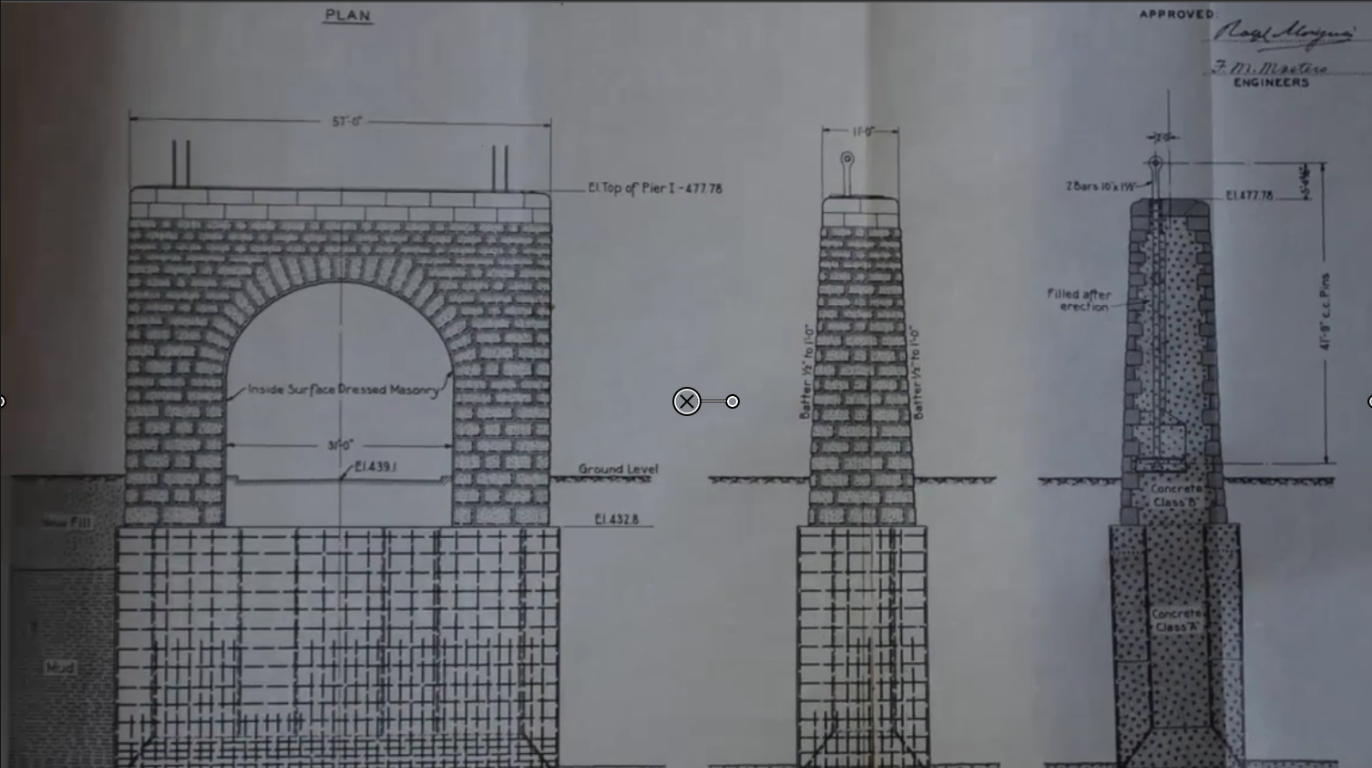
Engineering drawings for the bridge pier caissons depict a solid, reinforced mass concrete foundation extending continuously from bedrock to the pier. Section views show concrete classified by material type and reinforcing steel placed along the inside and outside faces. No permanent voids, chambers, or cavities are shown or permitted in the completed foundation design. The finished caisson is not a hollow structure that could conceal bodies while remaining structurally sound.
What would have happened if workers fell during construction
Even granting the premise that workers fell into a caisson during construction, only limited outcomes are physically possible. Workers or obstructions could be removed prior to final placement. If not removed, any remains would be encased in concrete during placement, eliminating the possibility of an empty space. The scenario implied in the interview requires a stable hollow cavity created by decomposition, a condition incompatible with mass concrete construction.
A human body does not decompose into a clean, durable void inside reinforced concrete. Decomposition leads to collapse and compaction, not a persistent cavity. A void large enough to correspond to even a single body would interrupt compressive load paths, concentrate stress, and produce cracking, settlement, or rotation in the pier. Multiple bodies would multiply these effects. Such distress would occur early under service load, not remain hidden for generations. The continued stability of the bridge contradicts the claim that large voids exist within its caissons.
Appeals to secrecy and silence
The interview repeatedly relies on the idea that the incident was not reported because of the era, lack of labor protections, or indifference to workers. While working conditions in the 1920s were often harsh, this appeal to silence does not resolve the engineering problem. Structural behavior is not influenced by whether an event was reported. If large voids existed in a critical foundation element, the bridge itself would reveal the problem through observable failure or deformation.
The video interview substitutes oral tradition and personal conviction for physical evidence. Engineering drawings show a solid, reinforced mass caisson with no provision for permanent voids. If bodies fell during construction, they would have been removed or encased, not left to form cavities. Decomposition cannot produce stable voids capable of surviving under the compressive loads carried by a bridge pier. The long-term performance of the structure is incompatible with the claim advanced by leaders of William Branham's cult of personality and repeated in the interview with Jack Vissing.