
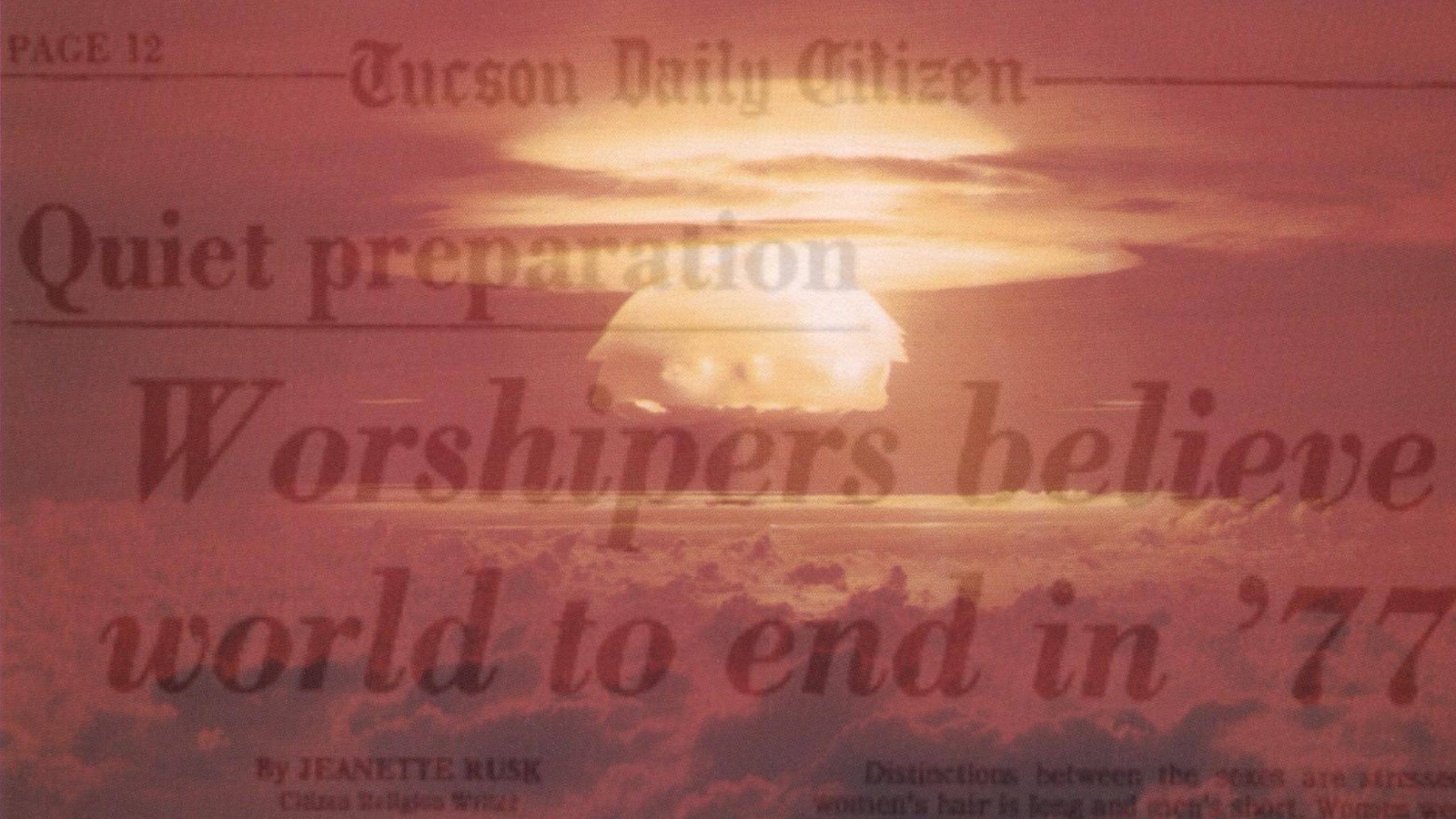
By 1977: Inside William Branham’s Failed End-Time Timeline
William Branham repeatedly linked the year 1977 to a series of visions he claimed were divinely inspired, insisting that nothing was revealed to him beyond that date. After his death, followers and leaders treated this vision boundary as a functional prophecy, shaping belief and behavior until 1977 passed without fulfillment and forced widespread reinterpretation.
William Branham's references to the year 1977 functioned as more than a speculative date within the belief system that developed among his followers. While Branham often used the word "predict" when speaking about 1977, he also rooted the timeline in a claimed series of visions that he said were given by divine inspiration. In his Church Age Book and related sermons, he repeatedly described seven prophetic scenes shown to him, stated that five had already been fulfilled, and emphasized that the vision carried events forward only to a fixed point. According to his own testimony, he could see nothing revealed beyond 1977, which he presented as the termination date of what had been divinely shown to him.[1].
This combination created a functional prophecy regardless of verbal qualifiers. Although Branham occasionally stressed that the exact date was not spoken audibly by God, the assertion that divine revelation itself ended at 1977 conveyed a sense of prophetic finality. For followers, the absence of revealed events beyond that year implied that the age itself must conclude by then. After Branham's death in December 1965, leaders within the Message movement increasingly emphasized this vision-boundary claim, treating 1977 not as a tentative estimate but as the logical and inevitable culmination of Branham's revelations, and publishing literature such as "By 1977" to spread awareness of the date in which the world would end. As a result, expectation of imminent judgment or transition became embedded in Message theology and daily life, shaping belief and behavior in the years leading up to 1977.[2]
Origins of the 1977 prophecy in Branham's early visions and later sermons
William Branham consistently traced the framework for his 1977 expectation back to a series of visions he claimed to have received in the early 1930s. In later sermons, he said these visions were written down and preserved, forming the basis for seven major prophetic scenes that would unfold over the course of the twentieth century. He repeatedly stated that five of those scenes had already occurred, reinforcing his claim that the remaining events were not speculative but were anchored in a previously revealed sequence [3].
Over time, Branham's retellings introduced chronological tension. In some accounts, he attributed the written prophecy to 1931; in others, to 1932 or 1933. Despite these discrepancies, he maintained that the vision itself governed the timeline. When speaking in the early 1960s, he tied the remaining scenes to the period between 1933 and 1977, asserting that the accelerating pace of history aligned with what he had been shown decades earlier. Even when he verbally labeled the date as a "prediction," the narrative consistently presented 1977 as the final horizon of the vision rather than an arbitrary calendar choice [4]. As a result, later listeners were not merely hearing a forecast but were being asked to accept a closed prophetic arc that left no revealed future beyond that point, a structure that would later be formalized and amplified by posthumous publications [5].
Distinction between "prediction" and "THUS SAITH THE LORD" in Branham's own statements
William Branham repeatedly attempted to draw a verbal distinction between what he described as direct divine utterance and what he labeled as personal prediction. In sermons addressing the 1977 timeline, he often paused to clarify that he was "predicting" rather than declaring "THUS SAITH THE LORD," and explicitly stated that the exact year could be off by a margin of years. These disclaimers allowed him to maintain that God had not spoken an infallible calendar date, even while continuing to anchor the expectation in a vision he said was divinely given [6].
At the same time, Branham's explanations blurred that distinction in practice. He insisted that the overall framework came from revelation, that the vision itself governed the sequence of events, and that history was unfolding precisely as he had been shown. By stating that five of the seven scenes had already taken place and that the remaining scenes lay directly ahead, he framed the prediction as the natural outworking of revealed knowledge rather than conjecture. The claim that the vision showed nothing beyond 1977 further reinforced this impression, functioning as an implicit prophetic boundary even when accompanied by verbal hedging [7].
This tension between cautionary language and revelatory framing created ambiguity that later leaders would exploit. While Branham could be quoted denying that God spoke the date audibly, the structure of his narrative conveyed inevitability. For followers, the repeated linkage of divine vision, fulfilled scenes, and a closed horizon at 1977 outweighed the technical distinction between prediction and prophecy, allowing the date to be received and transmitted as authoritative end-time truth [8].
Posthumous promotion of the 1977 prophecy by Message leaders
After William Branham's death in December 1965, responsibility for interpreting and preserving his teachings shifted to a network of ministers, publishers, and organizational leaders who regarded his sermons as the final revelation for the age. Within this environment, the 1977 timetable was increasingly presented not as a tentative forecast but as an authoritative prophetic marker embedded within Branham's visions. Leaders emphasized Branham's statements about fulfilled scenes and the absence of revealed events beyond 1977, while his qualifying remarks about possible error were rarely foregrounded in teaching or literature [9].
This posthumous framing served both theological and institutional purposes. By treating 1977 as the inevitable conclusion of the church age, leaders reinforced obedience to Branham's interpretations as a matter of spiritual survival rather than doctrinal preference. Sermons and printed materials repeated key quotations in isolation, creating a streamlined narrative in which the end-time message culminated decisively in 1977. In doing so, the movement transformed Branham's mixed language of prediction and revelation into a coherent prophetic expectation that demanded urgency and conformity [10].
As the date approached, this promotion intensified. Followers were encouraged to reorder their lives around the belief that time was nearly exhausted, and dissenting interpretations were often framed as evidence of spiritual blindness or compromise. The authority of the prophecy rested less on Branham's precise wording than on the collective insistence of post-1965 leadership that the vision itself could not extend beyond 1977, effectively closing the future and solidifying the date as a non-negotiable endpoint within Message theology [11].
The "By 1977" tract and the codification of a doomsday timetable
The tract titled "By 1977," published by Spoken Word Publications in Jeffersonville, Indiana, played a central role in transforming William Branham's scattered statements into a fixed doomsday narrative. Compiled and circulated after Branham's death, the tract assembled selected quotations from sermons spanning several decades and arranged them to present a coherent prophetic timetable culminating in the year 1977. By isolating statements about fulfilled scenes, impending judgment, and the absence of revealed events beyond that date, the publication gave the impression of a single, unbroken prophecy rather than a collection of evolving remarks .
Editorial choices within the tract significantly shaped interpretation. Discrepancies concerning the origin of the prophecy—whether Branham wrote it in 1931, 1932, or 1933—were not resolved but were instead woven together as complementary testimony. References to later revisions, including Branham's acknowledgment that associates updated earlier material to "bring it up to date," were presented without critical context. The result was a document that minimized internal tension while reinforcing the claim that the original vision remained intact and authoritative, even as its details shifted over time .
Through wide distribution, "By 1977" functioned as an unofficial doctrinal standard. Followers were encouraged to read, share, and use the tract as evidence that Branham's end-time message was nearing completion. In practice, the publication crystallized expectation, turning an interpretive framework into a countdown. By codifying the 1977 endpoint in print, the tract locked the movement into a timetable that would soon collide with historical reality, setting the stage for crisis and reinterpretation after the year passed without fulfillment .