
Campaign Advertisements vs. the Humble Persona: How William Branham Marketed Authority
William Branham publicly denied claiming prophetic status and criticized exaggerated healing promotions, yet his campaign advertisements consistently framed his ministry as prophetic, divinely commissioned, and guaranteed to produce miracles. Examining these advertisements alongside Branham’s own sermons reveals a sustained contradiction between humble rhetoric and aggressive promotional theology rooted in signs and wonders.
William Branham repeatedly framed his public ministry as reluctant and undesirous of exalted titles, insisting that others—not he—applied labels such as "prophet" to him [1][2]. He also criticized the practice of advertising specific healing outcomes, stating that he would rather not have advertisements that promise "The blind will see; the deaf will hear; the dumb will speak," because he did not claim certainty over such outcomes [3]. In addition, he contrasted his own approach with large, long-range publicity campaigns, claiming he did not operate with "great big advertisements for a year ahead of time" and that he had to act only as God directed [4].
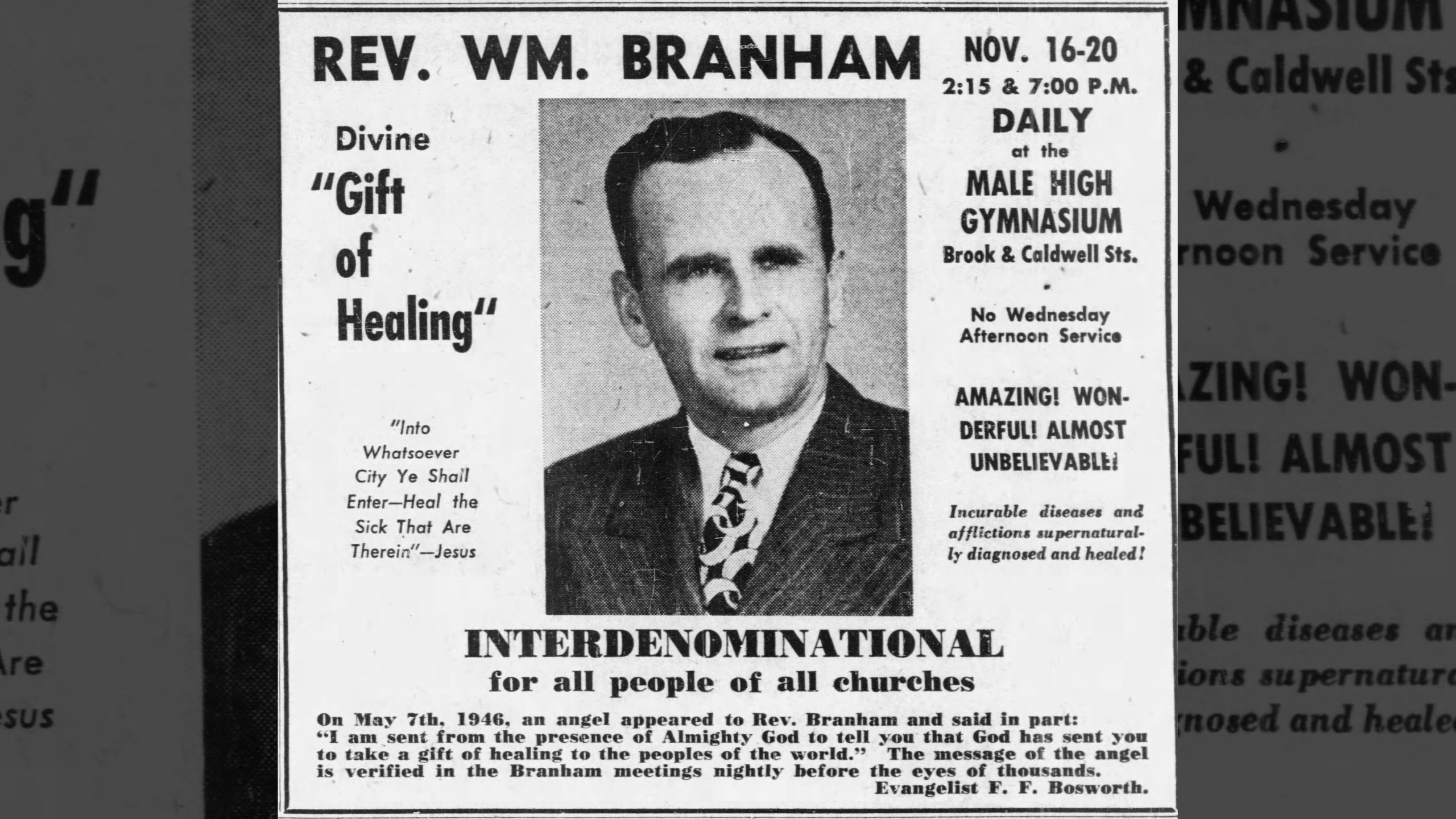
Yet the campaign advertisements used to promote Branham's meetings presented a far more assertive public image. Some promotions urged the public to "COME AND BRING THE SICK," claiming "many wonderful miracles," and leveraging large attendance claims to establish credibility [5]. Other advertisements used categorical miracle language, declaring: "The blind see! The deaf hear! The lame walk! The sick are healed!" and explicitly tied these outcomes to Branham's ministry [6]. Several promotions went further by describing Branham's work as "prophetic" or directly presenting him as a prophet, including the claim that he was "a Prophet Sent by God," and advertising "His Prophetic and Divine Healing Ministry" [7][8]. Additional advertisements grounded the authority claim in an alleged angelic commission and a bestowed "gift of healing," describing supernatural diagnosis and healing of incurable diseases and quoting an angelic message said to have commissioned Branham to bring healing to the world [9][10].
Advertising language of mass miracles, certainty of healing, and spectacle
Campaign advertising for William Branham consistently employed absolute and universal claims about healing outcomes, presenting miracles not as hoped-for possibilities but as expected results of attendance. Promotions declared, without qualification, that "The blind see! The deaf hear! The lame walk! The sick are healed!" and assured audiences that incurable diseases would be supernaturally diagnosed and healed through Branham's ministry [11][12]. Other advertisements reinforced certainty by urging the public to "COME AND BRING THE SICK," framing the meetings as places where healing was not merely prayed for, but reliably delivered [13].
This language functioned rhetorically to remove uncertainty and shift expectation from divine sovereignty to procedural outcome: attend the meeting, submit to prayer, and healing would follow. Attendance figures and spectacle amplified this effect. Advertisements cited crowds in the tens of thousands and emphasized overwhelming results, constructing an atmosphere in which mass participation itself was presented as evidence of divine approval [13][14]. Film promotions extended this spectacle beyond the meetings, offering "actual scenes" of Branham's healing ministry as visual confirmation that miracles were routine and verifiable [15].
In contrast, Branham acknowledged in sermons that such certainty was rhetorically powerful but theologically problematic. He recognized that advertising promised more than could be guaranteed, noting his discomfort with claims that predefined physical outcomes would necessarily occur [16]. Nevertheless, the advertising material continued to use categorical miracle language, indicating that certainty and spectacle were integral to the public-facing construction of the ministry, regardless of later verbal cautions.
I Never Said That I Was A Prophet!
Although William Branham later insisted that he never claimed the title of prophet and that such language originated with others, campaign advertising repeatedly framed his ministry in explicitly prophetic terms [17][18]. Some advertisements directly described Branham as "a Prophet Sent by God," while others promoted audiences' ability to "see" his prophetic ministry through films depicting "actual scenes" of supernatural activity [18][19]. These promotions were not ambiguous endorsements by enthusiastic followers; they were formal newspaper advertisements designed to define Branham's public identity before audiences ever heard him preach.
Some of you, right from this state, wrote me a letter and said, "When the anointing is on you, you can discern spirits." Said, "Then, of course, we, then we believe you're a prophet." (Now, I never said I was a prophet. You said so. See?)
Branham, 60-0607
Here not long ago, a real great minister come to me, and said, "I want to lay hands on you, Brother Branham." Said, "Everybody regards you as a prophet." I said, "I never said I was a prophet." He said, "But the people regard you that.
Branham, 64-0411
In sermons, however, Branham consistently redirected responsibility for the prophetic label away from himself. He stated plainly that he had never said he was a prophet and emphasized that the designation came from letters, ministers, or the general public rather than his own claims [1][2]. This rhetorical move allowed Branham to benefit from prophetic authority while maintaining plausible deniability when confronted with the implications of that authority. The contrast is significant: while spoken disclaimers minimized self-assertion, printed promotions asserted prophetic legitimacy as a central draw for the meetings [17][18].
The use of prophetic framing in advertising functioned as a credentialing mechanism. By positioning Branham as a prophet, the advertisements implicitly demanded trust, obedience, and expectation of supernatural accuracy. Prophetic identity validated miracle claims, angelic visitation narratives, and divine commissioning, all of which reinforced one another in the public imagination [19][20]. This strategy aligned Branham's ministry with biblical prophetic authority while bypassing the biblical tests traditionally applied to prophets.
The tension between denial and promotion created a durable narrative contradiction. Followers could later be told that Branham never claimed prophetic status, even while the historical advertising record shows that prophetic identity was central to how his ministry was marketed and understood. This contradiction became foundational to later defenses of Branham's authority, allowing responsibility for exaggerated claims to be shifted onto followers while preserving the benefits of prophetic status.
Of course, if we'd set it out in great big advertisements for a year ahead of time, and get every church in the country, and, oh, and swear up and down we wouldn't come unless everybody would cooperate, we'd probably start off with eight, ten thousand people or more, fifteen. But I—I can't do mine that way. I just... I have to do just as He tells me. And if He says, "Go down here," there's four or five down here, I just as soon go. I'd rather go to four or five knowing He sent me there, than to go to a hundred thousand knowing that He didn't send me there. See? See? I... My congregations and so forth is not as—as strong or as many as many of the brothers, or who are on the field today. But I don't have—I don't have the advertisements out like the rest of the brothers do. Another thing, I don't have the cooperation as other brothers do, and—because I'm interdenominational; and I have no church to back me up, just the friends of Jesus Christ is all I have.
Branham, 54-0306 The Unconditional Covenant That God Made With His People
Now, oh, sure, we have great get-togethers, "meetings," we call it, worldlied revivals, and so forth, all full of tinsel, sure, great big things, and great advertisement, "The man with the message of the hour, and So-and-so and So-and-so." We have all of that, but where is God?
Branham, 63-1201E Just Once More, Lord