
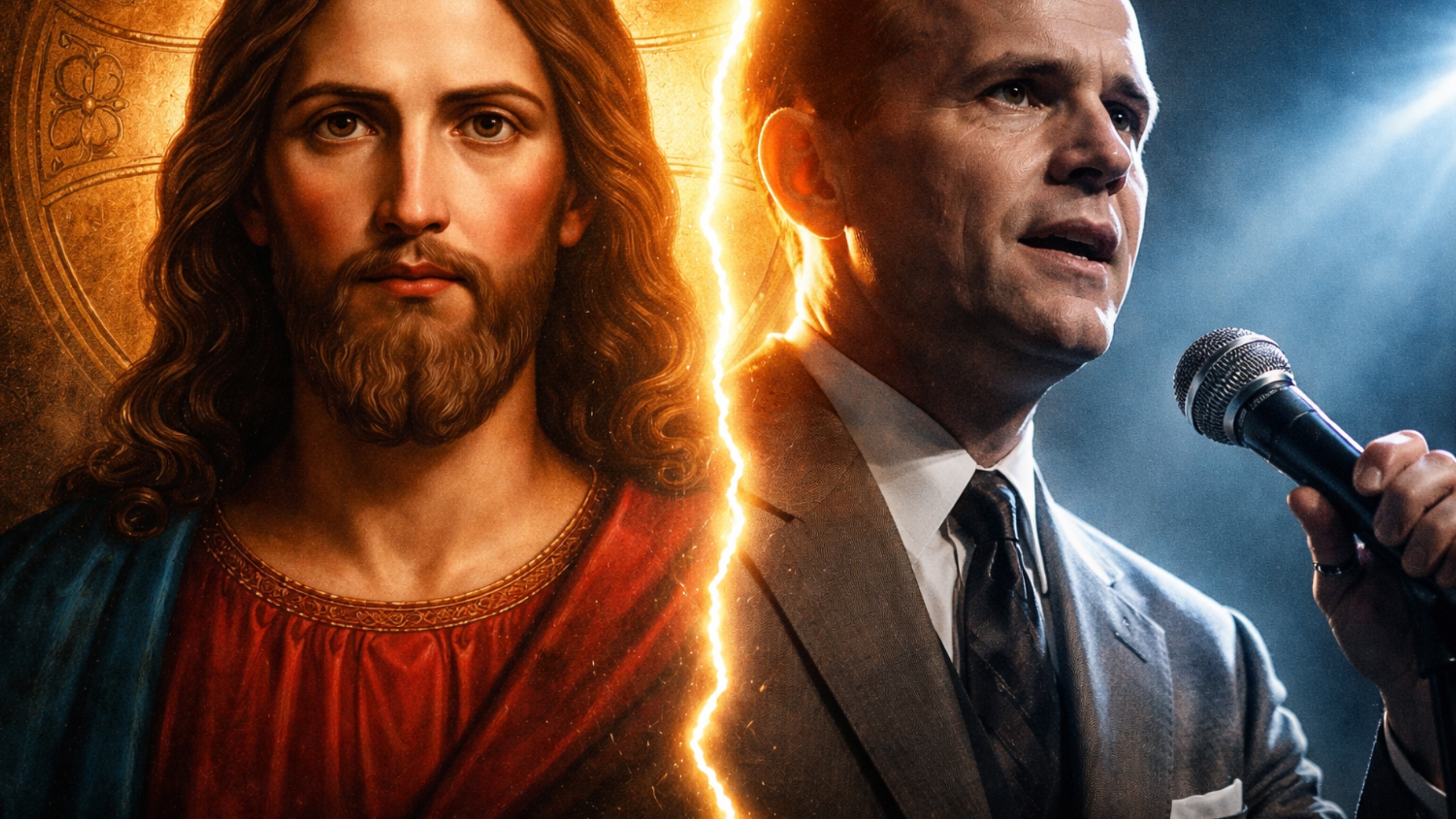
Christ Branham Theology: From Prophetic Language to a Replacement Christ
Christ Branham refers both to a post-Branham movement and to a theology that redefined how Christ was believed to be present in the last days. By examining William Branham’s own sermons alongside later leaders who interpreted his language literally, this study shows how prophetic implication hardened into a system that displaced Jesus Christ with an end-time messenger.
The belief that William Marrion Branham occupied a christological role within certain segments of the Branhamite movement did not arise from a single aberrant statement, nor did it originate exclusively after his death. It developed within a theological environment shaped by Branham’s repeated use of identity-laden language that reframed how Christ was understood to be present and active in the last days. Rather than centering Christological fulfillment solely in the completed work of Jesus Christ, Branham consistently directed attention toward an ongoing revelation of Christ occurring in the present age through a divinely chosen messenger.
But the Elijah of this day is the Lord Jesus Christ. He is to come according to Luke 17:30, the Son of man is to reveal Himself among His people. Not a man, God! But it will come through a prophet.
- William Branham. 1965
In his sermon Christ Is the Mystery of God Revealed, Branham articulated a framework in which God’s self-disclosure unfolds progressively through history, culminating not merely in the incarnation of Jesus, but in the manifestation of Christ within His people in the end time [1]. This formulation subtly displaced incarnation as a singular, finished event and replaced it with a continuing process of manifestation. Within that process, the locus of divine revelation was no longer confined to Scripture’s testimony about Christ, but was bound to the living voice through which God was said to be unveiling the mystery in the present.
This approach allowed Branham to maintain formal distinctions between himself and Jesus Christ while simultaneously presenting his ministry as the decisive vehicle through which Christ was being revealed anew. Followers were conditioned to hear Christological language not as historical proclamation, but as present-tense disclosure. Over time, this produced an interpretive environment in which loyalty to Branham’s message became functionally inseparable from fidelity to Christ Himself.
The emergence of Christ-Branham theology, therefore, cannot be explained simply as the excess of misguided followers. It must be understood as the downstream effect of a doctrinal system in which revelation, manifestation, and authority were relocated from Christ as confessed in Scripture to a contemporary prophetic figure. The sections that follow examine how this system was constructed through Branham’s own sermons, and how later leaders removed the remaining restraints by stating explicitly what Branham’s framework had already made plausible.
William Branham's Use of Loaded Prophetic Language and Insider Meaning
In Is This the Sign of the End, Sir?, William Branham framed end-time expectation around a present, unfolding revelation rather than a completed biblical testimony. He repeatedly emphasized that prophetic fulfillment was occurring "now," and that recognition of this fulfillment depended upon discerning the messenger through whom God was speaking. This approach trained listeners to interpret eschatology not as future hope grounded in Scripture, but as immediate disclosure mediated by a contemporary prophetic voice.
Branham tied this present-tense revelation to Luke 17:30, asserting that the Son of Man would be revealed again in the last days, not through institutional Christianity, but through a divinely vindicated ministry [2]. While he stopped short of explicitly identifying himself as Christ, the structure of his language positioned his ministry as the exclusive site where Christ's end-time revelation could be recognized. To accept the revelation required accepting the messenger; to reject the messenger was to miss the appearing of the Son of Man.
This insider framing created a two-tiered audience. Those outside the Message heard familiar biblical references to signs, visions, and prophecy. Those inside were taught that these references pointed directly to Branham's own experiences and ministry. By repeatedly linking supernatural signs, angelic encounters, and prophetic insight to the fulfillment of Jesus' words, Branham conditioned followers to hear Christological language as coded confirmation of his unique role in redemptive history.
Such language did not merely elevate a prophet; it redefined how Christ Himself was said to be present in the world. Revelation was no longer anchored primarily in Scripture's witness to Christ, but in the living, speaking voice of the messenger who alone could interpret the signs of the time. This insider logic would later allow followers to move from recognizing Branham as the revealer of Christ to identifying him as the locus of Christ's presence.
Elijah, Son of Man, and Melchisedec: Collapsing Roles into a Single Revealer
In Who Is This Melchisedec?, William Branham expanded his identity framework by drawing together Old Testament theophany, priest-king typology, and New Testament Christology into a single revelatory pattern. Melchisedec is presented not merely as a historical figure or a typological shadow, but as a manifestation of God Himself—eternal, without beginning or end, appearing in human form. This framing established a precedent for understanding divine appearances as recurring manifestations rather than unique, unrepeatable events.
Branham then carried this logic forward into the present age. If God could appear as Melchisedec in one era and as Jesus Christ in another, Branham argued, then God could again reveal Himself in a form suited to the last days. Within this scheme, the Son of Man is not confined to first-century Palestine but is revealed wherever God chooses to make Himself known. By presenting Melchisedec as God veiled in flesh and emphasizing that God "never changes His way," Branham supplied theological continuity for the idea of contemporary divine manifestation [3].
This reasoning functioned as a powerful interpretive bridge. Followers trained in this framework were prepared to see end-time revelation not as a return to Scripture's testimony about Christ, but as the reappearance of God Himself in a new form. Although Branham avoided direct self-identification as Melchisedec or Christ, the structure of his argument left little conceptual distance between divine manifestation and prophetic ministry. God reveals Himself in flesh; the flesh changes across ages; revelation follows the messenger.
As a result, the distinction between typology and identity became increasingly fragile. What began as biblical exposition was heard by insiders as present-tense disclosure. Within this interpretive environment, later leaders found it easy to conclude that recognizing God in the last days required recognizing Him in the one through whom He was currently revealing Himself. The Melchisedec teaching thus served not only as theology, but as a conceptual foundation for relocating divine identity into an end-time messenger.
The Anointed Ones and the Problem of False Christs
In The Anointed Ones at the End Time, William Branham addressed Jesus’ warning that false christs and false prophets would arise, performing signs so convincing that even the elect would be deceived. Rather than applying this warning outward toward himself or his own movement, Branham reframed it in a way that reinforced his authority while disarming scrutiny. False christs, he argued, were not individuals claiming to be Jesus by name, but anointed systems and teachers who possessed spiritual power without the true Word.
Within this framework, Branham sharply distinguished between “anointing” and “identity.” He taught that the same anointing could rest on both true and false ministers, but that only one messenger in the age would carry the full revelation of the Word. This allowed Branham to acknowledge widespread supernatural activity while reserving exclusive interpretive authority for himself. The decisive test was not whether a ministry displayed power, but whether it aligned with the revelation given through the prophet of the age [4].
This teaching had a paradoxical effect. By redefining “false christ” away from personal claims of messiahship and toward doctrinal disagreement, Branham effectively removed himself from the category of potential deception. At the same time, he trained followers to identify Christ’s presence with correct alignment to the prophetic message. Christ was no longer primarily known by confession of His person and work as revealed in Scripture, but by recognition of the revealed Word as taught by the end-time messenger.
As a result, the warning about false christs was inverted. Those who questioned Branham’s authority or resisted his interpretations were recast as deceived, while those who affirmed his role were positioned as the true elect. This logic further insulated Branham’s identity framework from critique and prepared the ground for later leaders to assert openly that Christ Himself was present in, or identified with, the prophetic office. What began as a warning against deception thus became a mechanism for consolidating christological authority around a single human figure.
The Role of Prophetic Exclusivity and "One Man" Authority
In The Rapture, William Branham articulated a doctrine of prophetic exclusivity that reinforced the idea that God works through a single, divinely chosen man to accomplish His purposes in each age. Salvation history, in this telling, is not guided by the collective witness of the Church or by the ordinary means of Scripture and teaching, but by the direct intervention of God through a uniquely vindicated messenger. This framework established a hierarchy in which access to truth depended upon alignment with the one through whom revelation was said to flow.
Branham taught that the Bride of Christ would be taken in the rapture not through denominational belief or creedal confession, but through recognition of the revealed Word for the hour. That Word, he insisted, was being delivered through a specific ministry identified by supernatural vindication and prophetic insight. By tying participation in the rapture to acceptance of the messenger, Branham effectively relocated eschatological hope from Christ’s finished work to present obedience to prophetic authority [5].
This emphasis on “one man” authority reshaped the spiritual imagination of Branham’s followers. Christ was no longer encountered primarily through Scripture or the sacraments of the Church, but through the spoken Word as interpreted by the prophet. Disagreement with the messenger was framed not as theological debate, but as evidence of spiritual blindness or rebellion against God’s revealed will. In this environment, prophetic authority absorbed functions traditionally reserved for Christ Himself, including the power to define who belonged to the Bride and who would be left behind.
The cumulative effect of this teaching was to elevate the prophetic office beyond accountability and beyond correction. Once revelation was believed to be centralized in a single individual, ordinary mechanisms of discernment ceased to function. This prepared the ground for later leaders to go beyond Branham’s careful phrasing and assert openly that Christ’s presence and authority were inseparable from the person of the end-time prophet. The rapture doctrine thus became another means by which christological authority was transferred from Jesus Christ to a contemporary human figure.
How Branham’s Language Functioned Differently for Insiders and Outsiders
In Questions and Answers on the Seals, William Branham clarified—and in some cases intensified—the interpretive framework he had introduced in earlier sermons. Presented as informal clarification, these question-and-answer sessions functioned as doctrinal boundary-setting moments in which Branham reinforced insider understanding while dismissing external critique. Questions that challenged his interpretations were routinely reframed as evidence that the questioner lacked revelation rather than as legitimate theological disagreement.
Branham repeatedly emphasized that the mysteries of God were hidden from theologians and denominational Christians and could be understood only by those who had received the revelation of the hour. This created a sharp epistemological divide between insiders and outsiders. To insiders, Branham’s earlier symbolic and typological language was decoded as literal, present-tense reality. To outsiders, the same language remained opaque or appeared exaggerated. The difference was not intelligence or study, but submission to the revealed Word as taught by the prophet [6].
Within this framework, Branham’s statements about the Son of Man, Elijah, and divine manifestation took on heightened significance. Followers were trained to reinterpret past sermons through the lens of progressive revelation, allowing earlier ambiguity to be resolved in favor of stronger identity claims. What Branham had once stated cautiously or indirectly was now explained as truth hidden “between the lines” for those with ears to hear. This retroactive reinterpretation amplified the theological weight of his earlier language without requiring him to restate it explicitly.
The question-and-answer format thus served as a mechanism for doctrinal consolidation. By controlling both the questions and the acceptable answers, Branham positioned himself as the final arbiter of meaning. Christological understanding became inseparable from acceptance of Branham’s interpretive authority. In this environment, followers were primed to accept increasingly elevated views of the prophet’s role, while remaining convinced that they were merely believing what had been present in the message all along.
From Implication to Declaration: How Followers Extended Branham’s Claims
In Trying To Do God A Service Without It Being God’s Will, William Branham articulated one of the clearest examples of the theological pattern that enabled later Christ-Branham declarations. In this sermon, Branham drew together Elijah typology, Son of Man language, and divine manifestation into a tightly compressed statement that distinguished between human instrument and divine identity while simultaneously binding them together. He insisted that the end-time Elijah was not the man himself, but God acting through the man, and then stated that “the Elijah of this day is the Lord Jesus Christ,” revealed as the Son of Man among the people [7].
Although Branham framed this language within prophetic categories and avoided a direct claim of personal deity, the implications were unmistakable to those trained in his interpretive system. If the end-time revelation of Christ occurs through a single prophet, and if that revelation is identified as God Himself rather than merely God’s message, then the prophet becomes the functional locus of Christ’s presence on earth. The distinction between God and the messenger survives only as a technical safeguard, not as a practical boundary.
It was precisely this structure that later leaders and ministers extended beyond Branham’s careful phrasing. Figures such as Rev. Thomas did not introduce new theological concepts; they verbalized the conclusions that Branham’s language already invited. When Thomas and others spoke openly of Branham as God tabernacled in flesh or as the embodiment of Christ for the age, they were not inventing doctrine so much as removing the remaining qualifiers that Branham himself had maintained.
This progression from implication to declaration marks the transition from Branham’s own ministry to explicit Christ-Branham theology. The shift did not require rejecting Branham’s sermons, but affirming them more literally than Branham was willing to state outright. In this way, the deification of Branham among certain followers represents the logical endpoint of a theological framework that had already relocated christological identity into the prophetic office.
Rev. Thomas and the Explicit Christ-Branham Interpretation
By the time figures such as Rev. Thomas articulated their views, the interpretive restraint present in William Branham’s own sermons had largely disappeared. Thomas did not claim to introduce new revelation or doctrine independent of Branham. Instead, he presented his conclusions as the natural and faithful reading of what Branham had already taught. In this sense, Thomas functioned not as an innovator, but as an expositor who stated openly what he believed Branham had meant.
According to Thomas, Branham was not merely a prophet through whom Christ spoke, but the embodiment of Christ’s presence for the age. Where Branham consistently spoke in prophetic and typological language—distinguishing between God and the man while binding them together—Thomas removed the remaining ambiguity. He interpreted Branham’s Elijah and Son of Man statements to mean that Christ Himself had returned in the person of William Branham, not symbolically or representationally, but ontologically. This marked a decisive shift from implication to declaration.
It is important to note that Thomas’s claims cannot be treated as quotations from Branham. Rather, they represent an interpretive move grounded in Branham’s own language. When Thomas asserted that Branham was God tabernacled in flesh, he was drawing a straight line from Branham’s repeated insistence that the end-time Elijah was “not a man, but God” and that this revelation occurred through a single, divinely chosen prophet. Thomas interpreted what Branham said to mean that the prophetic office and divine identity had fully converged in Branham himself.
This section of the movement demonstrates how Christ-Branham theology became explicit. What Branham framed in guarded, prophetic terms was restated by his successors as direct christological identity. The transition did not require altering Branham’s sermons; it required only interpreting them without the protective qualifiers Branham retained. In doing so, Thomas and others transformed Branham’s functional elevation into overt deification, establishing a splinter theology that openly displaced Jesus Christ with an end-time prophet.
Other Branhamite Leaders and the Normalization of Deity Language
Following William Branham’s death, the interpretive moves exemplified by Rev. Thomas were not isolated. Similar conclusions appeared across segments of the Branhamite movement, expressed by ministers, editors, and teachers who framed their claims as faithful continuity rather than doctrinal innovation. Over time, language that once appeared shocking or fringe—identifying Branham as God tabernacled in flesh or as the return of Christ—became normalized within certain circles through repetition and institutional reinforcement.
This normalization was achieved largely by reusing Branham’s own terminology while subtly altering its referent. Phrases such as “the Word made flesh,” “Christ revealed,” and “God among us” were no longer treated as prophetic metaphors requiring careful distinction, but as literal descriptors of Branham’s person. Leaders appealed to Branham’s sermons on manifestation, Elijah, and the Son of Man as justification, even when their conclusions exceeded Branham’s explicit statements. In this way, Branham’s authority was used to authorize claims he himself had never plainly articulated.
Crucially, dissent was reframed as spiritual blindness rather than theological disagreement. Those who objected that such language displaced Jesus Christ were accused of rejecting revelation or clinging to denominational tradition. This rhetorical strategy insulated the movement from correction and allowed increasingly explicit deity language to circulate without challenge. The question was no longer whether Branham should be identified with Christ, but whether one possessed sufficient revelation to recognize that identification.
As these interpretations spread, they produced a doctrinal environment in which Christ-Branham belief could be presented as the logical and faithful outcome of Branham’s message. What began as guarded prophetic implication hardened into doctrinal assertion. The effect was the gradual replacement of Christ as confessed in Scripture with a prophet-centered christology, maintained not by new revelation, but by the reinterpretation and absolutization of Branham’s own words.