
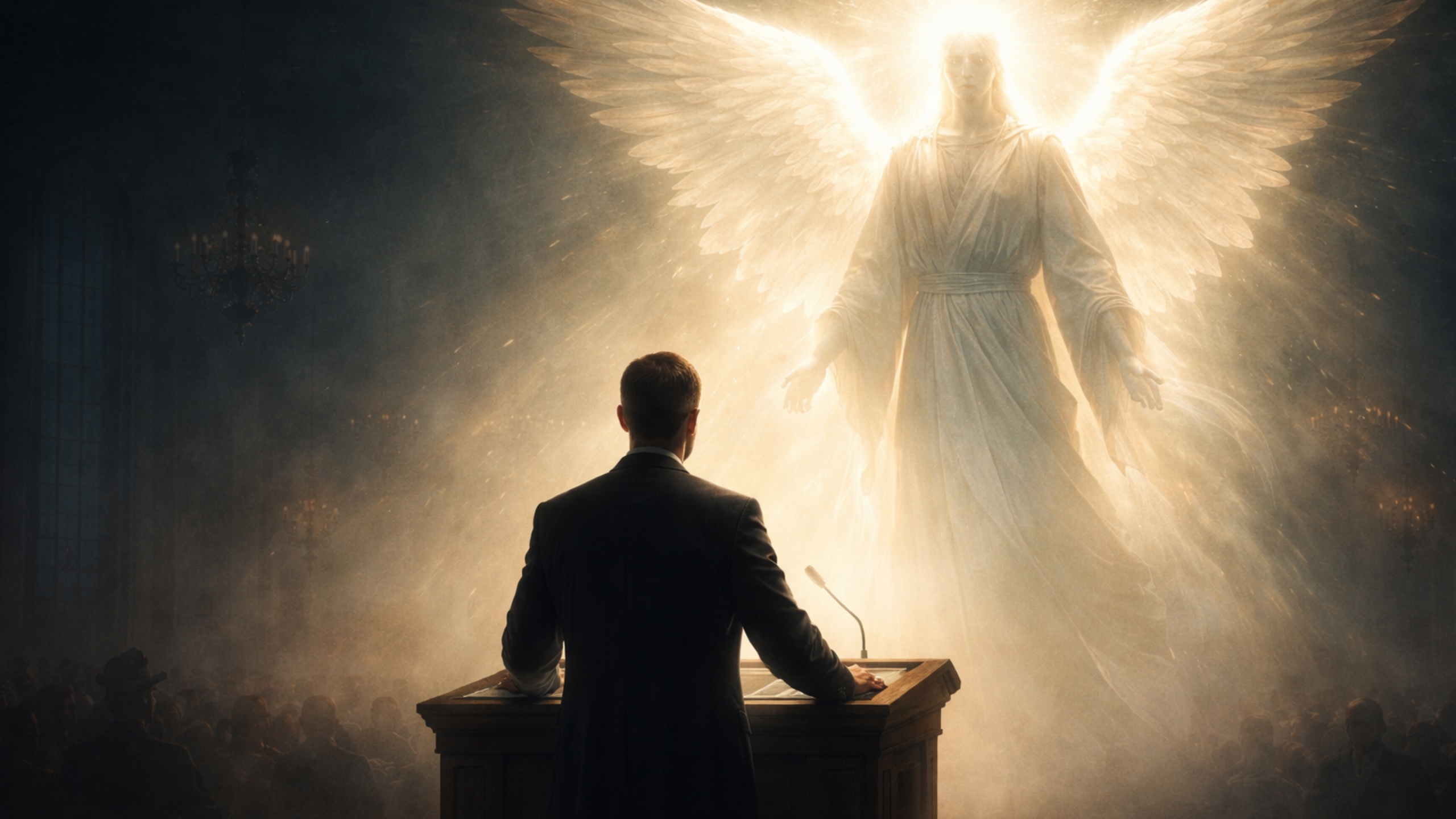
When Angels Replace Christ: Branham’s Most Dangerous Doctrine
William Branham repeatedly taught that Christ was an angel—specifically Michael the Archangel—and structured his ministry around an angelic commission that functioned as a source of authority and validation. This examination traces how Branham’s angel-centered theology departed from historic Christian doctrine, blurred the distinction between Christ and created beings, and reshaped worship, revelation, and authority in ways incompatible with biblical Christianity.
William Branham's teachings on angels represent a marked departure from historic Christian Christology, particularly in how he redefined the identity and function of Christ in relation to angelic beings. While orthodox Christianity distinguishes clearly between the Son of God and created angels, Branham repeatedly blurred or collapsed that distinction, presenting Christ as an angelic being and elevating angelic mediation to a central theological role. This departure is significant because it reorients worship, authority, and revelation away from the incarnate Son toward angelic figures and experiences.
In several sermons, Branham explicitly identified Christ with Michael the Archangel, asserting that Michael was Christ and that Christ functioned primarily as an angelic warrior rather than as the eternal Son enthroned as God. In doing so, Branham contradicted the explicit teaching of Hebrews 1, which emphasizes that the Son is categorically distinct from angels and is addressed by the Father as God, possessing an eternal throne. By redefining Christ as an angel, Branham undermined the doctrinal foundation of Christ's deity and eternal sonship while retaining Christian terminology that obscured the shift for his audience [1].
Alongside this redefinition of Christ, Branham framed his own ministry as operating under direct angelic authority. He regularly recounted encounters with an "Angel of God" who commissioned him, instructed him, and remained present during healing services. These narratives portrayed the angel not merely as a messenger but as an ongoing validating authority whose words were treated as divinely binding. Branham's prayers frequently addressed the angel directly, affirming belief in the angel's presence and faithfulness, and attributing the success of his ministry to the angel's confirmation through signs and wonders [2].
Branham also reinterpreted biblical theophanies through an angel-centered lens. In his exposition of Genesis 18, he identified the visitor who spoke with Abraham and discerned Sarah's thoughts as an angel whom he explicitly named as Christ. While historic theology understands such passages either as a theophany or as a pre-incarnate appearance of the Son without collapsing Him into the category of angels, Branham instead treated Christ as an angelic being who possessed supernatural insight and authority. This reinterpretation reinforced his broader framework in which angels functioned as mediators of divine knowledge and power, blurring the line between Creator and created beings [3].
Taken together, these teachings reveal a coherent but theologically aberrant system in which angels occupy roles traditionally reserved for Christ alone. By redefining Christ as an angel, centering revelation on angelic encounters, and modeling his own authority after an angelic commission, Branham departed from historic Christian doctrine and laid the groundwork for practices that closely resemble angel veneration rather than Christ-centered worship.
Christ as an Angel: Michael the Archangel and the Denial of the Son's Eternal Throne
A central pillar of Branham's angel theology was his repeated claim that Christ was identical with Michael the Archangel. This assertion was not presented as a speculative idea but as an authoritative doctrinal conclusion that reshaped how listeners understood the person of Christ. By identifying Christ as Michael, Branham placed Jesus within the category of angelic beings rather than affirming Him as the eternally begotten Son who stands categorically above angels.
Branham explicitly taught that Michael was Christ and described Him as the one who fought angelic wars in heaven against Satan. In this framework, Christ's identity was primarily that of a heavenly warrior angel rather than the Son addressed by the Father as God. This teaching directly conflicts with the New Testament distinction between Christ and angels, where angels are described as ministering spirits and Christ is described as the eternal ruler whose throne endures forever. By collapsing this distinction, Branham effectively denied the Son's unique status and eternal throne, replacing it with an angelic office and function [4].
This redefinition had cascading theological consequences. If Christ is an angel, then His authority becomes derivative rather than intrinsic, and His role is reduced to that of a created mediator rather than the uncreated Word through whom all things were made. Branham's language often attempted to preserve reverence for Christ while subtly shifting the category in which Christ belonged. The result was a theology that sounded exalted but undermined core Christian affirmations about Christ's nature, worship, and supremacy.
Branham's angel-Christ identification also created internal inconsistency within his own teaching. In some sermons, he affirmed Christ as Elohim or Jehovah, while in others he spoke of Christ as Michael, an angel engaged in cosmic battles. Rather than resolving this tension, Branham treated the terms as interchangeable, demonstrating a lack of doctrinal clarity regarding the difference between God and His messengers. This ambiguity allowed listeners to affirm traditional language while absorbing a fundamentally different Christology centered on angelic identity and function.
By redefining Christ as Michael the Archangel, Branham departed from historic Christian teaching and aligned himself with earlier heterodox movements that reduced Christ to a high-ranking angelic being. This move not only distorted the biblical witness concerning Christ but also normalized angel-centered categories of authority and revelation that would shape the broader structure of Branham's theology.
The Angel of the Lord and Branham’s Reinterpretation of Genesis 18
Branham frequently appealed to Genesis 18 to support his angel-centered Christology, using the encounter between Abraham and the divine visitors to reinforce his claim that Christ functioned as an angel. In Branham’s retelling, the figure who spoke with Abraham and discerned Sarah’s private thoughts was explicitly identified as an angel, whom Branham then equated directly with Christ. This interpretation was presented as proof that Christ historically appeared and operated as an angelic being prior to the incarnation.
Branham emphasized the supernatural knowledge displayed in the narrative, highlighting that the visitor discerned Sarah’s laughter while she remained inside the tent with His back turned. Rather than treating this moment as evidence of divine omniscience consistent with God’s self-revelation, Branham framed it as a demonstration of angelic telepathy. He then argued that this angel was Christ Himself, asserting that Abraham recognized the figure as Elohim, Jehovah, the Almighty, and the Logos. By doing so, Branham collapsed categories that historic theology carefully distinguishes, equating God, Christ, and angelic beings into a single interchangeable identity [5].
This reinterpretation represents a significant theological shift. In orthodox Christian theology, Genesis 18 has been understood either as a theophany or as a pre-incarnate appearance of the Son, without reducing Christ to the category of an angel. Branham’s version, however, recasts the encounter as an explicitly angelic manifestation, reinforcing his broader claim that Christ was an angel who temporarily appeared in human form. This move allows Branham to maintain biblical language while altering its theological meaning.
By presenting Christ as an angel in Genesis 18, Branham further normalized angelic mediation as the primary means by which God reveals Himself. The authority attributed to Christ in the passage is subtly transferred to angelic function rather than divine identity. This framing laid important groundwork for Branham’s later emphasis on angelic revelation in his own ministry, positioning angelic beings as legitimate bearers of divine authority, insight, and power.
Branham’s treatment of Genesis 18 thus illustrates how his angel theology was not limited to isolated statements but was woven into his broader interpretive framework. Scripture was consistently re-read through an angel-centered lens, reshaping foundational biblical narratives to support a Christology that departed from historic Christian doctrine and elevated angels into roles traditionally reserved for God alone.
The Angelic Commission Narrative and Its Role in Branham’s Stage Persona
Central to Branham’s public ministry was the recurring narrative of an angelic commission that he claimed marked the beginning and ongoing validation of his healing work. According to Branham, an “Angel of God” appeared to him in a room, delivered a divine mandate, and promised supernatural results if the people would believe. This encounter was not treated as a private visionary experience but as an authoritative commissioning event that defined his identity, message, and authority before his audiences.
Branham repeatedly recounted that the angel told him he had been born into the world to take a gift of divine healing to the people, assuring him that even cancer would not stand before prayer if sincerity and belief were present. In public prayers and sermons, Branham addressed the angel directly, affirming his belief that the angel was standing nearby and continuing to assist him in ministry. The angel’s words were treated as divinely binding promises, and Branham explicitly stated that he had taken the angel at his word because the angel claimed to be sent from God [6].
This angelic figure functioned as more than a messenger. In Branham’s presentation, the angel became an ongoing validating authority whose presence explained the supernatural phenomena reported in his meetings. Healings, discernment, and signs were attributed not simply to God’s sovereign action but to the faithfulness of the angel in confirming the commission. By framing his ministry this way, Branham embedded angelic mediation into the structure of his public persona, making the angel an essential component of how his authority was perceived and sustained.
The theological implications of this narrative are significant. By centering his ministry on an angelic commission, Branham effectively displaced Christ as the sole mediator of divine authority and revelation. The angel’s message, presence, and confirmation took on a functional role that paralleled or even overshadowed Christ’s mediatorial work. This dynamic encouraged audiences to associate spiritual power and legitimacy with angelic encounters rather than with the finished work and ongoing lordship of Christ.
Over time, the angelic commission narrative became inseparable from Branham’s identity as a prophet-healer. It provided a supernatural origin story, justified extraordinary claims, and insulated his authority from scrutiny by framing disagreement as resistance to a divine messenger. In this way, the angel was not merely part of Branham’s theology but a foundational element of his stage persona and movement.