
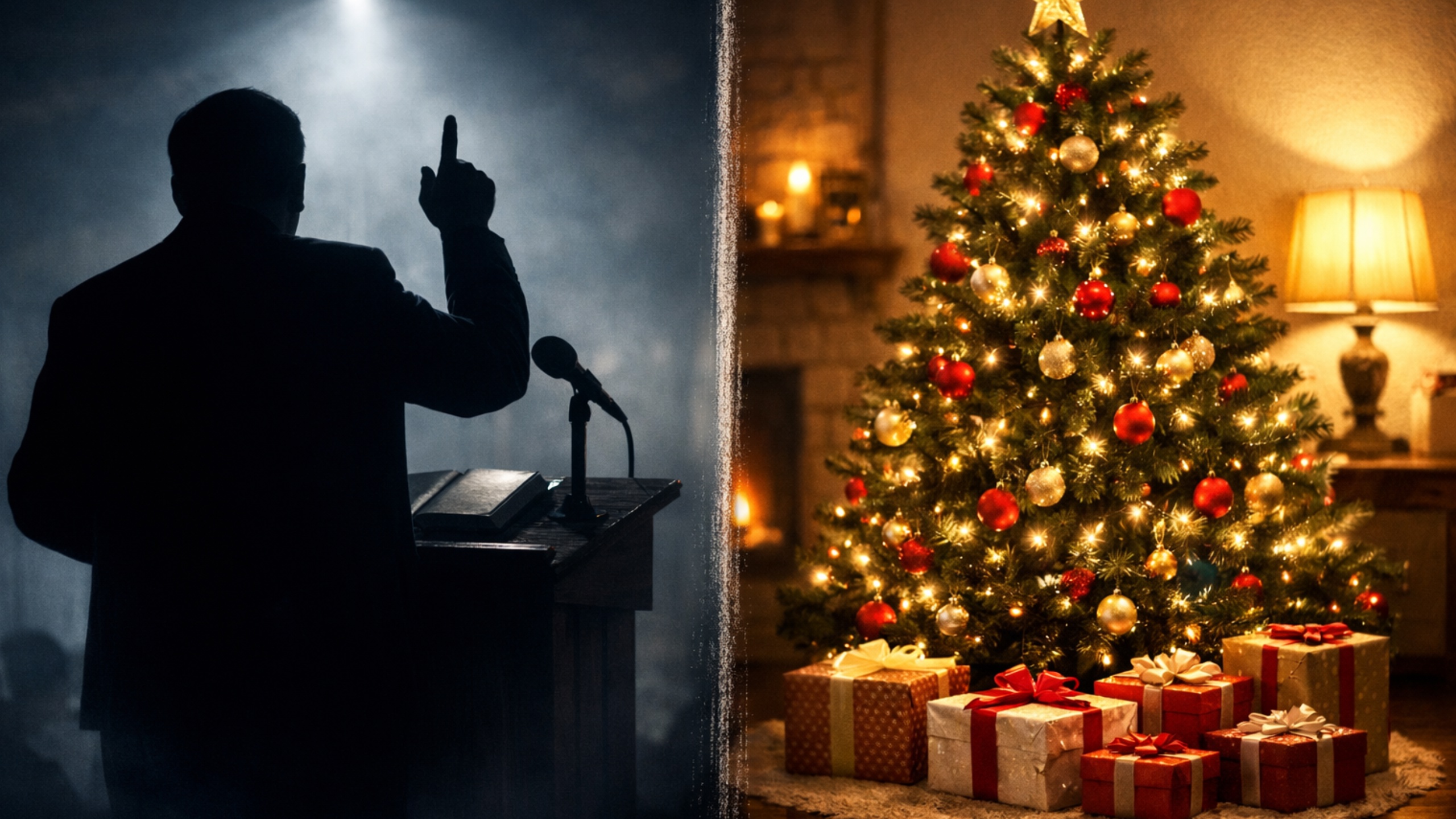
Christmas Tree Doctrine: Legalism for Followers, Exceptions for Himself
William Branham publicly condemned Christmas trees and celebrations as pagan idolatry deserving judgment, using fear of punishment to define who counted as a true believer. Yet his own sermons acknowledge a Christmas tree and gifts in his home, revealing a double standard that exposes how legalism functioned as a tool of control rather than consistent theology.
William Branham repeatedly denounced Christmas celebrations, especially the use of Christmas trees, portraying them as pagan practices incompatible with true Christianity. In his preaching, Christmas decorations were framed not as harmless cultural customs but as direct participation in heathen worship, which he associated with Roman paganism. Branham asserted that Christians who decorated trees or participated in Christmas traditions were unknowingly aligning themselves with idolatry and compromising their faith [1]. This teaching functioned as a clear behavioral prohibition, placing Christmas observance outside the bounds of what he defined as authentic Christian obedience. However, his family was exempt from this doctrine.
And then I want to take this time to express, to each and every one of you, how grateful I am to you, for your Christmas cards and gifts, and things that was received at our house. I certainly thank you, with all my heart. It certainly did us good, this morning. When...I got a little boy, small enough yet to kind of want a Christmas tree, and we had it in the room.
- William Branham, 1960
Branham further intensified this condemnation by portraying Christmas observance as evidence of spiritual deception within the broader Christian church. He depicted participation in Christmas traditions as proof that believers had accepted pagan dogma in place of Scripture, accusing them of adopting practices rooted in sun-god worship rather than honoring Christ [2]. By framing Christmas trees and related customs as “heathenism,” Branham positioned himself as a corrective voice against what he portrayed as widespread apostasy, reinforcing his role as a uniquely authoritative interpreter of Christian truth.
Paganism Claims and Historical Errors in Branham’s Christmas Teaching
Central to Branham’s rejection of Christmas was his claim that Christian observance of December 25 and the use of Christmas trees originated in pagan sun worship. He asserted that Christmas marked the birthday of the Roman sun-god and that decorating trees amounted to participation in idolatry. In this framework, Branham taught that Christians who embraced Christmas traditions were unknowingly venerating pagan deities rather than honoring Christ, placing them outside what he defined as true biblical faith [3].
These claims, however, rest on demonstrable historical errors. In Roman religion, Jupiter was not the sun god but the chief deity associated with the sky and thunder, while the sun was personified by Sol. By conflating Jupiter with solar worship, Branham presented a distorted account of Roman mythology that served his polemical purposes rather than historical accuracy [4]. This misuse of historical material allowed him to portray Christmas observance as spiritually dangerous while bypassing the complexity of early Christian history and the development of liturgical calendars. The result was a rigid theological narrative in which disagreement with his interpretation was equated with complicity in paganism.
Threats of Judgment and the Use of Christmas as a Boundary Marker
Branham did not frame Christmas merely as a theological error but as a moral test carrying eternal consequences. He warned that Christmas decorations, gift-giving, and what he called “Christmas tinsel” would be destroyed by unquenchable fire, and that those who tolerated or participated in such practices would perish along with the world. In his preaching, Christmas observance became a visible marker separating those he identified as true followers of Christ from those he labeled worldly and condemned to judgment [5]. This rhetoric elevated a non-essential cultural practice into a matter of salvation.
By attaching threats of divine punishment to Christmas participation, Branham transformed personal conscience issues into enforceable boundaries of loyalty. Followers were taught that rejecting Christmas traditions demonstrated obedience and spiritual insight, while participation signaled rebellion and spiritual blindness. This framing discouraged independent evaluation of his claims and fostered fear-based compliance, as disagreement was no longer treated as theological diversity but as evidence of impending damnation [6]. In this way, Christmas functioned as a control mechanism, reinforcing conformity and deepening dependence on Branham’s authority for defining acceptable Christian behavior.
Private Practice: Christmas Celebrations in the Branham Home
Despite Branham’s uncompromising public denunciations of Christmas celebrations, his private behavior did not consistently align with the standards he imposed on his followers. In a Christmas Day sermon delivered in 1960, Branham openly thanked members of his church and supporters for Christmas cards and gifts sent to his home. He described the presence of a Christmas tree in his living space, explaining that his young son desired one and that gifts from church members and friends were found beneath it on Christmas morning [7]. This admission directly contradicts his later claims that Christmas trees and gift-giving constituted pagan worship and spiritual compromise.
This contrast between public teaching and private practice reveals a significant double standard. While followers were warned that participation in Christmas traditions would result in judgment and destruction, Branham permitted and participated in the very practices he condemned when they occurred within his own household. Such inconsistency undermines the theological certainty with which these prohibitions were proclaimed and suggests that the rules functioned less as universally binding moral truths and more as tools for regulating the behavior of adherents [8]. For followers, this discrepancy was largely inaccessible, as his private actions were not emphasized within the movement, allowing the public narrative of strict holiness to remain intact.
Double Standards and the Function of Legalism in Cult Control
The contradiction between Branham’s public condemnation of Christmas and his private participation in it illustrates how legalism functioned as a mechanism of control rather than a consistently applied moral framework. Christmas observance was elevated to a test of obedience for followers, while exceptions were quietly made for Branham himself. This asymmetry reinforced a hierarchy in which the leader stood above the rules imposed on others, exempt from the consequences he warned would befall ordinary believers [9]. Such double standards are a common feature in high-control religious movements, where rules exist primarily to regulate adherents rather than leaders.
By framing Christmas participation as evidence of spiritual rebellion and impending judgment, Branham created an environment in which compliance signaled loyalty and dissent carried existential risk. Followers were conditioned to suppress personal conscience and historical inquiry in favor of obedience to his pronouncements. Meanwhile, his private inconsistency remained largely obscured, preserving the image of prophetic authority. In this context, legalistic teachings about Christmas did not merely shape religious practice; they reinforced dependency, fear, and conformity, functioning as a tool of cult control rather than genuine theological conviction [10].