
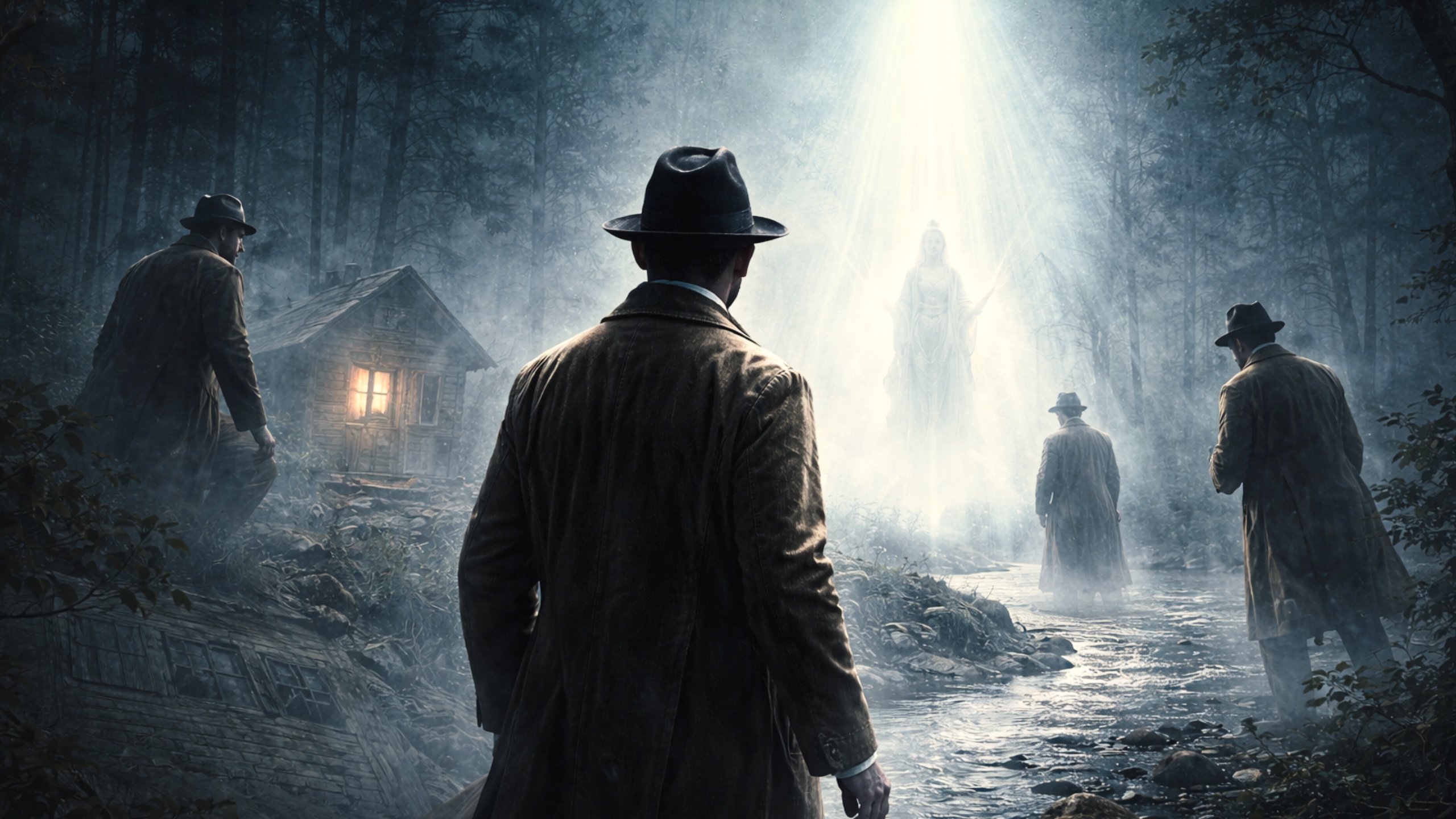
William Branham’s Commission Claims: A Timeline That Cannot Stand
William Branham claimed to have been divinely commissioned multiple times across his life, yet his own testimony assigns incompatible dates, locations, ages, witnesses, and purposes to these events. When examined collectively, these claims cannot be substantiated and reveal a pattern of retroactive reinterpretation rather than a coherent or credible commissioning event.
William Branham used the term “commission” to describe what he claimed were supernatural authorizations received from an angel or divine being, most often connected to healing, prophetic insight, or a global mandate. Over time, this terminology expanded beyond a single event into a layered narrative involving multiple encounters, shifting dates, and escalating claims. Rather than presenting one stable commissioning moment, Branham repeatedly described being commissioned before birth, at birth, in childhood, in early adulthood, and again during his public ministry years, often retroactively redefining earlier experiences as formal commissions. This accumulation of claims created a moving framework in which earlier statements were not corrected or withdrawn but instead absorbed into an ever-growing narrative of divine authorization.
Peter Duyzer documents that Branham explicitly claimed commissions while still in his mother’s womb, at birth, and again at age seven, yet these early claims cannot be substantiated from Branham’s own recorded sermons or consistent testimony [1]. The absence of corroboration is significant because Branham later treated these alleged early commissions as foundational proof that his later ministry was divinely ordained rather than situational or gradual. Duyzer further shows that Branham’s later public accounts repeatedly redefined what constituted a “commission,” allowing healings, visions, and personal impressions to be retrospectively framed as formal divine mandates.
Compounding the problem, Branham used the same commissioning language to refer to multiple, mutually exclusive events across different decades. His claims include commissions dated to the early 1930s, the mid-1940s, the late 1940s, and even into the 1950s and 1960s, often tying these claims to different locations and purposes. As summarized in a compiled list of Branham’s own assertions, these alleged commissions span from before his birth through at least 1963, including contradictory dates such as 1930, 1931, 1932, 1933, 1936, 1944, May 6, 1946, May 7, 1946, May 6, 1947, and later encounters in Houston and Arizona [2]. This proliferation of dates and meanings demonstrates that “commission” functioned less as a defined historical event and more as a flexible label applied whenever Branham sought to reinforce authority or reinterpret past experiences.
Early Claims of Prenatal, Birth, and Childhood Commissions
Branham framed some of the earliest "commission" claims as proof that his authority did not develop over time but was divinely initiated before he could make choices, receive training, or even understand Christianity. Branham treated the prophetic "called from the womb" motif as a template for self-interpretation, claiming a prenatal commission "by a vision" while still in his mother's womb [3]. Branham's understanding of his earliest life was filtered through what Duyzer describes as unreliable sources [3]. The practical problem is obvious: a prenatal "commission" cannot be independently observed, and within Branham's later storytelling it functions primarily as a rhetorical foundation stone rather than a verifiable event.
The birth-commission variant operates similarly. Branham told audiences that a supernatural light entered the cabin where he was born, casting the experience as a sign that his life and ministry were marked out from the beginning [5]. In this retelling, the light is presented not as a later interpretation but as an objective visitation "over the bed" on the day of birth, followed by later childhood recollections of the same presence speaking to him [5]. This narrative is important because it makes later commissions feel like continuity rather than escalation: if the light was present at birth, later angelic encounters can be presented as expected developments rather than new claims.
The childhood commission stories then push the logic further by implying early, direct interaction with an angelic being. Branham described an encounter with a tree, later interpreting it as an angelic presence he would eventually meet "face to face" [6]. The accounts cannot be substantiated by Branham's own messages; they fail even by the internal standard of consistency and traceability within Branham's sermon record [4]. This matters because these early commissions are not peripheral in Branham's system; they are presented as the earliest warrants for why later audiences should treat his later "commission" claims as inevitable and authoritative rather than contingent and expanding.
The Ohio River Commission Narratives and Date Conflicts
Among Branham’s commission claims, the Ohio River baptism event occupies a central and recurring role. Branham repeatedly described this event as the moment when an angelic being formally commissioned him, yet his own accounts assign incompatible dates, ages, circumstances, and even meanings to the same episode. Branham variously placed this Ohio River commission in 1929, 1930, 1931, 1932, 1933, 1936, and even 1939, sometimes within the same year or sermon cycle [7]. These shifting dates are not minor discrepancies but mutually exclusive claims that cannot all be true.
In some sermons, Branham stated that the Ohio River commission occurred when he was “about twenty-one years old,” which would place the event around 1929 or 1930 depending on the birth year he was using at the time [8]. In other accounts, he specified June 15, June 16, or June 18 of 1933, often emphasizing the heat, drought conditions, and the time of day as proof of vivid recollection [9]. Elsewhere, Branham asserted that the same commission occurred years after his marriage, assigning it to 1936 or even June 1939, dates that are impossible given established biographical facts [7]. These contradictions are compounded by Branham’s tendency to assert confidence in each version without acknowledging or reconciling prior statements.
Branham frequently embellished the Ohio River story with additional supernatural elements over time. Later retellings include claims that a visible light descended from the sky, that thousands of witnesses saw it, and that newspapers reported the phenomenon, while earlier accounts lack these details [10]. Rather than stabilizing the narrative, repetition appears to have amplified variation. Repeated retelling of a claim does not increase its reliability when the repetition itself preserves error [11]. The Ohio River commission thus becomes a case study in how Branham’s commissioning narrative evolved, fractured, and expanded, undermining its credibility even on Branham’s own terms.
Green’s Mill / Cabin Visitations and Their Relationship to Commission Claims
In addition to the Ohio River narratives, Branham repeatedly identified a series of encounters at Green’s Mill and in isolated cabins as formal commissioning moments. These accounts are significant because Branham often described them as clearer, more personal, and more authoritative than earlier experiences, even while continuing to affirm earlier commissions. Duyzer documents that Branham portrayed these encounters as face-to-face meetings with a supernatural being who explicitly instructed him to pray for the sick, promised miraculous results, and guaranteed global impact [12]. Unlike the Ohio River accounts, which involved crowds and public ritual, the Green’s Mill narratives emphasize solitude, secrecy, and direct instruction.
A key feature of these stories is Branham’s insistence that the Green’s Mill visitation was not a vision but a literal encounter with a man-like being. He repeatedly stressed that he heard footsteps, saw physical features, and engaged in extended dialogue, distinguishing these events from trances or impressions [13]. This distinction allowed Branham to elevate the authority of these commissions above earlier claims by presenting them as objective encounters rather than subjective experiences. At the same time, Branham varied the dating of these events, placing them before his healing campaigns, during his early ministry, or years later depending on the sermonic context.
Duyzer shows that the Green’s Mill commission claims introduce further contradictions. Branham sometimes described this encounter as the first time the angel appeared in human form, while elsewhere claiming that similar encounters occurred earlier in his life [14]. He also alternated between presenting the commission as a single decisive event and describing multiple visits in which instructions were clarified, expanded, or reinforced. This fluidity allowed Branham to retrofit later doctrinal developments, such as discernment of thoughts and prophetic insight, into earlier commissioning narratives.
The cumulative effect is that Green’s Mill functions not as a fixed historical moment but as a narrative anchor repeatedly reshaped to support evolving claims of authority. Duyzer concludes that these cabin-based commissions cannot be reconciled into a coherent timeline without dismissing multiple first-person statements made by Branham himself [15]. Rather than resolving earlier inconsistencies, the Green’s Mill narratives compound them by adding additional commissioning moments that overlap, contradict, and redefine prior claims.
Post-1946 Retroactive Dating and the Israel Nation Correlation
After 1946, Branham increasingly reinterpreted earlier experiences as formal commissions by anchoring them to global events, most notably the establishment of the State of Israel. In multiple sermons, he asserted that Israel was declared a nation on May 6, 1946, and that his angelic commission occurred the very next day, May 7, 1946, presenting this alignment as divinely orchestrated confirmation of his ministry [16]. This claim is historically incorrect, as Israel declared independence on May 14, 1948, and the United States recognized the new nation the same day. Nevertheless, Branham treated the alleged 1946 Israel declaration as a prophetic sign validating his commission.
This retroactive dating created a new layer of contradiction because it conflicted with earlier commission claims already placed in the early 1930s and mid-1940s. Rather than replacing those earlier claims, the 1946 narrative was added alongside them, producing overlapping commissions with different purposes and scopes. In some retellings, the 1946 encounter marked the beginning of Branham’s healing ministry; in others, it was described as an upgrade or clarification of an already-existing commission [17]. The effect was to transform commissioning from a single authorization into a recurring process that could be redefined whenever a new theological or historical connection seemed useful.
The Israel correlation also reveals a methodological problem in Branham’s storytelling. The date alignment was not drawn from contemporary records but asserted decades later, after Israel’s formation had become theologically symbolic in Pentecostal and prophetic circles. By backdating both the national event and his own experience, Branham created an appearance of prophetic symmetry that collapses under basic historical scrutiny [18]. This pattern demonstrates that later commission claims were shaped as much by retrospective theological framing as by lived experience.
As a result, the post-1946 commission narratives do not resolve earlier inconsistencies but magnify them. The same authority is claimed to originate in incompatible decades, tied to historically false premises, and presented without acknowledgment of prior conflicting statements. The cumulative record shows a pattern of retroactive reinterpretation rather than a stable, traceable commissioning event.
Mutually Exclusive Dates, Ages, and Locations Across Sermons
As Branham’s ministry progressed, the number of commissioning claims multiplied rather than converged. Across sermons preached over several decades, he attached the same commissioning authority to different ages, locations, and circumstances in ways that cannot be reconciled. At various times, he claimed to have been commissioned as a teenager, as a young married man, as a father, and again as a mature minister already engaged in healing campaigns. These claims were not framed as symbolic or developmental but as literal, historical events, each presented with confidence and specificity.
The age discrepancies alone are decisive. Branham placed a formal commission at approximately age seven, again around age twelve or fourteen, then at about twenty-one, later in his early thirties, and again in his late thirties and forties. Each age assignment was connected to a distinct narrative setting: a tree encounter, a river baptism, a cabin visitation, or a prayer experience. Because these ages correspond to different calendar years, the claims necessarily imply multiple first commissions, multiple beginnings of authority, and multiple initial mandates.
Location conflicts further compound the problem. The commission is alternately said to have occurred at the Ohio River in Indiana, in Kentucky, at Green’s Mill in Indiana, in a small cabin in the woods, in Houston, Texas, and later in Arizona. These are not presented as subordinate experiences but as decisive moments of authorization. In some sermons, the Ohio River is described as the foundational commissioning site; in others, Green’s Mill replaces it as the true beginning; elsewhere, Houston or Arizona is treated as the moment when the commission was fully revealed.
These contradictions are not isolated anomalies but part of a pattern. When a specific detail was emphasized in one sermon, it was often ignored or contradicted in another without explanation. Earlier statements were not corrected or withdrawn; instead, new claims were layered on top of old ones. The result is a record in which the same divine authority is claimed to originate in mutually exclusive times and places, making it impossible to construct a coherent historical timeline from Branham’s own testimony.
The accumulation of incompatible dates, ages, and locations shows that the commissioning narrative functioned as a flexible rhetorical device rather than a fixed historical memory. Authority was repeatedly re-anchored to whatever moment best supported the immediate sermonic or theological emphasis, leaving behind a trail of irreconcilable claims that undermine the credibility of the entire commissioning framework.
Expansion of the Commission Narrative Into Signs, Powers, and Global Mandate
As the number of commissioning claims increased, the content of those commissions also expanded. Early accounts focused narrowly on prayer for the sick, but later versions retroactively attached additional powers, signs, and global authority to earlier commissions. What began as a mandate to pray for healing was later described as authorization to discern thoughts, diagnose diseases supernaturally, pronounce judgments, and reveal hidden sins. These powers were not introduced as new commissions replacing old ones but as latent elements supposedly present from the beginning.
This expansion created a retroactive inflation of earlier events. Experiences that were originally described as impressions, visions, or private encouragements were later reframed as full commissions containing powers not mentioned at the time. The authority to discern hearts, for example, was sometimes attributed to the Green’s Mill visitation, elsewhere to later encounters, and at times implied to have been part of the original Ohio River commission. The shifting attribution makes it impossible to identify when any specific power was allegedly granted.
The scope of the commission also grew geographically and theologically. In later sermons, Branham claimed that his commission included praying for kings, monarchs, and world leaders, as well as delivering a final message to the entire world. These elements do not appear consistently in early accounts but are projected backward as implicit components of earlier encounters. By expanding the content of the commission without fixing its timing, Branham transformed commissioning into a cumulative process rather than a definable event.
This narrative inflation serves a clear function: it allows later doctrinal developments to be justified as part of an original divine mandate rather than as innovations. When questioned or challenged, Branham could appeal to an earlier commission whose details were never fully specified at the time, insulating later claims from scrutiny. The result is a commissioning framework that grows in authority while losing historical clarity.
The progressive expansion of signs, powers, and global mandate underscores the central problem of Branham’s commission claims. Authority is asserted first, and its content is filled in later as needed. Instead of a single, verifiable authorization, the record reveals an elastic narrative repeatedly stretched to accommodate new claims, new powers, and new theological emphases.
Internal Contradictions Within Branham’s Own Testimony
When Branham’s commission claims are compared against one another without privileging any single retelling, the internal contradictions become unavoidable. He repeatedly asserted absolute certainty about details that directly conflict with earlier statements. Dates are given with precision—day, month, hour—only to be replaced later by equally precise but incompatible claims. Each version is presented as factual and authoritative, without qualification, correction, or acknowledgment of contradiction.
One recurring contradiction concerns whether witnesses were present. In some accounts, Branham insisted that thousands of people saw a supernatural light descend at the Ohio River, and that newspapers reported the event. In other retellings, he admitted that only he heard the voice or saw the manifestation, and that others present were skeptical or unaware. These claims cannot be reconciled: either the event was public and widely observed, or it was private and unverifiable. Branham alternated between these versions depending on rhetorical need.
Another contradiction lies in whether the commission was singular or repeated. At times, Branham described “the commission” as a once-for-all event that initiated his ministry. Elsewhere, he spoke of repeated commissions that clarified, upgraded, or expanded his authority. Both cannot be true in the way he presented them. A singular foundational commission excludes later first commissions; repeated commissions undermine claims that authority was settled from the beginning.
Branham also contradicted himself about the nature of the encounters. Some commissions are described as visions or trances; others are emphatically described as physical encounters with a man who ate, spoke audibly, and walked away. Yet Branham sometimes applied the same commission to both categories, blurring distinctions he elsewhere insisted were critical. This inconsistency weakens the evidentiary value of his own descriptions.