
Where Are the Records? William Branham and the Myth of Documented Healings
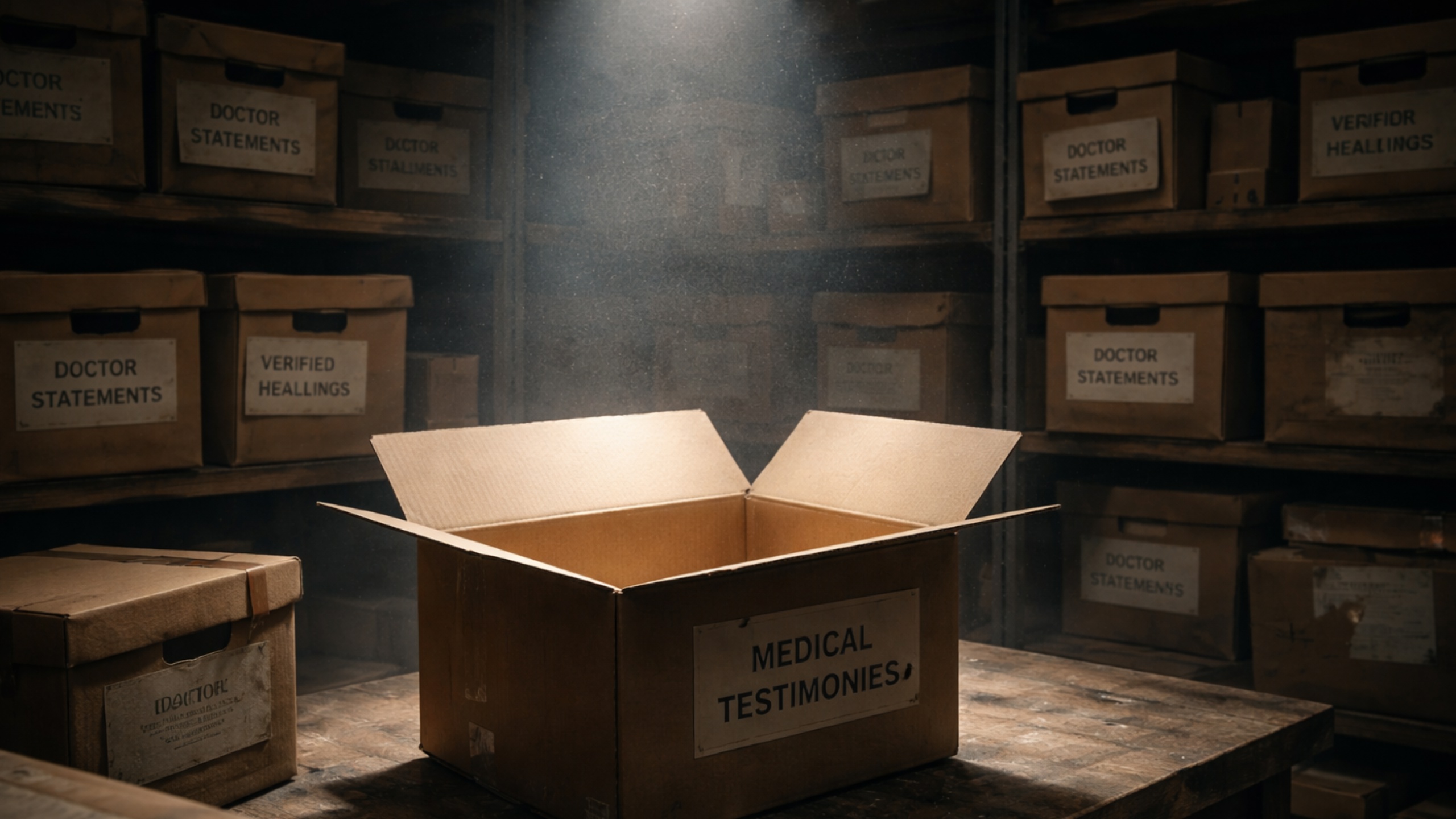
William Branham repeatedly claimed to possess tens of thousands of documented medical testimonies verifying miraculous healings, yet no such records were ever produced during his lifetime or afterward by organizations preserving his ministry. By contrasting these claims with cases like Donny Morton—where surviving documentation contradicts Branham’s narrative—this work examines the gap between asserted evidence and the historical record.
Throughout his public ministry, William Branham repeatedly asserted that his healing claims were supported by extensive written verification. He told audiences that doctors, hospitals, clinics, and even public officials had supplied formal statements confirming miraculous healings, including cases of the blind seeing, the deaf hearing, and the dead being raised. These assertions were not presented as vague personal assurances but as claims of tangible, archived evidence that could silence critics and remove doubt. Branham emphasized both the scale and the authority of this supposed documentation, insisting that it numbered in the tens of thousands and originated from reputable medical sources, thereby framing his healing ministry as uniquely substantiated compared to other evangelists of his era [1].
Now, to the critic, a few years ago you could make remarks; but now we have tens of thousands of documented statements by doctors, clinics, hospitals, everywhere across the world, of absolutely outstanding miracles of blind, deaf, dumb, raised from the dead, when the doctor pronounced them dead, documented statements. So there's... heir-their... The unbeliever's mouth is hushed. See? You don't hear much more of it, do you? Nothing to be said.
- Branham, William. 1961. Be Not Afraid, It Is I
Beyond general references to documentation, William Branham repeatedly described specific categories of verification that he claimed were already in hand. He told audiences that published claims of healing were vetted in advance and could not be printed unless corroborated by doctors, mayors, and other officials who allegedly attested to the facts in writing. According to Branham, these statements were not informal testimonials but formal documents confirming diagnoses, deaths, and subsequent recoveries, sometimes after patients had been pronounced dead for hours. He presented these claims as evidence that his ministry operated under stricter standards of proof than those normally applied to revival preaching, insisting that every publicized miracle rested on prior verification rather than faith alone [2].
As Branham’s ministry progressed, his language escalated from references to individual documented cases to claims of overwhelming numerical scale. He told audiences that what once might have been questioned could no longer be disputed because the volume of documentation had grown so large that criticism was rendered futile. These were not described as personal letters or informal accounts but as statements allegedly originating from doctors, clinics, and hospitals across the world. By framing the evidence as both massive and geographically diverse, Branham portrayed his healing claims as uniquely verified in modern religious history, suggesting that disbelief persisted only because critics refused to acknowledge an evidentiary record that he insisted already existed in abundance [3].
Despite the repeated assurances that vast quantities of written medical verification existed, William Branham never produced these documents for public inspection. No catalog, archive, or representative sample of the claimed statements was ever released during his lifetime, nor were independent investigators granted access to review them. This absence is especially notable given Branham’s insistence that the records were already compiled, verified, and sufficient to silence critics. The gap between the certainty of his claims and the total lack of surviving documentation creates a historical problem: the evidence that was said to exist in abundance cannot be examined, audited, or corroborated, leaving the claims dependent solely upon Branham’s own assertions rather than the documents he repeatedly invoked [1].
A Documented Counterexample: The Donny Morton Case
In contrast to the unproduced testimony files Branham claimed to possess, the case of Donny Morton provides an example where contemporaneous documentation does exist and can be examined. Branham repeatedly cited the child’s case as a flagship miracle, claiming that Donny had been healed after being rejected by leading medical institutions and that the event had been verified by doctors and publicized in national media. However, surviving newspaper reports, medical follow-ups, and later family testimony present a different record. Donny Morton was not healed; after continued deterioration, he died later that year from spinal meningitis complicated by pneumonia. This documented outcome directly contradicts Branham’s later retellings, which continued for years after the child’s death and described recovery, walking, and normal activity that never occurred. Unlike the unseen “boxes” of testimonies, the Donny Morton case demonstrates what verifiable documentation looks like when it exists—and how it can expose divergence between narrative claims and historical record [5], [6].
Donny Morton was my brother and what William Branham said about my brother healing and running to my dad or wearing shoes none of it was true.
- Denelda (Morton) Clayton
Posthumous Control of Records by Branham Organizations
After William Branham’s death, control of his sermons, recordings, and alleged documentary materials passed into the hands of organizations formed to preserve and promote his ministry. These organizations have repeatedly affirmed the historical reliability of Branham’s claims while maintaining exclusive custody over his archival materials. Despite decades of requests from researchers, critics, and former adherents, no comprehensive release of the claimed medical testimonies has occurred. The continued absence of these records is significant, given that the organizations responsible for safeguarding Branham’s legacy possess both the motive and the institutional capacity to publish such material if it existed. Instead, the narrative of vast documentation has been preserved rhetorically, while the documents themselves remain inaccessible or nonexistent, perpetuating reliance on Branham’s assertions rather than verifiable evidence [1].
Among the organizations that claim stewardship over William Branham’s legacy, Voice of God Recordings has played the most visible role in curating and releasing archival material. While the organization has published sermons, photographs, and a limited set of documents intended to support Branham’s ministry, it has never released the vast body of medical testimony he claimed to possess. This selective disclosure creates a structural problem: materials that reinforce Branham’s narrative are made public, while the specific documents said to provide objective medical verification remain absent. Given Branham’s repeated insistence that these records already existed and had silenced critics, their continued nonappearance under institutional custodianship suggests that the documentation functions as a rhetorical device rather than an archival reality [1].