
Drinking and Homosexuality: Moral Absolutes, Private Exceptions
William Branham’s Message enforced strict prohibitions against alcohol and homosexuality as markers of holiness and separation, yet historical records, testimony, and visual evidence reveal persistent exceptions within his inner circle. This investigation traces how authority, proximity, and institutional preservation consistently overrode the very moral standards imposed on followers.
William Branham's movement constructed a rigid moral framework that treated alcohol consumption and homosexuality as signs of deep spiritual corruption and end-time decay. These prohibitions were not presented as optional disciplines or pastoral counsel, but as markers separating the "true Bride" from a fallen religious world. Within this system, visible separation from drinking culture and sexual "perversion" functioned as proof of divine election and obedience, reinforcing Branham's authority as both prophet and moral exemplar.
Yet the historical record surrounding Branham's ministry reveals persistent tensions between public absolutes and private exceptions. Testimony from Branham's associates, family members, revival partners, and later insiders describes a culture in which alcohol use, drunkenness, and acknowledged homosexual activity existed within the very circles tasked with enforcing these standards. These contradictions were not peripheral anomalies but recurring features of Branham's ministerial environment, stretching from his early ordination context through the height of the postwar healing revivals.
This study examines how strict moral prohibitions were maintained rhetorically while simultaneously suspended in practice for insiders, partners, and trusted aides. The resulting double standard did not weaken Branham's authority within the movement; instead, it became one of the mechanisms by which authority was preserved, normalized, and insulated from scrutiny.
Anti-Alcohol Doctrine Versus Practice in Branham's Inner Circle
William Branham's preaching repeatedly framed alcohol as a moral contaminant incompatible with holiness, self-control, and spiritual discernment. Drinking was associated with worldliness, spiritual blindness, and the corruption of religious life, and followers were taught that abstinence was a visible sign of obedience. This position, however, sharply contrasted with the documented behavior of individuals closest to Branham and active within his ministerial orbit.
Branham's early ministerial formation occurred inside the Pentecostal Baptist Church of God led by Roy E. Davis, where public acknowledgment of habitual drunkenness among congregants was made without apology. Davis admitted that intoxicated men and women regularly disrupted services, stating that he had "had to leave the pulpit to raise drunken men out of the laps of members of my congregations" and that it was "not an uncommon thing to see from one to half dozen 'drunks' in my audience" [1]. This environment formed the immediate ecclesiastical context in which Branham was ordained, undermining later claims that his ministry emerged from a rigorously sober or morally disciplined setting.
The contradiction extended beyond the church environment into Branham's own family. His brother, Howard Branham, owned and operated a bar in Jeffersonville while remaining socially and professionally connected to William Branham's revival activities [2]. Newspaper advertisements and local reporting associate Howard Branham with the promotion and sale of alcoholic beverages during the same period in which William Branham publicly denounced alcohol from the pulpit. Photographic evidence further shows members of the Branham family raising glasses together in social settings, reinforcing the pattern of private tolerance amid public condemnation [3].
These examples demonstrate that anti-alcohol teaching within the Message functioned less as a universal moral rule and more as a disciplinary standard selectively applied. While rank-and-file adherents were expected to embody strict abstinence as proof of spiritual legitimacy, those within Branham's inner circle operated under a different set of assumptions—one in which proximity to authority mitigated or nullified the very prohibitions imposed on others.
Roy E. Davis' Church and the Early Culture of Drunkenness
William Branham's ordination took place within the Pentecostal Baptist Church of God led by Roy E. Davis, an environment that contemporaneous reporting depicts as marked by persistent disorder tied directly to alcohol abuse. Public letters and editorials in Louisville newspapers document that Davis' congregation was widely known for drunken disruptions, to the point that the behavior became a subject of civic embarrassment and religious controversy rather than an isolated pastoral difficulty.
In a published exchange responding to criticism, Davis defended himself by describing the extent of intoxication present in his services, acknowledging that drunken men and women were a regular occurrence and that the situation had become visible to the broader community [4]. Rather than denying the problem, Davis framed it as an unavoidable consequence of ministering among morally degraded people. This defense, however, implicitly confirms that habitual drunkenness was normalized within the church structure itself.
In my own church in this city I have had to leave the pulpit to raise drunken men out of the laps of members of my congregations. I have had to take women—drunken women—by the arm in the presence of my congregation and lead them to seats. It is not an uncommon thing to see from one to half dozen "drunks" in my audience.[3]
- Rev. Roy E. Davis (While Branham was an elder in the church)
Editorial responses to Davis' statements were sharply critical, noting that no other pastor in the area reported similar conditions and arguing that Davis' congregation was effectively providing ammunition to critics of Prohibition by visibly tolerating public intoxication within a religious setting [5]. These responses highlight that the issue was not merely the presence of troubled individuals seeking help, but the repeated inability—or unwillingness—of leadership to establish behavioral boundaries consistent with the moral standards being publicly advocated.
This context is essential for understanding the formation of Branham's later message. His early ministerial credentials emerged from a church already associated with disorder, alcohol abuse, and public scandal. The later insistence on strict abstinence within the Message did not arise from a historically consistent culture of sobriety, but from a retrospective moral reconstruction that obscured the realities of Branham's ordination environment while weaponizing abstinence as a tool of authority over followers.
Howard Branham: Alcohol, Business, and Proximity to the Revival Platform
Howard Branham occupied a unique position within the Message ecosystem as both William Branham's brother and a visible participant in his revival travels. This proximity gave Howard access to the revival platform's social and economic networks while insulating him from the moral scrutiny applied to ordinary adherents. Contemporary newspaper records identify Howard Branham as the owner and operator of a bar in Jeffersonville, Indiana, actively engaged in the sale and promotion of alcoholic beverages during the same period that William Branham publicly condemned alcohol consumption as sinful and spiritually destructive [6].
Local reporting and advertisements associate Howard Branham by name with alcohol-centered social events and commercial promotions, including holiday gatherings and branded drink advertising [7]. These notices do not depict a marginal or short-lived involvement, but an established business operation embedded in the community. Despite this, Howard continued to travel with William Branham and maintained close personal access to the revival ministry, suggesting that familial proximity functioned as a moral exemption.
Photographic evidence reinforces this pattern. Images of the Branham family gathered socially, raising glasses together in a celebratory toast, further undermine the claim that strict abstinence governed the private lives of those closest to Branham [8]. Such imagery stands in sharp contrast to the Message's later rhetoric, which framed alcohol consumption as evidence of spiritual compromise or false belief.
Howard Branham's dual role as bar owner and revival associate illustrates how moral rules within the Message operated hierarchically rather than universally. While followers were disciplined through abstinence requirements framed as divine mandates, insiders—especially family members—were permitted to violate those same standards without consequence. This asymmetry contributed to a culture in which obedience was demanded downward but never enforced upward, reinforcing Branham's authority while shielding his immediate circle from accountability.
Revival Partners and Public Drunkenness: Allen, Ridley, and Baxter
Alcohol use within William Branham's revival network was not limited to family members but extended to prominent revival partners whose public behavior contradicted the holiness standards preached from the platform. These individuals were not fringe participants but central figures whose association with Branham lent credibility to his ministry while simultaneously exposing its internal contradictions.
And I'm going to speak very plainly, and I've said it before. And I'm not the least alarmed to say it, because it's the truth. Baxter was a womanizer. He even got drunk on the plane and came off doing the goose-step and everybody laughing at him. In India, he consorted with women. They came to Brother Branham and said, 'Is it right for the father to have these women?'
- Rev. Lee Vayle, Branham's parter and publicist
A. A. Allen, one of the most visible healing evangelists associated with Branham's campaigns, was repeatedly arrested for alcohol-related offenses. Newspaper reports document Allen being stopped for reckless driving and subjected to a Drunkometer test that indicated a blood alcohol content well above the legal limit, resulting in arrest and financial penalty [9]. Despite these public incidents, Allen continued to operate within revivalist circles that emphasized sobriety as a spiritual necessity, demonstrating a gap between moral rhetoric and tolerated behavior among elite figures.
Similarly, Rev. Caleb A. Ridley, who served as the Ku Klux Klan's supreme religious chaplain and held revivals alongside Branham and Roy E. Davis, was charged with driving under the influence according to contemporaneous reporting [10]. Ridley's public role as a religious authority and moral spokesman stood in stark contrast to documented legal consequences stemming from intoxication, further illustrating that alcohol-related misconduct was neither rare nor disqualifying within Branham-adjacent revival culture.
The most consequential example, however, was Ern Baxter, Branham's closest revival partner from 1947 to 1953. According to Lee Vayle, Branham's long-time associate and publicist, Baxter was both a habitual drunkard and a womanizer [11]. Vayle described Baxter boarding an international flight to India intoxicated, behaving inappropriately, and offending both fellow travelers and local populations through sexual advances. This conduct occurred in direct proximity to Branham's highly publicized prophecy that India would experience mass conversions, a campaign that later collapsed in failure.
Baxter's behavior did not result in public discipline or separation during the height of the revival partnership. Instead, the moral failure was retrospectively reframed as a spiritual lesson after the prophetic claims failed to materialize. He went on to found the Shepherding Movement. This pattern—tolerating misconduct during periods of perceived success and reinterpreting it only after failure—allowed Branham's authority to remain intact while shifting responsibility onto associates once outcomes contradicted prophetic expectations.
William D. Upshaw, Prohibition, and Alcoholic "Medicinal" Promotion
William D. Upshaw occupied a paradoxical position within the moral economy of the postwar healing revivals. As a former U.S. Congressman, revivalist, and nationally recognized advocate of Prohibition, Upshaw publicly embodied the anti-alcohol cause while simultaneously lending his credibility to commercial products that relied on alcohol-based formulations. His association with William Branham's revivals placed this contradiction directly within the Message's moral framework.
Newspaper reporting documents Upshaw publicly endorsing Sargon, a widely marketed "revitalizer" promoted as a medicinal tonic during the Prohibition era [12]. Such products were commonly alcohol-based and legally marketed by exploiting loopholes in medicinal regulation. Upshaw's endorsement framed Sargon as a wholesome remedy and presented his personal testimony as evidence of its legitimacy, even as he continued to champion Prohibition principles and moral reform.
This contradiction was not incidental. Upshaw had previously run for President under the Prohibition Party and was widely known for his temperance advocacy, making his commercial promotion of a questionable medicinal product particularly striking. Within revival culture, however, this inconsistency did not diminish his standing. Instead, it was either ignored or reframed as an acceptable exception when linked to healing narratives or perceived spiritual benefit.
Upshaw's role illustrates how anti-alcohol doctrine within Branham's orbit was selectively enforced and rhetorically flexible. Alcohol was condemned when associated with social pleasure, personal weakness, or rank-and-file behavior, but tolerated or obscured when embedded in commercial, medicinal, or revivalist contexts tied to respected figures. This selective moral reasoning reinforced hierarchical authority, allowing elite participants to bypass standards that were rigidly imposed on ordinary followers while maintaining the appearance of doctrinal purity.
Homosexuality Condemned Publicly, Tolerated Privately
Within William Branham's preaching, homosexuality was consistently framed as a grave moral perversion and a defining sign of societal collapse. Branham frequently linked same-sex relations to the sins of Sodom, presenting them as evidence that modern civilization had crossed an irreversible moral threshold. These denunciations were delivered with prophetic certainty and used to reinforce the Message's separation from both secular culture and mainstream Christianity.
Despite this public posture, multiple witnesses and later admissions reveal that homosexual men were present within Branham's inner circle and were not merely tolerated but entrusted with critical responsibilities. The most notable examples were Gene Goad and Leo Mercier, the two men responsible for recording, preserving, and distributing Branham's sermons—the very materials that became canonized as "the Message." Their proximity to Branham placed them at the center of the movement's doctrinal transmission rather than its margins.
In 2000, Lee Vayle, Branham's close associate, theologian, and long-time defender, publicly acknowledged that both men were homosexuals and that Branham knowingly hired them in that condition [13]. Vayle's admission was not framed as a rumor or accusation but as a factual recounting of divine instruction, asserting that God Himself directed Branham to employ "two homosexuals." This explanation functioned as a theological justification rather than a moral reckoning, reframing the contradiction as part of a mysterious divine purpose.
The practical outcome of this arrangement was a stark double standard. While homosexuality was condemned relentlessly from the pulpit and used to discipline followers, those within Branham's trusted inner circle were exempt from scrutiny and consequence. This exemption was not accompanied by calls to repentance, reform, or public accountability. Instead, it was concealed until decades later, when acknowledgment could no longer threaten Branham's authority.
This pattern demonstrates that moral absolutes within the Message were not applied uniformly but strategically. Public condemnation served to consolidate control over adherents, while private tolerance preserved the functionality and loyalty of the leadership structure. In this way, homosexuality became both a rhetorical weapon and a selectively ignored reality within Branham's movement.
Gene Goad, Leo Mercier, and Lee Vayle's Admissions
Gene Goad and Leo Mercier were not peripheral figures within William Branham's ministry; they were entrusted with the technical and logistical control of Branham's sermons, recordings, and distribution network that later became institutionalized as "the Message." Their role positioned them as gatekeepers of Branham's prophetic legacy, shaping what followers would hear, preserve, and ultimately revere as authoritative teaching.
I believe it was about 1956 and no later, that Leo and Gene, Leo Mercier and Gene Goad, God told Bro. Branham to hire them; two homosexuals. So I want you to get the drift of what I'm saying. This, what I'm talking about here, where God made Himself known, and through a Prophet, is where men turned back and the homosexuals were standing right there to take over.
- Lee Vayle, Godhead P19, July 1, 2000
Lee Vayle's public admission in 2000 marked a decisive break from decades of silence surrounding their status. Speaking without ambiguity, Vayle stated that both Goad and Mercier were homosexuals at the time Branham hired them and that this fact was known within the inner circle . Importantly, Vayle did not describe their homosexuality as a later moral failure or private struggle but as an established condition present at the moment they were placed into positions of trust.
Rather than expressing concern over the moral implications, Vayle reframed the situation theologically. He asserted that God Himself instructed Branham to hire "two homosexuals," suggesting that their presence was part of a divine test or turning point in which faithful men "turned back" while others took control. This framing displaced responsibility away from Branham's judgment and redirected it toward an inscrutable divine purpose, effectively shielding the leadership structure from critique.
The implications of this admission are substantial. While Branham's sermons repeatedly condemned homosexuality as an abomination warranting divine judgment, his most sensitive doctrinal and archival responsibilities were delegated to men whose conduct, by those same standards, placed them outside salvation. No evidence exists of disciplinary action, calls for repentance, or efforts to remove them from leadership roles. Instead, their authority persisted uninterrupted for decades.
This arrangement exposes a fundamental asymmetry within the Message's moral system. Homosexuality functioned as a tool of exclusion and fear for adherents while being quietly neutralized when it conflicted with operational necessity or leadership loyalty. Vayle's later admission did not resolve the contradiction; it merely confirmed that moral absolutes were subordinate to institutional preservation within Branham's movement.
Affection, Intimacy, and the Question of Public Appearance
Beyond testimony and later admissions, visual and experiential evidence contribute to understanding how boundaries were navigated within William Branham's inner circle. Multiple photographs depict Branham engaging in prolonged physical contact with male associates in ways that exceeded customary public affection for the period, particularly among ministers who preached strict codes of sexual propriety. These images became points of concern not because physical affection alone implies sexual conduct, but because they intersected with Branham's own teachings on avoiding even the "appearance of evil."
But, see, what did it do? (Then the man was picked up right there by the—the FBI from here, sent up there and picked him up up there, the Royal Mounted Police.) And the ministerial association come to me, and, 'A homosexual,' they say, 'why, Brother Branham's probably the same thing.
- William Branham
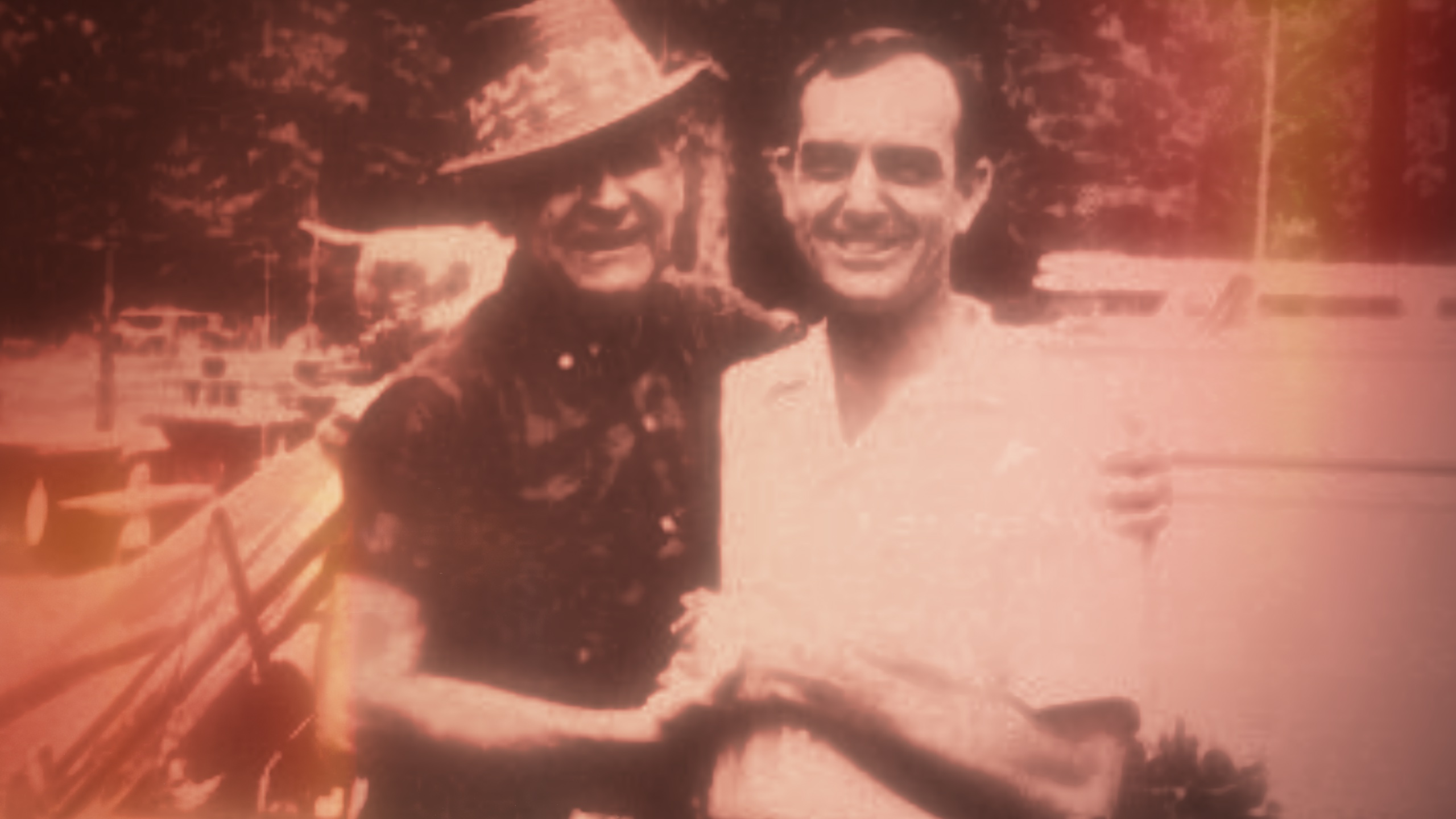
One widely circulated photograph shows Branham holding hands with Pastor Willard Collins in an overtly affectionate posture during an outdoor setting [14]. Another image depicts Branham reclining against the crotch of Wallace McAnally while resting on the ground during a trip together [15]. Such images were preserved, circulated, and later discussed within the Message community, creating discomfort among followers who were simultaneously instructed that holiness required visible separation and restraint.
Branham himself frequently invoked the principle of abstaining from appearances that could invite suspicion, citing scriptural injunctions to avoid even the perception of moral compromise. Yet no effort appears to have been made to restrict, contextualize, or discourage the creation and retention of photographs that visibly contradicted this standard. The existence of these images suggests either a lack of concern for the standard when applied to Branham himself or an assumption that his prophetic status rendered him exempt from ordinary expectations.
Within high-control religious systems, visual cues play a critical role in shaping collective memory and moral intuition. In this case, photographs functioned as silent contradictions—evidence that insiders were permitted freedoms denied to followers. For adherents trained to scrutinize their own behavior relentlessly, the normalization of intimate physical contact at the leadership level reinforced a hierarchy in which moral risk flowed downward but never upward. The question raised by these images is not solely about intent, but about how authority redefined what was permissible simply by being exercised.
Willard Collins’ Testimony and Boundary Violations
Testimony from Rev. Willard Collins, former pastor of the Branham Tabernacle in Jeffersonville, provides first-person insight into how physical intimacy and boundary violations were normalized within William Branham’s personal relationships. Collins’ account is significant because it does not originate from hostile critics or later detractors, but from a long-standing insider who remained connected to the Message for decades.
Collins recounted an incident in which Branham proposed that the two men spend the night together alone in a pile of hay during a hunting trip [16]. The plan was only altered when Collins’ mother intervened and insisted that Branham sleep in her bed instead. Collins explicitly described this as the first occasion in which he slept in the same bed with Branham, presenting the event as unremarkable within their relationship rather than as an extraordinary or uncomfortable occurrence.
One day, he said, "Let's go down to your dad's squirrel hunting." I said, "Okay". Well, we went down there, he said, "We'll hunt tomorrow and we'll stay all night and hunt the next day." And I said, "Okay". We got there and he said, "Now, I saw a pile of hay out in the barn. You and me will just sleep out there." My mother found out about it. She said, "You're not sleeping in the barn! You're going to sleep in my bed. Well, that was the first time that I had the opportunity of sleeping with him!
- Rev. Willard Collins, Pastor of the Branham Tabernacle until 2015 (Audio below in "Quotes")
This testimony aligns with other reports indicating that Branham frequently placed himself in intimate or secluded situations with male associates, offering shared sleeping arrangements without apparent concern for perception or propriety. Such behavior stands in tension with Branham’s own preaching, which emphasized vigilance against moral temptation and the necessity of avoiding situations that could give rise to suspicion.
The significance of Collins’ testimony lies not in proving sexual intent, but in establishing a consistent pattern of boundary erosion. In high-control religious environments, leaders often operate under an implicit exemption from rules imposed on followers. Collins’ account illustrates how Branham’s authority allowed him to redefine acceptable conduct through personal example, even when that conduct contradicted publicly enforced moral standards.
For adherents conditioned to fear moral failure and public shame, these private exceptions created a dissonant moral landscape. Authority, rather than doctrine, became the decisive factor in determining what behavior was acceptable. Collins’ testimony therefore functions as corroborating evidence that the Message’s moral absolutism was selectively suspended when it intersected with Branham’s personal autonomy.