
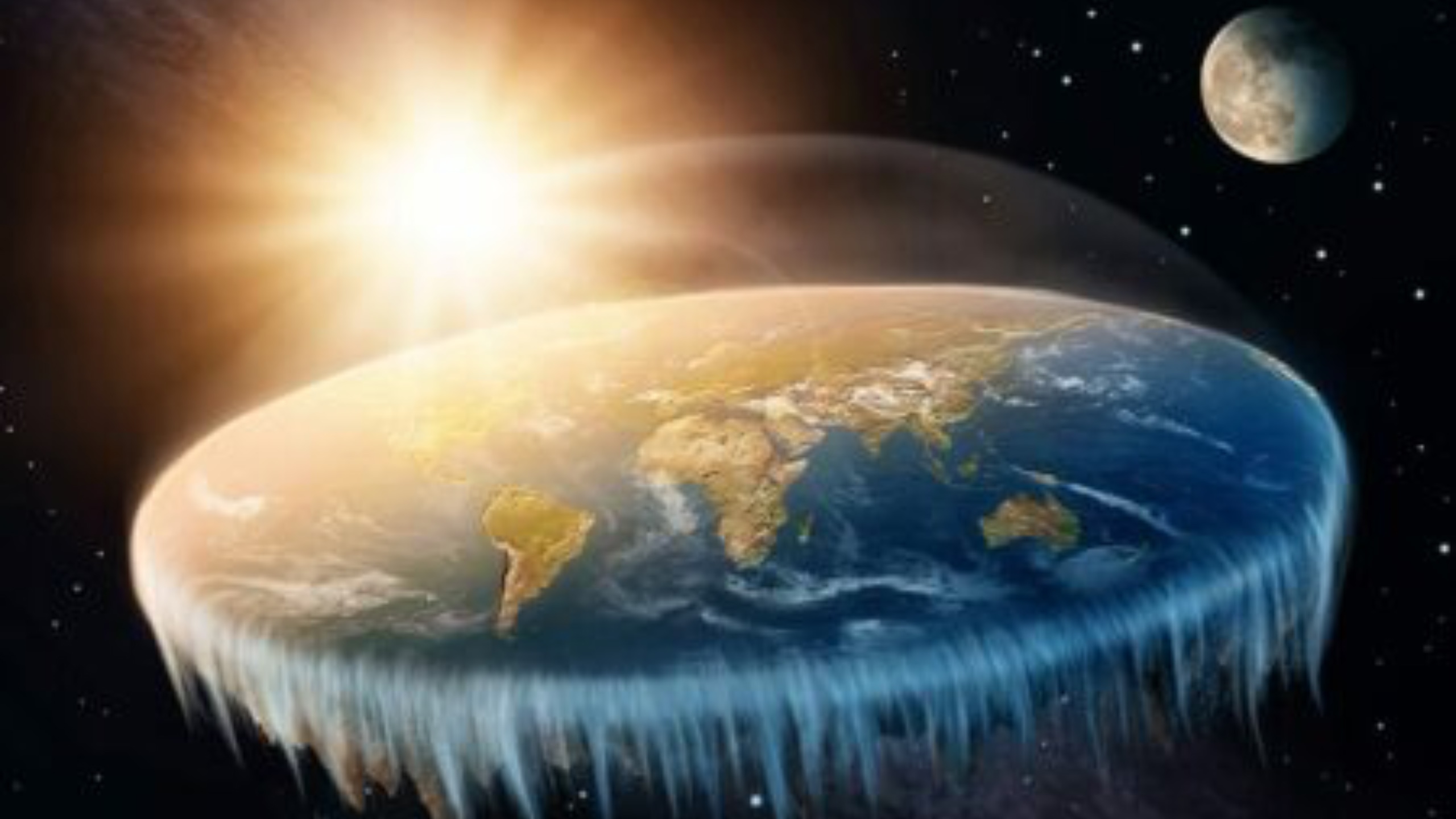
Flat Earth Theology vs. Reality: Examining Branham's Flat Earth Doctrine
In 1965, William Branham publicly claimed that the earth was square, appealing to a literal reading of the Bible’s “four corners of the earth” and alleging confirmation from contemporary reports. This analysis examines the factual problems with flat earth theory, highlights contradictions within Branham’s own earlier statements, and distinguishes symbolic biblical language from claims about physical cosmology.
By the mid-1960s, William Branham publicly asserted that the earth was not round but "square," grounding this claim in a literal reading of biblical language and an alleged confirmation from contemporary newspaper reports. In an August 1965 sermon, Branham rejected scientific consensus by arguing that earlier objections to Revelation's reference to "four corners of the earth" had been overturned, insisting that recent reports demonstrated the earth's square shape. He presented this assertion as vindication of a literalist interpretation of Scripture and framed it as evidence that scientific authorities were unreliable while his reading of the Bible was correct. This position represents a marked departure from conventional Christian interpretation and situates Branham within modern flat-earth cosmology, which treats symbolic biblical language as a description of physical geography rather than theological imagery. [1]
Now, you know, sometime ago, they told us that the…that, “When the Bible said that ‘he saw four Angels standing on the four corners of the earth,’ that that couldn’t be. The earth was round.” But the Bible said, “four corners.” Well, now you seen, two weeks ago, or three weeks ago, it’s been now, the papers packing this article, they found out that the world is square. How many seen that? Why, sure. See? I got it all copied off, just waiting for somebody to say something.
Branham, William. 1965, August 22. Christ Is Revealed In His Own Word (65-0822M).
Problems with Flat Earth Theory Based on Established Facts
The flat earth theory conflicts with multiple, independently verifiable observations that have been established long before the space age and repeatedly confirmed since. The curvature of the earth has been demonstrated through horizon drop observed at sea, changes in stellar constellations with latitude, time zones corresponding to longitude, and circumnavigation by air and sea. Gravitational measurements, satellite telemetry, and orbital mechanics further confirm a spherical earth consistent with Newtonian and relativistic physics. These observations do not depend on trust in a single institution or government but arise from converging lines of evidence across astronomy, navigation, engineering, and everyday commercial travel. Flat earth models are unable to coherently account for these phenomena without ad hoc explanations that contradict empirical measurement, making the theory incompatible with established physical reality.
Contradictions Within Branham's Statements on Earth's Shape
Branham's 1965 assertion that the earth was "square" stands in tension with earlier statements in which he did not insist upon a literal cosmological interpretation of the biblical phrase "four corners of the earth." In a 1954 sermon, Branham acknowledged that the language of Revelation might appear problematic to those who understood the earth to be round, yet he explicitly dismissed the idea that the phrase required a flat or square earth, stating that roundness did not preclude the use of such terminology. This earlier explanation functioned as a rhetorical reassurance rather than a scientific claim, allowing biblical imagery to coexist with a round-earth understanding. The later reversal, in which Branham claimed empirical proof for a square earth, represents a clear contradiction in his teaching and illustrates a shift from interpretive flexibility to doctrinal certainty unsupported by evidence. [2]
But, look now, he saw all four corners of the earth, and the angels standing on the four corners of the earth. Now, you say, “I thought it was round”; that don’t keep it from having four corners, you see. All right.
Branham, William. 1954, January 3. Questions And Answers #1 (54-0103M)