
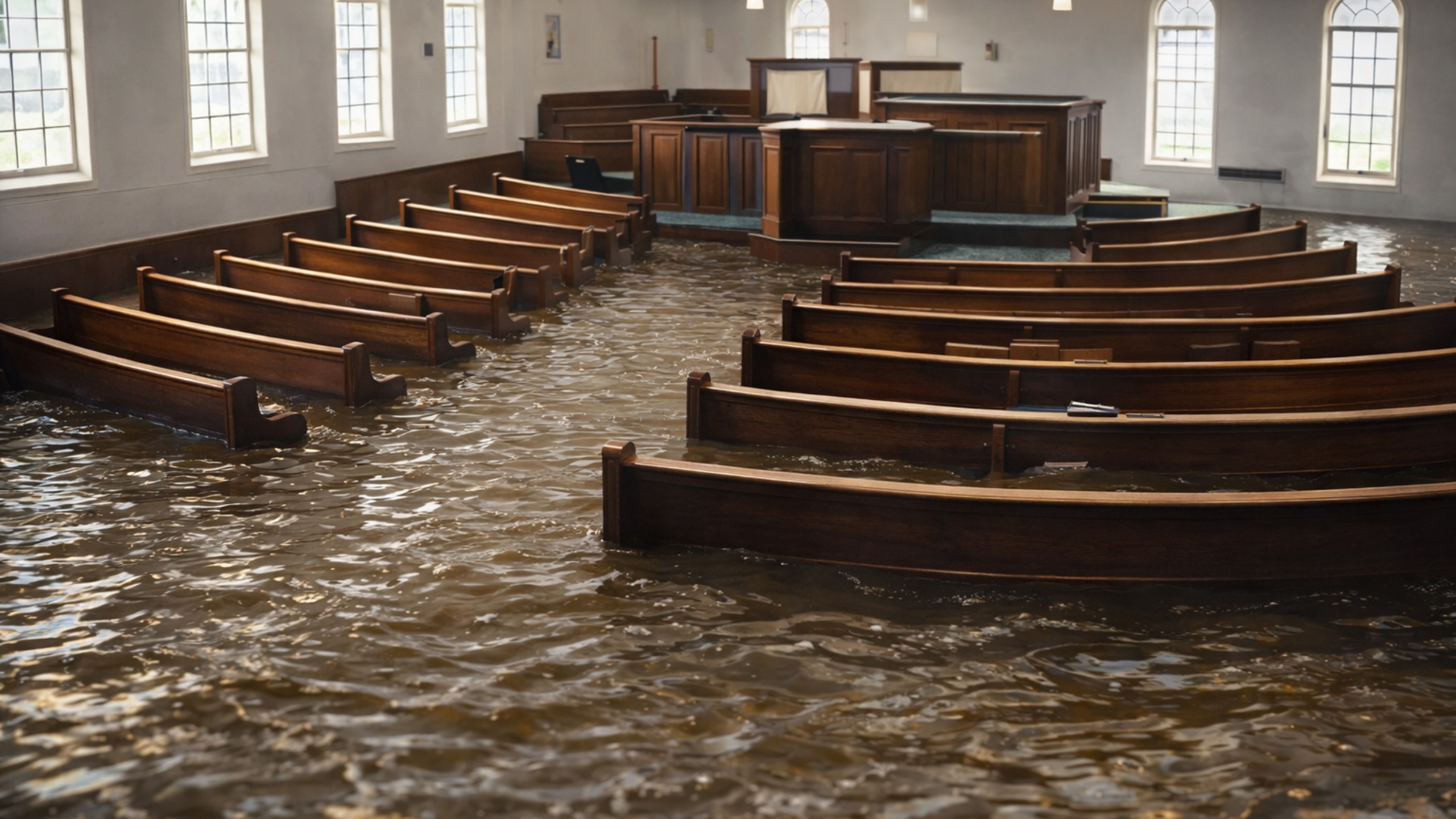
William Branham and the Floating Bible Story That Wasn't His
William Branham often cited the 1937 Ohio River flood as evidence of divine validation, telling audiences that his Bible was miraculously preserved. Contemporary newspaper records, however, reveal that the core elements of this story originated from a documented incident at a different church, reframed over time as a personal miracle.
While traveling and preaching, William Branham repeatedly told a story connected to the 1937 Ohio River flood in Jeffersonville, Indiana, presenting it as a personal, faith-affirming miracle involving a Bible that was supernaturally preserved. In Branham's version, floodwaters lifted the Bible and pulpit, later setting them back exactly as before, with the Bible remaining open and unharmed, reinforcing his claim that divine power visibly vindicated his ministry and message. This account became part of a broader pattern in which flood imagery, prophetic authority, and physical signs were woven into Branham's itinerant storytelling to establish credibility with new audiences.
Contemporary documentation from Jeffersonville, however, shows that a dramatic flood-related story involving a floating church floor, pews, and pulpit was already widely circulated locally in 1937. The event was reported as an unusual but explainable occurrence during the flood and was explicitly framed as a curiosity suitable for a "Believe It or Not" feature rather than a supernatural sign. Understanding the existence and circulation of this documented incident is essential for evaluating how Branham later adapted similar elements into his own narrative while omitting the original context and location of the event .
I said, “I seen a man come down from the skies, and take a measure stick and stick it there on Spring Street, said twenty-two feet.' He said, “You're just excited.' I said, “I'm not excited! It's THUS SAITH THE LORD!' And that old Bible where it had been preached on that night…She started raining, the floods breaking through and so forth, and this old church…The seats went right straight up to the ceiling, the Bible went right straight up to the ceiling, washing through here with all that water raising it up. The pulpit went right straight up. They come right down; and every seat set right back in the same place, and the Bible laid right back in the same place, and all that water, and still opened up, the same chapter at the same place. “Heavens and earth will pass away, but My Word shall never pass away.' How that Bible float in that salty water for two years without even soiling the words on It! God's Word's are true. Amen.[1]
- William Branham
The 1937 Ohio River Flood and Documented Church Incidents in Jeffersonville
The Ohio River flood of 1937 inundated large portions of Jeffersonville, Indiana, producing extensive structural damage and a wide range of unusual but well-documented effects on buildings along the riverfront. Local newspapers recorded water depths, displaced structures, and temporary failures in building construction as floodwaters rose well above normal levels. Among these reports were accounts emphasizing mechanical causes—such as buoyancy and loosened floor joists—rather than supernatural explanations, reflecting how journalists and residents understood the disaster at the time.
Within this context, the incident involving a church interior rising intact was reported as an oddity rather than a miracle. The newspaper description focused on measurable flood depth, structural separation from side walls, and the need for later repairs before services could resume. No claim was made that the event involved divine intervention, prophetic fulfillment, or a sacred object being miraculously preserved beyond natural explanation. This framing establishes an important baseline against which later retellings can be measured, particularly when those later versions omit structural details and reinterpret the event as an act of supernatural preservation .
The First Presbyterian Church "Floating Pews and Pulpit" Newspaper Account
The Jeffersonville Evening News account of March 8, 1937, clearly identifies the location of the flood-related incident as the First Presbyterian Church and describes the event in precise, mechanical terms. The article explains that floodwaters reached approximately fifteen feet inside the building, loosening the floor joists from the side walls and allowing the entire floor, with pews and pulpit intact, to float upward before settling back into place. The preservation of the interior furnishings is attributed to buoyancy and structural separation, not to any religious or supernatural cause.
This specificity is significant because it anchors the event to a known congregation, a fixed location, and an observable physical explanation. The article does not mention a Bible, a sermon in progress, or a prophetic declaration connected to the event. Instead, it frames the occurrence as a curiosity suitable for a "Believe It or Not" column and notes the practical repairs required before church services could resume. These details establish a documented narrative that later retellings can be compared against, particularly when elements such as a miraculously preserved Bible are introduced without reference to the original church or its Presbyterian identity .
PEWS AND PULPIT ARE SAVED AS FLOOR RIDES CREST
One of the freak stunts of the flood in Jeffersonville and an item for Ripley's "Believe It or Not" column, happened at the First Presbyterian Church, it was learned. Water to the depth of approximately fifteen feet was in the edifice during the crest period, causing the floor joists to become losened[sig] from the side-walls.
As the waters continued on their climb the church floor with the pews and pulpit, raised, and, floating on the top, were saved from damage. It was stated that the carpet on the pulpit floor was not even wet.
It will be necessary to anchor the floor to the walls of the building, which were not hurt during the disaster, before services can be resumed, it was stated.[2]
More on the First Presbyterian Church: http://www.1stprez.org/history.html