
Jeffersonville Ku Klux Klan
During the prohibition-era Jeffersonville of William Branham's childhood, a war was raging between the illicit gambling, entertainment, and liquor industry and local government. Otto Wathen and the R. E. Wathen Distilleries was supplying liquor to the Cincinnati and Chicago mob under the disguise of a medicinal license, and Wathen had allegedly cooperated with several individuals to produce liquor using illegal liquor stills on private property. Local law enforcement could do little to stop the illegal activity, and some claimed that the local government turned a blind eye to the criminal activities.
During the prohibition-era Jeffersonville of William Branham's childhood, a war was raging between the illicit gambling, entertainment, and liquor industry and local government. Otto Wathen and the R. E. Wathen Distilleries was supplying liquor to the Cincinnati and Chicago mob under the disguise of a medicinal license, and Wathen had allegedly cooperated with several individuals to produce liquor using illegal liquor stills on private property. Local law enforcement could do little to stop the illegal activity, and some claimed that the local government turned a blind eye to the criminal activities.
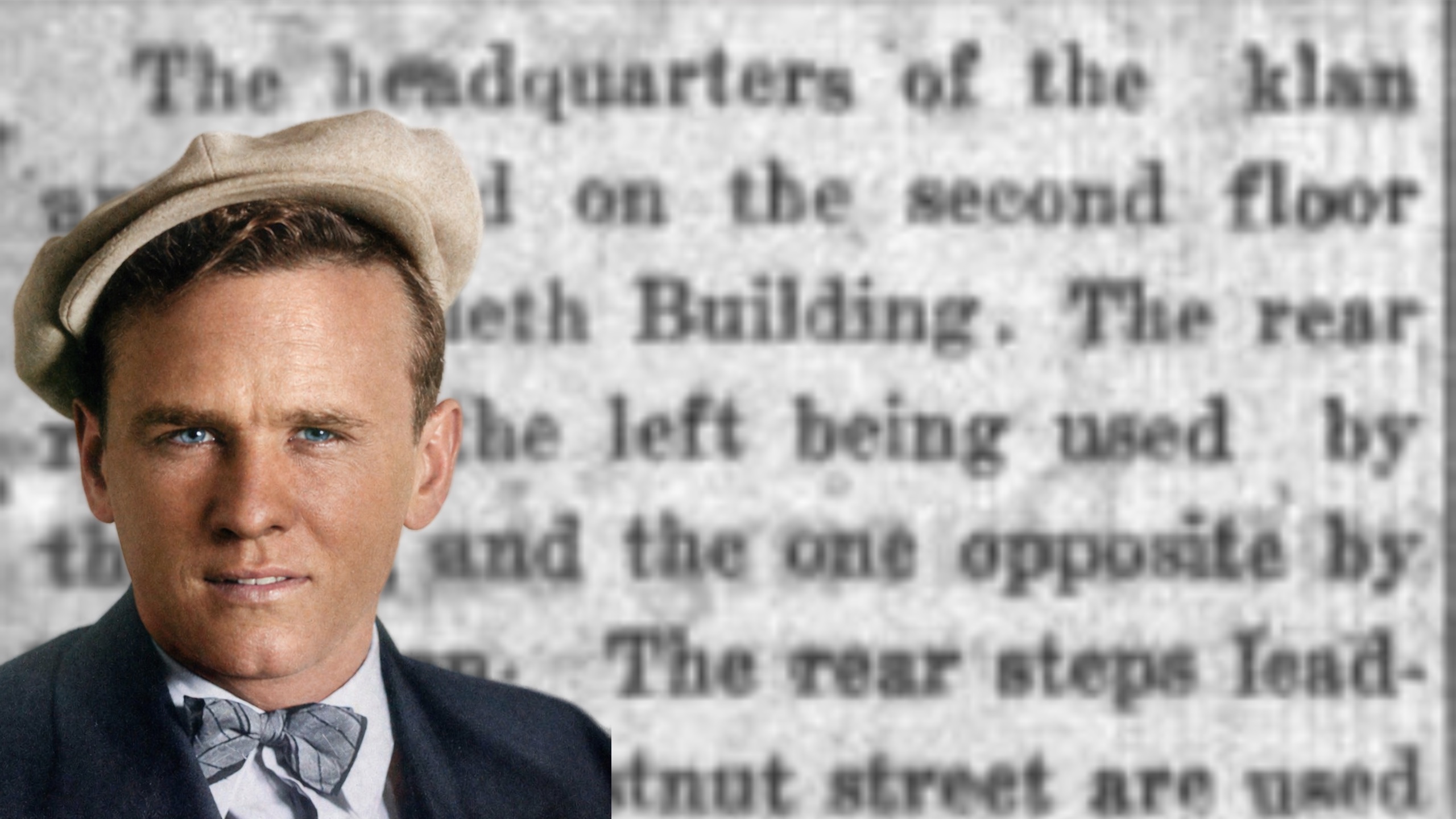
In 1921, the Supreme Religious Chaplain of the Ku Klux Klan, Caleb A. Ridley, planted the Jeffersonville chapter of the Klan. After an attempt to hold Klan meetings in Louisville was abandoned, Ridley moved event across the Ohio River to Jeffersonville. Meetings were held in the Armory,[1] where the Klans former official Spokesperson and Branham's first pastor, Roy E. Davis, held revivals with Jeffersonville Mayor's son Ralph Rader a few years later. The Klan headquarters was later moved to the Speith building, and Branham's father-in-law Charles Brumbach was appointed with the entrance key.[2]
At the same time, the Indiana Ku Klux Klan was quickly growing into what would become the largest installation of the white supremacy group in the United States. The Klan vowed to clean up gambling and liquor, and announced their ambition in their Indianapolis newspaper, "The Fiery Cross". Shortly after, Jeffersonville liquor stills were raided, and many producers of illegal liquor were arrested. William Branham's father, Charles, was among those arrested in the raids. Shortly after, the Klan claimed responsibility for the cleanup of Jeffersonville.
This appears to be one of William Branham's early influences. The "heroic" forces of the Ku Klux Klan began to change the landscape of Jeffersonville, from a lawless bootleg, casino and gambling town to one who feared the "Invisible Army" of Ku Klux Klan militants. A headquarters was established in the Speith building, and Charles Brumbach, Hope Branham (Brumbach)'s father, appears to have been in charge of locking the facility. The Klan was becoming a strong political force in the State of Indiana with the leadership of Grand Dragon D. C. Stevenson and his efforts to take control of the White House through Indianapolis, and Jeffersonville was a claimed as a big win for the white supremacy group.
Though William Branham never included all of the details in one single retelling, parts of the story are scattered throughout his recorded sermons from 1947 to 1965.
I was only about eight years old, or nine, watching the whiskey still run all night long, and get right up and started down packing water back to this still.
Branham, 51-0415A
Life Story
When I was a little boy, my father being a bootlegger, I was hated. Anybody... Go downtown, I start to talk to somebody, nobody would have nothing to do with me. They, they'd see somebody else come along, they could talk to, they'd walk away and leave me.
Branham, 64-0418B
A Paradox
On March 6, 1924, Charles was arrested for operating the whiskey still. Shortly after, William Branham was shot and critically injured. According to both William Branham and the newspapers, this placed the family in a desperate situation.
I remember Mrs. Roeder stood by me, out there in the hospital. I'll never forget that woman. No matter whatever happens, I could never forget her. She was just a young woman then. Her husband was the superintendent down here at the car works. And I—I remember she standing by me, her and Mrs. Stewart. And they was the one actually that paid my hospital bill. I... We didn't even have food to eat, in the house, so how could we pay a hospital bill, hundreds of dollars? But she, through her church society and the Ku Klux Klan, paid the hospital bill for me, Mason's. I can never forget them. See? No matter what they do, or what, I still... there is something, and that stays with me
Branham, 63-1110M
Souls That Are In Prison Now
A few weeks after Branham was shot, the Klan described their cleanup operation on the bootleggers of Jeffersonville, Indiana. This "clean up" not only included the closing of illegal whiskey stills, but also harsh propaganda campaigns against the Catholic community and especially any elected officials who were Catholic. It was a theme William Branham would continue throughout his career as an evangelist.
In Jeffersonville, at the height of the Klan's growth in 1924, the anti-Catholic white supremacy group was met with rising opposition. The headquarters was severely damaged in an alleged arson attempt, and the Klan's membership records, financial records, and other information stolen. When the Jeffersonville Evening News began publishing these records, it was announced that Mr. Brumback held the keys to the Klavern.
Fiery Cross Jeffersonville Indiana Announcements
The Fiery Cross denounced the Sheriff of Jeffersonville, who they claimed to be Roman Catholic, after an altercation with a vehicle.
The Fiery Cross Sunday, May 11, 1923
The first announcement of a cross burning in the area. According to the publication, when the principals of the organization were described to the public, the speaker was enthusiastically received and applauded.
The Fiery Cross Friday, May 11, 1923
Continued propaganda against Catholic Sheriff Cole.
The Fiery Cross Friday, May 11, 1923
The beginning of the battle of the Klan against the Jeffersonville and Clark County bootleggers.
The Fiery Cross Wednesday, May 23, 1923
Clark County Klan representative in Indianapolis is met with an attack by bricks.
The Fiery Cross Friday, July 13, 1923
More of the battle against Catholic Police Chief Cole.
The Fiery Cross Friday, July 13, 1923 (Page 10)
Klan advertisement announcing parade and picnic. The "Old Man" (D. C. Stevenson) Parade was expected, as well as other "National Speakers" (which would have likely included former official Klan spokesperson Roy E. Davis.)
The Fiery Cross Friday, August 24, 1923
Jeffersonville holds a very successful Klan meeting, followed by Masonic band concert. It was held on the property of the Knights of Pythias.
The Fiery Cross Friday, November 9, 1923
In an attempt to positively influence the public's opinion of the White Knights, a Jeffersonville African-American church is the recipient of enough funds to meet all expenses. In fact, the remainder of their debt was paid by the Klan.
The Fiery Cross Friday, December 7, 1923
Women of the Klan (popular in Indiana at the time) conducted a funeral in Jeffersonville.
The Fiery Cross Friday, March 7, 1924
Klansman raiding a gambling casino was arrested by the Jeffersonville Police force. According to the article, it was attributed to the mayor being Roman Catholic.
The Fiery Cross Friday, March 28, 1924
The Klan announced success in the education of Jeffersonville about their "Roman Catholic-ruled" government. Apparently, their cleanup of bootleggers, gamblers, and other vice was starting to sway public opinion. The Fiery Cross Friday, March 28, 1924 (Page 2)
Immediately after Charles Branham (William's father) was arrested for operating a liquor still in Clark County, the Klan announced their success in breakup up a Jeffersonville liquor ring.
The Fiery Cross Friday, April 11, 1924
120 Klansmen took part in the largest funeral held in Jeffersonville at that time. 2,000 persons attended.
The Fiery Cross Friday, May 9, 1924
The Klan newspaper published an expose of the local Jeffersonville newspaper's article on political affairs.
The Fiery Cross Friday, May 23, 1924
The courier of the Fiery Cross newspaper in Jeffersonville was removed from a bowling alley after a "Roman Catholic conversation."
The Fiery Cross Friday, May 30, 1924
Local Jeffersonville attorney speaks against Ku Klux Klan in a Flag Day speech.
The Fiery Cross Friday, June 27, 1924
Political advertisement for Samuel L. Scott, democrat from Jeffersonville.
The Fiery Cross Friday, October 31, 1924
The Jeffersonville office of the Ku Klux Klan is burned, and several of their important documents stolen.
The Fiery Cross Friday, December 12, 1924
(Page 6)
The Jeffersonville office of the Ku Klux Klan is burned, and several of their important documents stolen.
The Fiery Cross Friday, December 12, 1924