
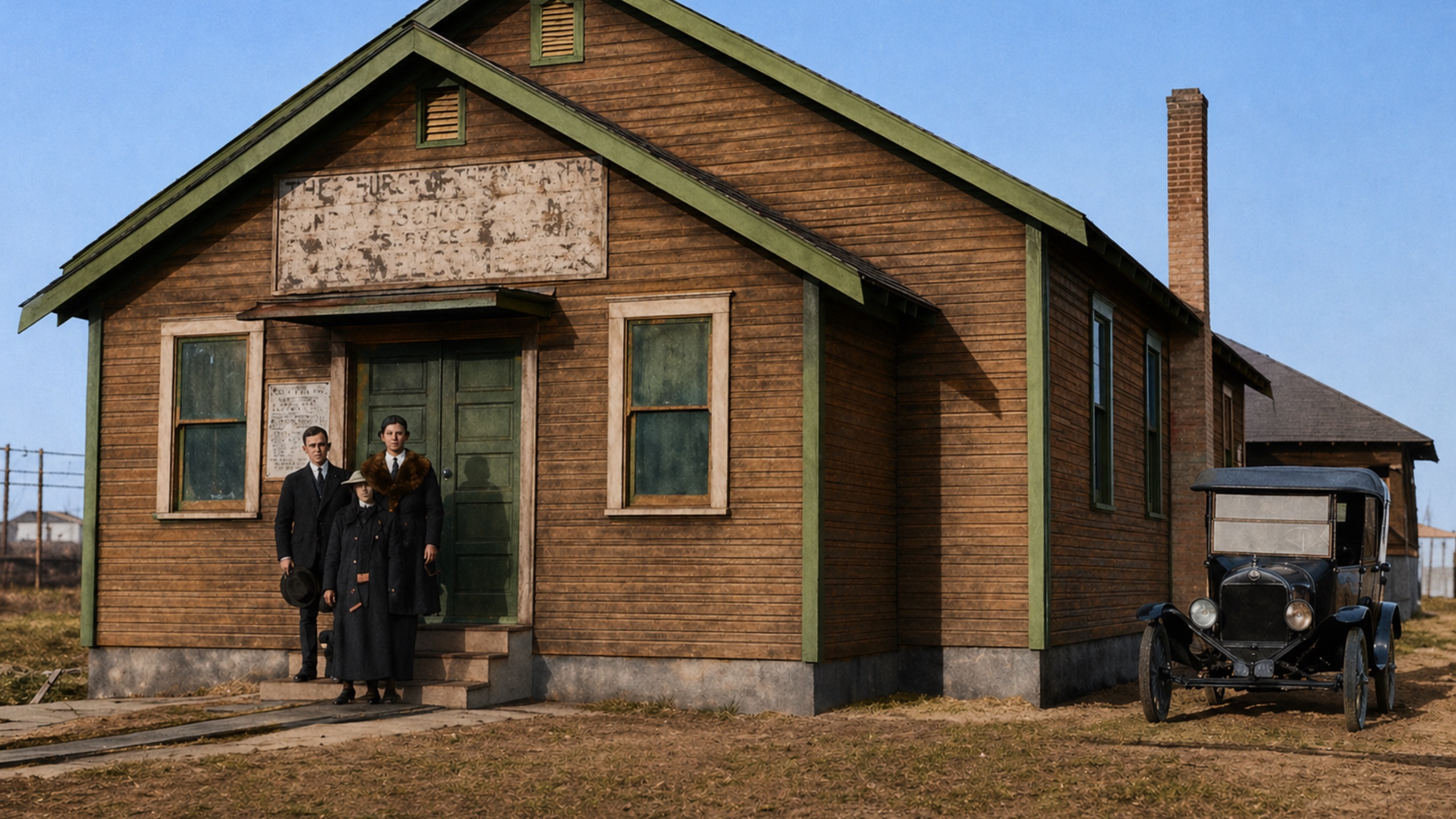
Midway Gospel Tabernacle
Midway Gospel Tabernacle in Mishawaka, Indiana, led by Rev. G. B. Rowe, was a racially integrated Pentecostal church that stood out during the era of the Indiana Ku Klux Klan and later became central to William Branham's fictionalized Life Story claim that he first encountered Pentecostalism there while vacationing near Paw Paw Lake in 1934; the documented history instead shows that Branham was already ordained in Roy E. Davis's Pentecostal Baptist Church of God, pastoring a Pentecostal tabernacle in Jeffersonville, connected to Rev. Frank E. Curts, and likely attended the Mishawaka meetings through existing Pentecostal networks, making Midway Gospel Tabernacle an important example of how Branham reshaped his early Pentecostal history to create a more dramatic and misleading stage persona.
Midway Gospel Tabernacle just outside of South Bend in Mishawaka, Indiana, was the church of Pentecostal leader Rev. G. B. Rowe. It was widely recognized for its racially integrated services during a time when both the Indiana Ku Klux Klan and other Pentecostal leaders rose in opposition. Midway Gospel Tabernacle is the church that William Branham described in his fictional "Life Story" accounts as his "first encounter" with Pentecostals when went on vacation to Paw Paw Lake in 1934.
In William Branham's Life Story accounts, the version of the stage persona used was that of a Baptist minister[1] who accidentally stumbled onto a Pentecostal Revival in Mishawaka. According to Branham, a "colored boy" urged him to speak after being called out by the minister.
So I—I never seen the Pentecost before, so I thought, 'Well, believe I'll go and see what it looks like.' So I walked in, and there they was all clapping their hands [Brother Branham claps his hands—Ed.] like that, and screaming and singing. I thought, 'What manners. Tsk, tsk, tsk, tsk, tsk, never seen anything like that in my life. What are they all talking about?'
And first time I'd ever been in a Pentecostal meeting to hear them clapping their hands and running all over the floor. And I thought, 'Oh, my, what church manners.' Come to find out, I was one of them and didn't know it. So I—I just fit there just like a glove to a hand. And it was in that place there where the colored boy, when they was asking about me. I was the next to the youngest minister in the whole conference, just gathered with them a night, and the colored boy said…They kept asking where I was. And I had a little T-shirt on, a little seersucker pair of trousers on. That was during the time of the depression you know, and no one knew me to be a minister, so I was just setting real quiet. And the colored boy said, 'Do you know who he is?' And I said, 'Yes, sir.' And he said, 'Well, go get him.' I said, 'Look,' I said, 'I'm him, but don't—don't say that. See?.' He said, 'Here he is, right here.'[2]
- Branham, William. 1952, July 20. Life Story
The actual history is somewhat different. On August 15, 1934, Pentecostal leader Rev. Frank E. Curts held a revival at William Branham's own Pentecostal Tabernacle, which at the time was on the corner of 8th and Pratt streets in Jeffersonville adjacent to the current location of the Branham Tabernacle today.[3] Branham had been ordained into the Pentecostal Baptist Church of God sect, a Pentecostal denomination founded by Klan leader Roy E. Davis with assemblies in multiple cities across the United States.[4] After Davis' church burned to the ground earlier that year, Branham assumed leadership as head pastor of the Pentecostal church and its congregation[5] while Davis continued planting churches for the Pentecostal sect in other locations.[6]
Immediately before holding revivals with William Branham at Branham's Pentecostal Tabernacle, Rev. Curts held revivals with Rev. G. B. Rowe in Bloomington, Indiana.[7] It is very likely that Branham and/or Davis attended the Pentecostal revivals in Bloomington to invite Curts to Branham's Pentecostal Church, and also very likely that Curts mentioned the services with Rev. Rowe in Bloomington to Branham and invited Branham to the upcoming convention in September at the Midway Gospel Tabernacle in Mishawaka. Branham's stage persona, however, pretended not to know the names of the men, and Branham's editors appear to have purposefully misspelled the name of both Rev. Curts and Rev. Rowe.
And I set down by a colored brother. And I set down there; they had the conference up in the North. So they couldn't have it in the South on account of the—the mixing of the colored and the white. And so, I set down by a colored brother there. I had on a little T-shirt, you know. Nobody knowed me, so and a pair of seersucker trousers. I was setting there listening, and a man, I believe, from Cincinnati by the name of Kurtz, and he came out. Now, he belongs to one of those Pentecostal organizations, don't know which one it was. But best I remember, the man's tabernacle…His name is Raugh, R-a-u-g-h, a German, Raugh, Raugh, or something like that. And it was a…I got set down there, you know, and I thought, 'I'm going to enjoy this well today.'[8]
William Branham attended the revival held at Midway Gospel Tabernacle on September 17-23, 1934. According to eyewitnesses at the revivals, Branham was "driving a panel truck with advertisements about his 'healing revivals'".[9] The revival at Midway Gospel Tabernacle was led by Raymond Hoekstra,[10] who would later become the campaign manager for both William Branham and "Little" David Walker revivals.[11]
This page is being updated! Check back for more!