
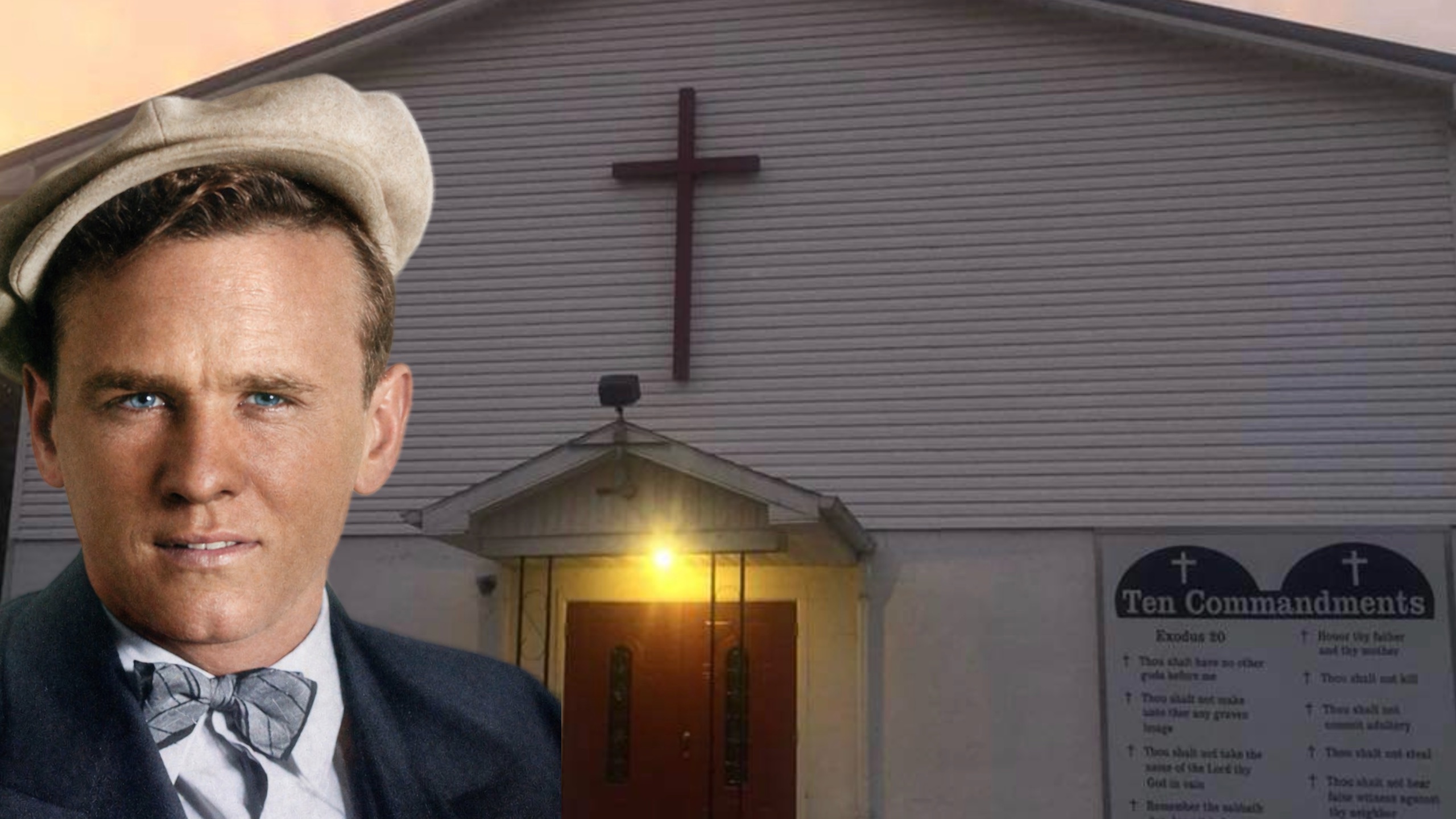
Milltown Baptist Church
Milltown Baptist Church appears to have been an important satellite congregation in the Pentecostal Baptist Church of God world connected to Roy E. Davis and William Branham, with Branham serving as pastor there through the early healing revival years while later reshaping its history into a visionary stage narrative; the church linked Branham's Jeffersonville ministry, Roy Davis's Pentecostal-Baptist sect, Georgie Carter's healing claims, E. Howard Cadle, and the Cadle Tabernacle network, while Hattie Wright Mosier's testimony about Edith's alleged healing directly challenges Branham's later claims that he had never heard of Milltown, was divinely sent there by vision, and saw Edith restored to walking through a "Thus Saith The Lord" declaration.
The Milltown Baptist Church appears to have been a satellite church for the Pentecostal Baptist Church of God sect that Roy E. Davis and William Branham promoted during the early years of Branham's ministry, and Branham led the church until at least the early 1950s. According to Hattie Wright Mosier in a testimony recorded by George and Rebekah Smith in 1979,[1] a "Brother Roy" (likely Roy E. Davis) held healing revivals near Milltown, IN.[2] Shortly after that meeting, the locals were suddenly aware of William Branham's church in Jeffersonville.[3] Not long after, William Branham assumed the role of head pastor of the Milltown Baptist Church.
William Branham claimed that the former pastor of the Milltown Baptist Church was involved in a gun battle. The church was allegedly "turned over to the city" and the doors were permanently closed.[4] Branham said that it was a "Missionary Baptist Church",[5] the name Branham used[6] to describe Roy Davis' work with the Missionary Board of the Southern Baptist Convention that Branham was originally ordained into.[7] After the cult headquarters burned to the ground, Branham traveled between Jeffersonville and Milltown pastoring at both churches.[8] Roy Davis was ousted by the Missionary Board of the Baptist Church on August 12, 1926,[9] so Branham would have been Pentecostal at the time. Davis' Jeffersonville church was still listed as the "Pentecostal Tabernacle" when Branham took over for Davis and became an evangelist for the sect.[10] When Branham held two-week revivals in Milltown, Rev. N. C. Guthrie assumed leadership of Branham's Jeffersonville church in his absence.
Branham was still the head pastor at the Milltown Baptist Church when the Latter Rain revival broke out in 1947.[11] Georgie Carter, who Branham claimed to have healed of tuberculosis, was his pianist. As late as 1953 Branham continued functioning as the head pastor while appointing an associate pastor to help him run the church.[12] [13] It was at Milltown where Branham met E. Howard Cadle,[14] who founded the Cadle Tabernacle in Indianapolis that would become infamous for both being the Ku Klux Klan headquarters[15] and Branham's launch of Jim Jones' career.[16]
In later versions of his stage persona, William Branham began claiming that he had never heard of Milltown before a vision told him to travel there.[17] In her testimony to George and Rebekah Smith for the Only Believe Magazine, however, Hattie Wright Mosier pointed out several flaws in William Branham's version of the story used for the stage persona. According to Mosier, she went to Jeffersonville before Branham came to her, and Branham told Edith that in order to be healed, she had to come back "at least three more times".
And this woman named Shutters told us to go to the Branham Tabernacle and take Edith. She said they was having special meetings, and a certain night would be the last meeting. So we went that last night. We took little Edith, and my, was that place full of people, singing and clapping their hands. And the music! There was a short, thin fellow that played the bass drum, and he could really hit it just right. And then that Brother Hornback and the sisters up there sung so beautiful. I remember that there was a dirt floor, and a big wood stove to one side. I don't rightly know whether to say it was something to see or to hear, because you could just do both, you see. When Brother Bill prayed for Edith, she took a few steps that night, the only ones she ever did take. He said to us, "I want you to come back, at least three more times."
- Hattie Wright Mosier[18]
When William Branham re-invented his stage persona in 1959 with the sermon "My New Ministry", Branham used Edith as an example of his healing power when he used the phrase "Thus Saith The Lord". According to that version of the story, Branham claimed that if he went to Milltown (instead of Hattie Wright Mosier coming to Jeffersonville), Edith would "get up from there and walk, to the glory of God".[19] In her testimony, however, Hattie Wright Mosier vehemently denied William Branham's claim of vision and healing. Not only did the alleged "healing" happen in Jeffersonville, according to Hattie, Edith never walked again.
When Edith got a little older, she'd hit out at things. Just anything that got near her, she'd hit it. She just couldn't help herself that away. See, she couldn't even feed herself, and somebody had to lift and carry her. I carried her till I just couldn't do it no more. She never got over her affliction, not to walk and take care of herself.
- Hattie Wright Mosier[20]
Interestingly, Hattie Wright Mosier described the dirt floor of the "Branham Tabernacle" while describing this event as happening in the fall of 1935.[21] This timeline is in agreement with other research overturning William Branham's claims to have dedicated his "Branham Tabernacle" in 1933. Roy E. Davis' cult headquarters burned to the ground in 1934,[22] and William Branham admitted that he took over the congregation of Davis' cult headquarters after the burning. Branham stated that he remained Davis' assistant pastor until Davis returned to Texas.[23] Rev. Joseph D. Freeman assumed the role of head pastor at Davis' cult headquarters in November 1935 while the new church — which would eventually become the Billie Branham Pentecostal Tabernacle in 1936 and later the Branham Tabernacle in 1954 — was being constructed.[24] As an assistant pastor for Davis during the revivals in Milltown, Branham would have most certainly had "heard the name Milltown". Not to mention the fact that Milltown was frequently mentioned in the Jeffersonville newspapers.[25]
In the later versions of his stage persona, however, William Branham not only claimed to have never heard of Milltown when the "vision" instructed him to travel there.
Then when morning came, and I went to my church that evening, and I said, 'I had a vision, and I heard the name of Milltown. Does anyone know where it’s at?' No one knew. Following Sunday, I said, 'There’s someone in trouble at a little place called Milltown. I’ll probably get a—a letter somewhere that’ll call me to a city, Milltown. There’s somebody in trouble. I don’t know what it’ll be. I’ll just have to go there.' I said, 'It may be out in some other part of the nation.' And while I was speaking, there was a man setting there, said, 'Brother Branham, I know where Milltown is.' Said, 'It’s about…Just a little bitty place way out in the southern, thirty, forty miles below Jeffersonville or New Albany, down towards southern part of Indiana.' Said, 'I live near there.' I said, 'What…How’s it spelled?' He said, 'M-i double l-t-o-w-n, Milltown.' I said, 'That’s it.'[26]
Over the years, as William Branham's stage persona changed and evolved, many new additions were added to the alleged vision to make it seem more exciting. In 1959, the healing of Edith shifted away from Hattie Wright Mosier's testimony of hearing about "Brother Bill" after hearing "Brother Davis" and traveling to Jeffersonville. Branham began claiming that he had a vision of healing Edith at the dinner table in the Wright home, and declared "Thus saith the LORD" that Edith would be healed while Hattie was in another room.
When I was sitting at the table, eating dinner, I had been explaining what faith was. I said, 'And faith is like this. If I’d see a vision of Brother Shelby sitting so-and-so, and each one the way they was.' And Sister Hattie was sitting way back out, toward another room. She didn’t have much to say. Never does. And then while we were talking, I’d say, 'If the Lord showed me a vision that something was to take place, then I would, could say it. That’s what raises my faith.' I said, 'When the Lord shows me what will take place, then I got confidence. It’s going to be that way.' When He showed me, I said, 'I’d come right here, if that little, afflicted girl sitting there, and the Lord showed me she was going to be healed. I’d come right here and stand in the track, see if everything was just exactly the way He said. And then say, 'THUS SAITH THE LORD. Edith, rise up and walk.’ I said, 'You’d see those little legs unfold, them little hands unfold. And she’d get up from there and walk, to the glory of God,' I said, 'If it would come like that.' I had been telling them about this experience.[27]