
Movies and Television
The conflict between white supremacy and the television and film industry developed from the Klan's revival through The Birth of a Nation into a broader cultural battle over who would shape American values, as white supremacist groups first used film to glorify their cause and then, after failing to compete with Hollywood's growing influence, turned to religious leaders and revival networks to attack movies, television, and popular culture as corrupting forces; within this pattern, figures such as William Branham carried Klan-adjacent themes into the postwar healing revival by framing Hollywood and television as a demonic "invasion" of the United States while selectively condemning media that challenged segregationist and fundamentalist social ideals.
The war between white supremacy and the television/film industry has been waged since the re-organization of the Ku Klux Klan in 1915. Due to the strong influence of leaders in white supremacy on American religion, it is a battle that was and is often fought through religious leaders.
When the Ku Klux Klan was rebirthed in 1915, it came on the heels of D. W. Griffith's film "The Birth of a Nation." In many ways, the film was responsible for reviving the Klan[1] after the 1865 Klan died out. The film depicted people with black skin as inferior predators of white women and those who supported racial equality in Washington as "Radical Republicans".[2] The racist narrative was widely accepted as historical fact, and when the Klan was rebirthed in Atlanta under Colonel William Joseph Simmons, it presented itself as the solution to the problem that the film created.
When New York World exposed the Ku Klux Klan as a domestic terrorist organization in 1921,[3] however, many of those "values" were not so widely accepted — especially in the northern states. The film industry shifted dramatically, and films produced were not aligned with the agenda of white supremacists. As the studio system was introduced and the Golden Age of Television began to form,[4] many of those involved did not support the Klan's agenda. Yet the media they produced was largely popular and highly influential. White supremacists began to fear that the film industry would have a greater influence on the nation than that of their own propaganda engine.
Though it was short-lived, the solution in the 1920s was a counter-offensive. The Klan began to produce films of their own. The films were played in cinemas owned or run by Klansmen or white supremacists sympathetic to the Klan's agenda. One theater in Noblesville, Indiana, for example, advertised that patrons could view the film "before or after the K.K.K. parade tonight" and that the theater was "Kool, Kozy, and Klean."[5] In regions where the religious communities were sympathetic to the Klan, local churches, schools, parks, and other public venues played the films.
Klan groups set up film companies and produced their own feature films during the 1920s, such as The Toll of Justice (1923) and The Traitor Within (1924). As part of the Klan's efforts to position itself at the heart of local communities, these films would play in churches, schools, Klaverns (Klan buildings) and at outdoor events. Posters advertised Klan values as much as the film itself, with slogans such as 'Do away with the underworld' and 'Protect clean womanhood', while often identifying the Klansman as '100 percent American'. Indeed advertisements for The Toll of Justice presented 'The picture that every red-blooded American should see'.[6]
- The New Republic
The Klan, however, could not compete with the quickly growing film and television industry. The war between Hollywood and the Klan was a monumental failure for the white supremacists. With the birth of television in the late 1920s, the writers, directors, actors, and producers opposed to the Klan agenda had a much more effective platform: they could influence the nation right from their own living room. The only option was to boycott the industry, and the only effective means to communicate this boycott was through the religious system. As a result, the Klan began to weaponize religion to continue the war against Hollywood.
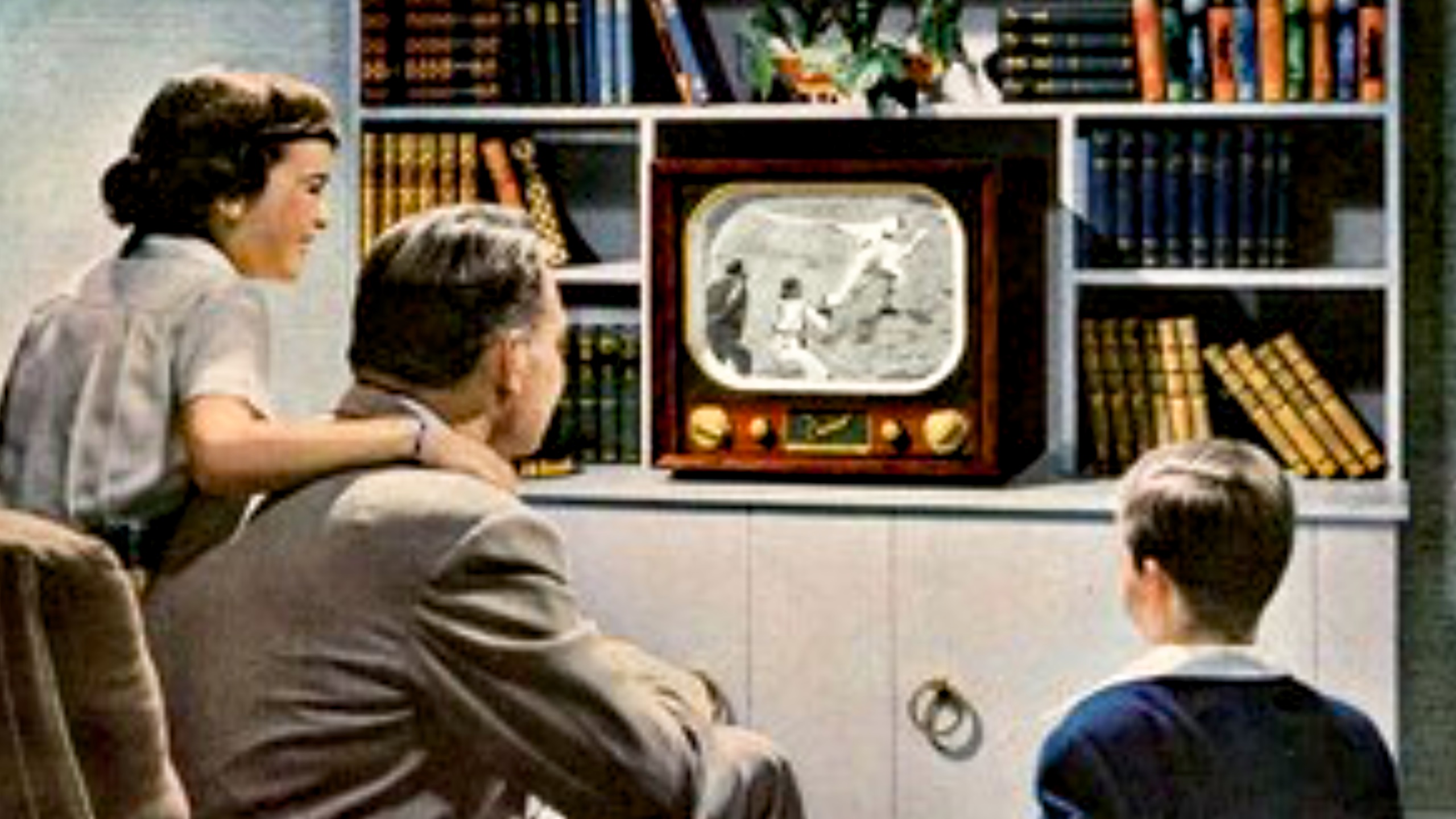
William Branham, the leader of the Post WWII Healing Revial mentored by the Klan's 2nd-in-command, Roy E. Davis, introduced themes into the revivals such as "The Invasion of the United States" targeting Hollywood's influence. He ridiculed television programs opposed to Klan values, such as "I Love Lucy" which portrayed an interracial marriage.[7] Though William Branham owned a television set[8] and frequently watched it in his home or in hotels,[9] he strongly condemned owning a television and claimed that he would never have one in the home because "God told me not to do it".[10]
What is it? It's the devil. It's the devil, the invasion. He swept into this nation, like a roaring lion. He set himself down here in the best place they had, in Hollywood. He said, 'I can get the movies here until the television comes on, then I'll get them.' And he sit down there.[11]
- William Branham - The Invasion Of The United States