
Paris Texas
The city of Paris, in Lamar County Texas, has a fascinating history as it relates to the themes of white supremacy flowing through the Latter Rain movement. Paris was the site of some of the most notorious lynchings in the United States. Even now, decades later, racial tensions result in the grisly deaths of African Americans while white supremacy organizations provoke conflict and incite violence.[1].
The city of Paris, in Lamar County Texas, has a fascinating history as it relates to the themes of white supremacy flowing through the Latter Rain movement. Paris was the site of some of the most notorious lynchings in the United States. Even now, decades later, racial tensions result in the grisly deaths of African Americans while white supremacy organizations provoke conflict and incite violence.[1].
Paris was the site of some of the country's most notorious lynchings after Reconstruction. At the county courthouse, a towering statue commemorates "Our Heroes" of the Confederate Army, and plaques mark the location of former "Negro"-only toilets.[2]
- Newsweek
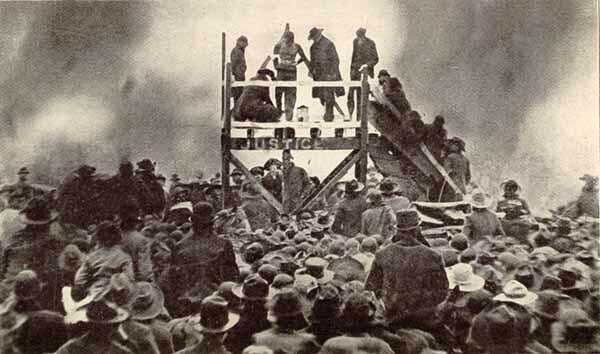
In the late 19th Century and early 20th Century, several black Americans were dragged into the Paris Fairgrounds to be tortured and killed. Thousands of white spectators watched, sometimes cheering, as black men were dragged onto a scaffold, scalded with hot irons, and either burned to death or hanged.[3] Between 1885 and 1942, at least 468 people were lynched in Texas,[4] and Paris was a hotspot for lynching, sometimes referred to as "the court of Judge Lynch".
One of the more recognized lynchings was that of Isaac Bruce, a black man wrongfully convicted of raping a white girl. An angry mob came at Bruce with a rope and was stopped by Sheriff John P. Cox. Cox declared that he would "be a dead man before a prisoner in my custody is harmed". On the day of the murder, Bruce had spent all day at a church function, spent the evening with a different girl, and had an alibi. He did not match the initial description given to the police by the victim. At a police lineup, however, the victim pointed to Bruce as her rapist.[5] In a trial that lasted just three days, Bruce was sentenced to death by hanging.
As of 2006, Paris, Texas was still racially segregated and prided itself in its dark history. It called itself "the best small town in Texas"[6] while hate crimes — including homicide — go nearly unpunished.
There was the 19-year-old white man, convicted last July of criminally negligent homicide for killing a 54-year-old black woman and her 3-year-old grandson with his truck, who was sentenced in Paris to probation and required to send an annual Christmas card to the victims' family.[7]
- Chicago Tribune
In some versions of William Branham's stage persona, Branham claimed that his family came from the hills of Kentucky. He claimed that his father, Charles Branham, was uneducated while his mother, Ella Branham, came from the family of a schoolteacher and had a good education while being raised in Burkesville, Kentucky.[8] Other versions of the stage persona, however, claim that his mother was instead from Oklahoma and that her family had moved near Paris, Texas.
My mother is—is from Paris, Texas. My father was from Kentucky. And so, my dad was there breaking horses when he, in a rodeo, when he met mother. And so he…They were married, and mama was only fifteen years old when I was borned. So that…She was just a kid, and pop was eighteen.[9]
- William Branham
It reminds me of when I was at home. My father used to break bronco horses. He was borned in the state of Kentucky. My mother's from Oklahoma, and moved down into Texas, just above Paris. And my dad went west to breaking horses. And he was a quite a rider, and a very fine shot, and, with a gun. And he went west breaking horses, and that's how he met my mother.[10]
- William Branham
The Paris connection could explain why Roy E. Davis chose to migrate to Jeffersonville, Indiana. Davis was from Lamar County, just outside of Paris,[11] and frequently returned to hold revivals in the city. His brother, the Rev. W. R. Davis, lived in Detroit, Texas, and joined Davis in the revivals in nearby cities.[12] In the early 1930s, after having risen through the ranks as the second-in-command of the 1915 Ku Klux Klan under Col. William Joseph Simmons,[13] and after having started a white supremacy second group with Simmons called the "Knights of the Flaming Sword", Roy Davis planted the church in Jeffersonville that would eventually become the Branham Tabernacle.[14]
Joel Osteen, pastor of the Lakewood Church in Houston, Texas, was born in Paris, Texas.[15] His father, John Osteen, who joined the Latter Rain revivals in the early 1950s, was also born in Paris.[16]