
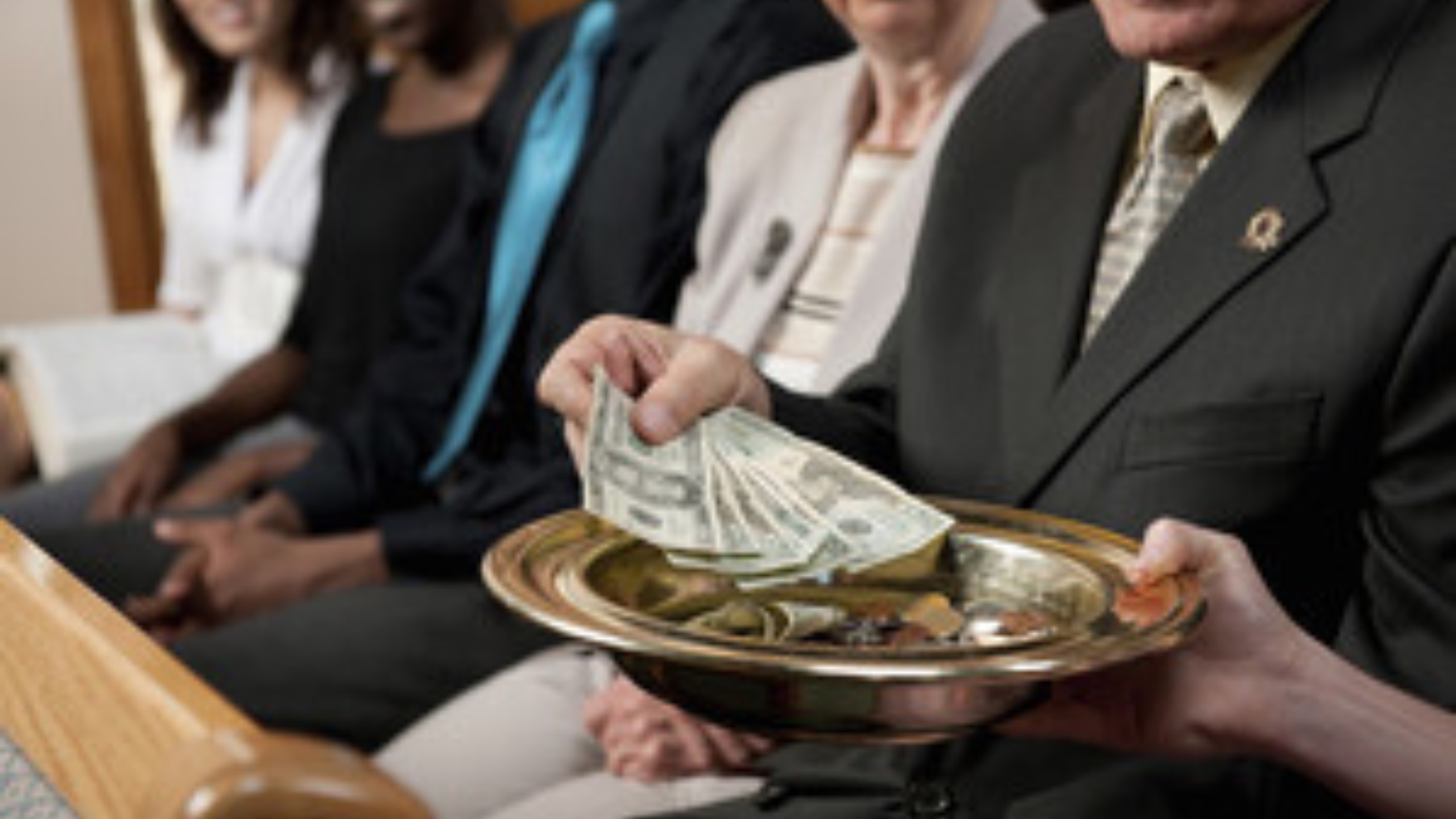
Tithes and Offering
William Branham's repeated claim that he "never took an offering" was misleading because, while he may not have personally passed the plate, his revival campaigns, churches, and ministry systems collected substantial offerings, love gifts, and tithes through others, producing enough money to fund travel, investments, personal comforts, and eventually attract IRS scrutiny; by presenting himself as financially detached while benefiting from collections, promoting ten-percent tithing, and selectively applying Old Covenant giving without its broader Sabbath, Jubilee, redemption, and community-restoration provisions, Branham created a religious economy that framed donations as obedience to God while shielding the leader and ministry structure from honest financial accountability.
Throughout multiple versions of his stage persona, William Branham claimed that he never accepted an offering. In no uncertain terms, he frequently stated, "I never took an offering in my life". This was partially true; he himself likely never collected the money. It is very deceptive, however, since others collected the money for him and he also frequently mentioned the collection plates being passed. According to Sarah Branham, William Branham’s daughter, a substantial amount of money was collected over the years.[1] So much, in fact, that Branham was the target of a tax evasion inquiry by the Internal Revenue Service in the 1960s.[2]
I get paid from my church. I never took an offering in my life. I don't ask people. When people gives me money, I put it in foreign missions. See? Some of my trustees are setting present right now, knows that's true. I don't spend one cent of it.
Branham, William. 1964, APR 18. A Paradox. 64-0418B
Branham's healing revival campaigns did, in fact, collect money. The collections were so commonplace that collecting money resulted in an unusual exchange between William Branham and Franklin Hall. Branham confirmed that he also received the "love offering" that was being collected.
[Brother Hall asks, "What are you going to start it with?"—Ed.] I'm going to start it... [Brother Hall asks, "Some money, huh?"—Ed.] Some money... [All right good, I will help you start it."] All right, sir; that's fine. God bless you. Branham, William. 1951, May 9. Testimony. 51-0509
[Later in the transcript]
Many of you has put you in a portion of your living here to help pay the expense as we've went along, and in the love offering for Brother Hall and I.
It was obvious from his lifestyle that not only did he invest large sums of money as Sarah claimed, but he also spent it for pleasure. When traveling, William Branham stayed in extravagant hotels like London's Piccadilly, [3] and wore expensive jewelry such as his Longines watch. [4]
During his revival meetings, collecting money was an important part of the show. Offerings were generally free will, and according to those involved were very generous. W. E. Kidson, Branham's first campaign manager, described the generosity of the donors to reporters who decided to investigate for themselves. To their surprise, they learned that Branham had collected large suitcases full of money.
But first a collection had to be taken to defray the $60 rent for the tent, even though it wasn't being used, and the rent for the gym. So far the people in Houston, Tex., had been kindest in showing their appreciation but Brother Kidson had no doubt that the people of Vandalia could outdo them. (A man at the hotel later told us it had taken two husky men to carry in the boxes of offerings from the kind people of Vandalia the night before). As the collection was taken, the audience stood and sang Brother Branham's favorite hymn, "All Things Are Possible, Only Believe" and Brother Branham entered. [5]
William Branham also collected tithes from his churches in Jeffersonville, Indiana, and Tucson, Arizona, and promoted part of the Old Covenant tithing system. Members of Branham's cult following are asked to give ten percent of their earnings to the pastor. According to former members, this money is seldom distributed to the poor and needy of the churches.
The trouble of it is, you go to digging, the first thing you know, you stick your shovel down: say, "Pay ten percent." Oh, oh. Can't do that. You don't get much water. The next you got… If you'll just keep on digging, brother, and keep on digging, and dig them old doubts out, them old dish pans and rocks and stones and things like that, dig deep enough to throw it all out, and get enough water flowing through there so you can get a good decent drink once in a while. What's the matter tonight? You got to dig away from your church, dig away from this, dig away from that, and dig into Christ Jesus. Hallelujah.
Branham, William. 1953, Jun 9. Make The Valley Full Of Ditches. 53-0609E
The Old Covenant tithing system described in Leviticus was not designed to benefit the priests, nor was it designed as a means of earning money for any single person. Leviticus 27:30 states that donations are owned by the Lord:
Every tithe of the land, whether of the seed of the land or of the fruit of the trees, is the Lord's; it is holy to the Lord - Lev 27:30
Under the Old Covenant Law, the Israelites set aside days, weeks, months, and years for rest. The Old Covenant Sabbath included every seventh day,[6] seventh week, seventh month,[7] and seventh year.[8] During these periods of time, the Israelites either did not labor or celebrated using part of the donations to the community. Money, livestock, land, and even humans [9] donated as tithe was used during their sabbatical rest.
But in the seventh year the land is to have a year of sabbath rest, a sabbath to the Lord. Do not sow your fields or prune your vineyards. Do not reap what grows of itself or harvest the grapes of your untended vines. The land is to have a year of rest. Whatever the land yields during the sabbath year will be food for you-for yourself, your male and female servants, and the hired worker and temporary resident who live among you, as well as for your livestock and the wild animals in your land. Whatever the land produces may be eaten.
Leviticus 25:4-7
The fiftieth year was the "Year of the Jubilee", and possessions were returned to the donors.[10] Donors who did not redeem their property effectively donated it to the priests, who continued to manage the property for future sabbaticals.
Under Branham's system of tithing, donations were usually given in money, there were no provisions for redeeming donations, and only the seventh day was recognized as Sabbath. On the days of rest, celebration, or Jubilee, none of the goods were returned to the donors for members of Branham's cult of personality. Branham, though claiming to enforce the Old Covenant Tithing system, avoided significant parts of it.
And you shall hallow the fiftieth year and you shall proclaim liberty throughout the land to all its inhabitants. It shall be a jubilee for you: you shall return, every one of you, to your property and every one of you to your family.
Leviticus 25:10