
Tucson
Tucson, Arizona, is one of two main cities from which William Branham's cult of personality was controlled, the other being William Branham's hometown of Jeffersonville, Indiana. In 1963, William Branham removed his children from the public school system and relocated to Tucson.[1]
Tucson, Arizona, is one of two main cities from which William Branham's cult of personality was controlled, the other being William Branham's hometown of Jeffersonville, Indiana. In 1963, William Branham removed his children from the public school system and relocated to Tucson.[1]
When combined with the Civil Rights timeline and the timeline now established for Roy E. Davis and his sect of the Original Knights of the Ku Klux Klan, it is evident that Branham moved to Tucson in protest of racial integration. When speaking unfiltered, Branham openly declared his position in favor of racial segregation[2] and denounced members of the Civil Rights movement making huge advances in equality.[3] In the months leading up to his flight from Indiana, Branham became more open about that position. In October 1962, for example, Branham publicly denounced the government's intervention in giving James Meredith equal opportunity.[4] He said that James Meredith and the "colored people" were trying to "sell their birthrights" dishonoring the "blood of Abraham Lincoln".[5]
We give them integration. Now it's worse than it ever was.
- William Branham[6]
The election of John F. Kennedy posed a rising threat to Branham's agenda of white supremacy and support of racial segregation. Branham[7] and the white supremacy groups strongly opposed JFK and viewed the President-elect as the face of their enemy. Kennedy appealed to the oppressed black communities by promising that he would create equal opportunity for all mankind "by the stroke of the President’s pen".[8] January 1, 1963, marked the 100-year-anniversary of the Emancipation Proclamation freeing African American slaves. Martin Luther King, Jr. — also a target for William Branham's hate speech[9] — started a campaign asking President Kennedy for a second emancipation proclamation on the anniversary of the first.
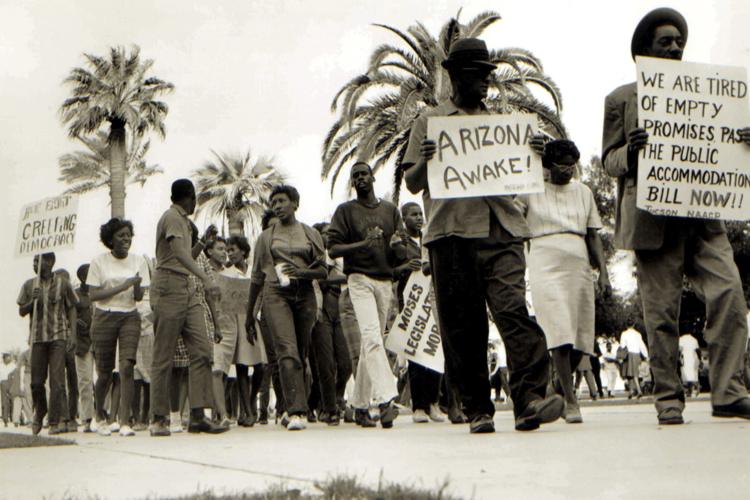
Tucson presented an unusual segregated alternative for Branham. Though Arizona started desegregating the school system early, declaring segregated schools as unconstitutional in 1953, Tucson refused to comply. Tucson schools remained racially segregated and discriminated against non-white students for decades — for forty years — and was not fully compliant until the year 2018.[10]
Two days before the anniversary of slavery ended, Branham announced the move in a sermon to his Jeffersonville congregation. But he also announced that wasn’t planning to stay with his family; he said that his plans were to become mobile,[11] fully negating any reason for himself to have moved to Tucson; the move was solely for the purpose of transplanting his children from the Indiana school system to the Arizona School system.
One of the greatest mistakes this nation made, it made it on November the 11th, this year. That was its great, fatal mistake. One of the greatest mistakes that the colored race ever made, was down in Louisiana and over in there, when they voted for Kennedy, the other night, put him in. They actually spit on that dress of Abraham Lincoln, where the blood of the Republican party that freed them, and voted a Catholic.[12]
Racial segregation of schools was not the only thing that would have been appealing to William Branham and the members of his sect aligned with the white supremacy agenda. William Branham's favorite restaurant in Indiana was the "Blue Boar Cafeteria",[13] and as much as eighty percent of his cult of personality in the Louisville/Jeffersonville, Indiana area chose to dine at the Blue Boar Cafeteria on Sunday afternoons.[14] The Blue Boar Cafeteria was well known in the 1960s for being an "all-white" restaurant that did not permit non-white customers to enter.[15] In February of 1961 — while William Branham and his cult of personality were frequenting the cafeteria, Raoul Cunningham, president of the NAACP, united the NAACP Youth Council and CORE gathered and held a mass campaign of protests. Fifty-eight protesters were arrested when they targeted the Blue Boar Cafeteria and theaters. (By the end of the campaign, police had incarcerated over 700 people.)[16]
Before the adoption of the Civil Rights Act of 1964, Arizona continued to oppress African Americans. Popular restaurants refused service to people with black skin, and blacks were brutally beaten for moving into a "white neighborhood".[17]
So, last Sunday, as I was going into the Blue Boar Cafeteria in Louisville, where I think about eighty percent of this congregation gathers on Sunday afternoon, to eat, who did I see coming down the street? I tell you, my heart quivered when I seen our Brother Dauch coming down the street, exactly what He told me. I shook his hand, on the—on the street.[18]
Considering the long trail of criminal activity in Roy E. Davis' sect of the Ku Klux Klan, Tucson also would have been appealing from the standpoint of organized crime. Tucson was the home of Detroit mobster Pete Licavoli, New York City Mafia kingpin Joe Bonanno, Sr, [19] the Battaglia and Spinelli families, and more.[20] It wasn't until after Branham's death in 1965 that the Tucson mob was exposed and an FBI probe was demanded.[21] Coincidentally, leaders and elite members of William Branham's cult of personality from Tucson such as Branham cult leader and head of William Branham's "Tucson Tabernacle" Pearry Green,[22] and Billy Collins, [23] the son of Willard Collins, head pastor of Branham's Branham Tabernacle in Jeffersonville, were involved with and named in organized crime lawsuits. Voice of God Recordings, the cult headquarters owned and operated by William Branham's son and current central figure of the "Message" cult, and Wayne C. Evans, son of Branham's close business associate "Welch Evans", were also named in a racketeering suit in Pima County.[24]
Not long after William Branham's death, Tucson was rocked by a series of mob-related bombings.[25] Upon investigation in 1968, it was determined that bombings dating back to 1954 were the result of organized crime.[26] It should come as no surprise that "blasts" were a huge part of William Branham's later ministry after the move to Tucson. In 1963, for example, during the "1963 Mystery Cloud" event created by William Branham's stage persona, Branham originally described blasting in Tucson. Branham continued to mention blasts that "shook the whole country" related to Tucson as late as July of 1965.[27] Interestingly, Branham also used the blasting as a cover story for his work to stay the execution of Leslie Douglas Ashley in Houston,[28] suggesting that he was aware of the timeline of the bombings.
Just a few days ago, when them seven Angels came down in that vision. Many of you knowing it. Said, “Go to Tucson and wait there for a while, and you'll hear a blast go off.[29]