

1 Corinthians 7 Divorce
William Branham taught that a woman cutting her hair constituted biblical grounds for divorce, presenting this claim as a direct divine decree rather than interpretive opinion. This doctrine conflicts with explicit apostolic teaching on marriage, revealing deeper theological problems involving authority, revelation, and the sufficiency of Scripture.
1 Timothy 3 Deacons Qualifications
The New Testament presents deacons as servants entrusted with practical care and moral integrity, not as enforcers of authority or discipline. This study contrasts that biblical role with William Branham’s authoritarian redefinition of deacons as church “police,” exposing a fundamental shift from service-oriented ministry to control-based governance.
100-Year Prophecy
Bob Jones rose within the Kansas City Prophets and helped shape IHOPKC by promoting dramatic testimony, “technicolor” visions, angel-visit narratives, and end-times claims that echoed earlier Latter Rain patterns associated with William Branham. The through-line is that repeated prophetic failures and escalating dominion-focused timelines were treated as legitimizing “revelation,” creating a template for modern charismatic prophetic authority that continued to influence the NAR and related movements.

1907
William Branham’s widely repeated 1909 birth year is a historically inaccurate date that emerged from his later sermons and theological self-mythologizing rather than from any legal documentation. Contemporary records—including multiple census entries, newspaper accounts, and early public documents—consistently demonstrate that he was born in 1907, a fact overshadowed over time by the prophetic significance Branham attached to the later date.
1908
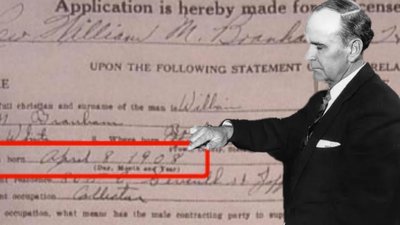
Branham repeatedly claimed an astrologically significant birth on April 6, 1909, but contemporaneous records in the source set—especially the 1920 census age entry and the 1934 marriage license listing “April 8, 1908,” reinforced by his age on Billy Paul’s 1935 birth certificate—conflict with that story and point to an earlier timeline. Additional context from 1924 reporting on Charles Branham’s still-related sentence and Otto H. Wathen’s involvement helps situate when identity details could have been reshaped, while later Dowie-linked claims introduce yet another incompatible birth-year implication.
1909
William Branham’s widely repeated 1909 birth year is a historically inaccurate date that emerged from his later sermons and theological self-mythologizing rather than from any legal documentation. Contemporary records—including multiple census entries, newspaper accounts, and early public documents—consistently demonstrate that he was born in 1907, a fact overshadowed over time by the prophetic significance Branham attached to the later date.

1910 Census Branham
This study reconstructs Ella Branham’s life using U.S. Census records and vital documents, establishing a clear timeline that conflicts with later revival-era narratives. The evidence shows that the widely repeated log cabin story reflects retrospective storytelling rather than the documented household realities of the Branham family.
1920 Census Jeffersonville
This study reconstructs Ella Branham’s life using U.S. Census records and vital documents, establishing a clear timeline that conflicts with later revival-era narratives. The evidence shows that the widely repeated log cabin story reflects retrospective storytelling rather than the documented household realities of the Branham family.
1920S Healing Revival Tent Meetings
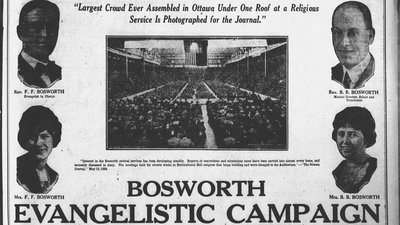
F. F. and B. B. Bosworth helped transform early twentieth-century revivalism into a polished, large-scale public program that blended music, disciplined preaching, and highly publicized healing services, often buoyed by unusually favorable newspaper coverage. Their campaigns grew from multi-day Alliance meetings into "mammoth tent" spectacles and month-long series, but the movement’s credibility faced sharper scrutiny when widely reported healings—especially the James Buck episode in Altoona—raised questions about claims, reporting, and accountability.
1928
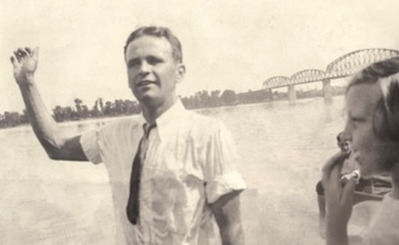
According to William Branham and the dates given for ordination,[1] his "conversion experience" was the moment that he was recruited into Roy E. Davis's Pentecostal Baptist Church of God Sect. Davis was a "personal friend"[2] that baptized him,[3] converted him,[4] and ordained him as a minister for the sect.[5] Though different versions of William Branham's stage persona used multiple dates for his recruitment, the date that Branham appears to have started working in the Pentecostal Baptist Church of God sect was 1928. Branham mentioned this date, mathematically, multiple times. In April 1959, Branham told his audience that he was converted "thirty-one years ago".
1932
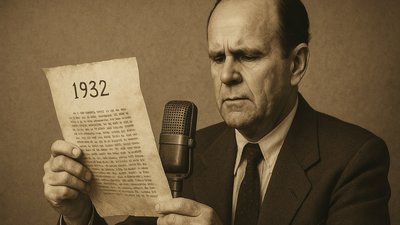
William Branham’s claim to a set of "1933 prophecies" is undermined by a 1960 sermon in which he theatrically reads from a paper he himself dates to 1932, exposing how the timeline of the alleged vision was flexible and retrospectively standardized. The later exhumation of his church’s cornerstone—where he claimed the original written prophecy was entombed—revealed no document at all, leaving only an empty cavity that some spiritualized as a miracle but which in practice underscores the lack of verifiable evidence behind his prophetic narrative.
1933
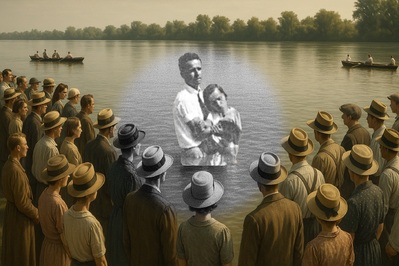
Dismantling William Branham’s famed 1933 Ohio River baptism story—showing that claims of a visible light, an audible commissioning voice, massive crowds, and nationwide newspaper coverage are contradicted by eyewitnesses, contemporary press records, and the documented history of his church and mentor, Roy E. Davis. It argues that the baptism narrative and the so-called 1933 prophecies were retrofitted into Branham’s biography as tools of authority, illustrating how myth-making and repetition, rather than verifiable evidence, became the foundation for prophetic belief in the Message movement.

1933 Automobile Prophecy Analysis
Claims about a 1933 prophecy predicting egg-shaped automobiles emerged publicly decades after engineers, scientists, and newspapers were already discussing and displaying aerodynamic vehicle designs. Extensive coverage, World’s Fair prototypes, and published predictions demonstrate that the “vision” closely followed widely known technological trends rather than anticipating them.
1933 Baptism
Dismantling William Branham’s famed 1933 Ohio River baptism story—showing that claims of a visible light, an audible commissioning voice, massive crowds, and nationwide newspaper coverage are contradicted by eyewitnesses, contemporary press records, and the documented history of his church and mentor, Roy E. Davis. It argues that the baptism narrative and the so-called 1933 prophecies were retrofitted into Branham’s biography as tools of authority, illustrating how myth-making and repetition, rather than verifiable evidence, became the foundation for prophetic belief in the Message movement.
1933 Branham Prophecies Claim
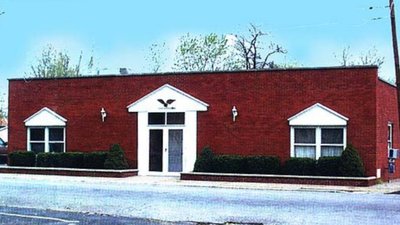
The Branham Tabernacle emerged from the Pentecostal networks of Jeffersonville in the 1930s, closely tied to the ministry of Roy E. Davis and his associates, before William Branham assumed a central role. Over time, the church’s origins were reshaped within Message tradition, particularly after Branham’s 1945 reinvention of his public persona and the renaming of the congregation, creating a retrospective narrative that differs from the documented historical record.
1933 Dedication

1933 Prophecies
William Branham did not publicly mention his supposed 1933 visions until 1953, when he claimed to have prophesied that Communism, Fascism, and Nazism would merge into a single system that would dominate the world and burn the Vatican—a narrative that closely echoes earlier fundamentalist apocalyptic literature and is flatly contradicted by subsequent history. As Communism failed to conquer Europe and eventually collapsed, Branham quietly revised his message, recasting Roman Catholicism rather than Communism as the final world power, presenting this reversal not as a correction of failed prophecy but as further divine revelation.
1933 Prophecies Cornerstone Claim
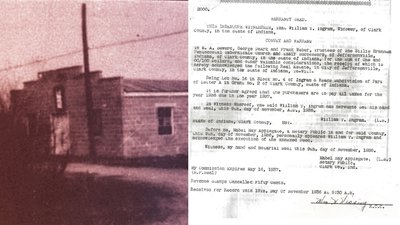
Deeds, advertisements, and location-based evidence place William Branham’s first organized congregation in 1936 rather than 1933, aligning the movement of meeting sites with a verifiable historical timeline. This chronology also situates Branham’s early ministry within Roy E. Davis’ sectarian Pentecostal network and highlights how later autobiographical claims reshaped these origins to support retrospective narratives such as the “1933 Prophecies.”

1933 Prophecies Revised
William Branham made deliberate use of lighting, recording controls, and post-production edits to maintain different versions of his public persona. Paused tapes, spliced recordings, and revised prophecies reveal a managed narrative that complicates claims of spontaneous or supernatural authority.
1933 Prophecy
Claims about a 1933 prophecy predicting egg-shaped automobiles emerged publicly decades after engineers, scientists, and newspapers were already discussing and displaying aerodynamic vehicle designs. Extensive coverage, World’s Fair prototypes, and published predictions demonstrate that the “vision” closely followed widely known technological trends rather than anticipating them.
1933 Tent Meetings Jeffersonville Location
Deeds, advertisements, and location-based evidence place William Branham’s first organized congregation in 1936 rather than 1933, aligning the movement of meeting sites with a verifiable historical timeline. This chronology also situates Branham’s early ministry within Roy E. Davis’ sectarian Pentecostal network and highlights how later autobiographical claims reshaped these origins to support retrospective narratives such as the “1933 Prophecies.”
1935 Sante Davidson Revival Song Leader
Deeds, advertisements, and location-based evidence place William Branham’s first organized congregation in 1936 rather than 1933, aligning the movement of meeting sites with a verifiable historical timeline. This chronology also situates Branham’s early ministry within Roy E. Davis’ sectarian Pentecostal network and highlights how later autobiographical claims reshaped these origins to support retrospective narratives such as the “1933 Prophecies.”

1936
In the introduction of his publication, "I Was Not Disobedient to the Heavenly Vision", William Branham described the timeline[1] of his alleged "Gift of Healing" for versions of his stage persona prior to the 1950s version. In the 1950s, Branham claimed that his "gift" came in the year 1947,[2] which he (incorrectly) claimed to be the same year that Israel became a nation. According to the timeline, William Branham had a very active healing ministry with "mighty miracles" from the years 1936-1939. By 1947, newspaper reporters in Jeffersonville noted that William Branham had been in the faith healing business for "several years".[3]
1936 Deed 8Th And Penn Property
Deeds, advertisements, and location-based evidence place William Branham’s first organized congregation in 1936 rather than 1933, aligning the movement of meeting sites with a verifiable historical timeline. This chronology also situates Branham’s early ministry within Roy E. Davis’ sectarian Pentecostal network and highlights how later autobiographical claims reshaped these origins to support retrospective narratives such as the “1933 Prophecies.”
No records found.