
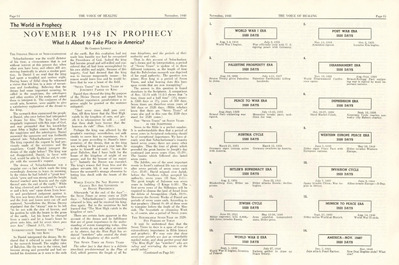
1948 Doomsday: Prophecy and Politics
After the birth of Latter Rain and the Latter Rain Revival, and as Branham's associates began to join into the Voice of Healing Revival, William Branham and his associate editors of the Voice of Healing Publication began promoting the idea that 1948 would be the year of destruction. A section of the publication entitled "The World In Prophecy" started informing readers of the "prophetic" and mathematic projections pointing to the End of Days using charts, graphs, numerologies, and specific passages from the Christian Bible without their surrounding Biblical context.
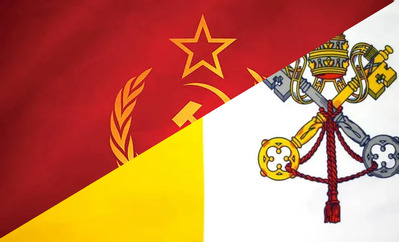
1933 Prophecy of the Isms: Branham’s Changing End-Time Vision
William Branham did not publicly mention his supposed 1933 visions until 1953, when he claimed to have prophesied that Communism, Fascism, and Nazism would merge into a single system that would dominate the world and burn the Vatican—a narrative that closely echoes earlier fundamentalist apocalyptic literature and is flatly contradicted by subsequent history. As Communism failed to conquer Europe and eventually collapsed, Branham quietly revised his message, recasting Roman Catholicism rather than Communism as the final world power, presenting this reversal not as a correction of failed prophecy but as further divine revelation.
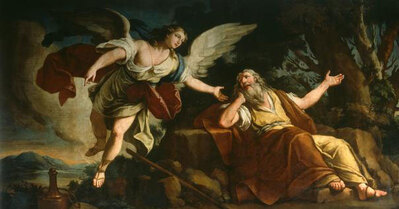
The Elijah Prophet Myth: William Branham, Restoration Theology, and Control
William Branham’s claim to embody the spirit of Elijah developed gradually through restorationist theology, culminating in an end-time messenger doctrine that redefined biblical authority and spiritual legitimacy. Rooted in ideas drawn from British Israelism and echoed in Christian Identity thought, this framework produced profound theological errors and fostered authoritarian control, gender policing, and suppression of dissent.
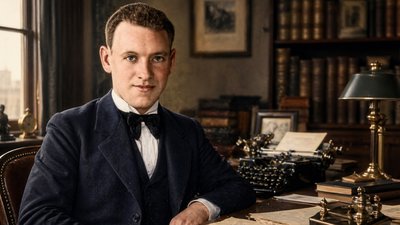
Philip E. J. Monson
Philip E. J. Monson was a British Israelite organizer, founder of Covenant Evangelistic Association, Kingdom Bible College, and Zion Press, and a key West Coast promoter of Anglo-Israelism through Howard Rand's Anglo-Saxon Federation of America, using Bible classes, publishing, and institutional networks to spread racialized prophecy teaching; his 1928 "two-seed" thesis, which linked Cain to Satan and Abel to a supposedly pure bloodline, became an important precursor to later Christian Identity and Serpent's Seed doctrine, influencing figures such as Wesley Swift and forming part of the ideological stream that later overlapped with William Branham's Latter Rain-era Serpent's Seed teaching.
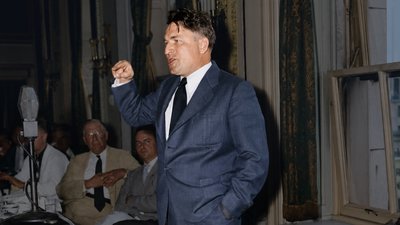
Gerald L. K. Smith
Rev. Gerald L. K. Smith was a minister from Wisconsin known for his mixture of religion and politics to spread the white supremacy agenda. He was instrumental in transforming British Israelism into the Christian Identity movement of the 1940s and 1950s. When the Americanized version of British Israelism began to develop themes of antisemitism and white supremacy, Smith was the leading ultra-right-wing figure[1] organizing movements that fueled the change.
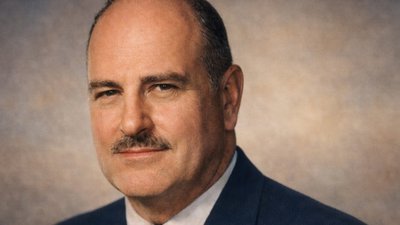
Gordon Winrod: From Defenders of the Faith to States’ Rights Politics
Gordon Winrod did not emerge from the fringes but from a religious ecosystem that had already normalized antisemitic and racialized theology through revivalist platforms and institutional protection. By tracing the connections between Gerald B. Winrod, Aimee Semple McPherson, Gordon Lindsay, and the healing revival infrastructure, this research demonstrates how extremist ideology migrated seamlessly from prophecy preaching into organized political activism.
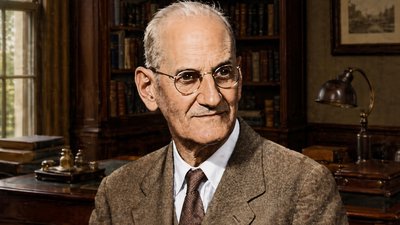
Howard Rand
Howard Benjamin Rand was an attorney, Prohibition Party figure, founder of the Anglo-Saxon Federation of America, and one of the most important American organizers of British Israelism, blending pyramidology, prophecy, racialized identity, anti-Roosevelt politics, antisemitic propaganda, and claims that Anglo-Saxons descended from biblical Israel into a system that helped move British Israel teaching toward Christian Identity; through figures such as William J. Cameron, Gerald Winrod, Gordon Lindsay, and later William Branham's Serpent's Seed theology, Rand's network became part of the ideological background connecting fundamentalist politics, white supremacy, Latter Rain revivalism, and later Pentecostal and charismatic restorationist movements.
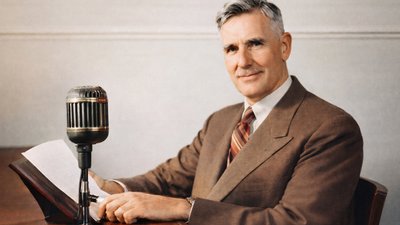
Charles Fuller and the Political Foundations of Modern Evangelical Media
Charles Fuller emerged as a powerful radio evangelist whose ministry blended revivalism, political activism, and prophetic rhetoric during a period of intense religious and cultural upheaval in the United States. His associations with figures such as Gerald B. Winrod, Paul Rader, and William Branham, along with the founding of Fuller Theological Seminary, positioned him as a key transitional figure linking early fundamentalism to later charismatic and Third Wave movements.
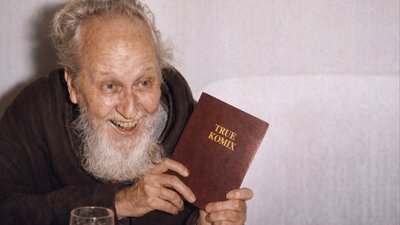
David Berg and William Branham: The Prophetic Roots of the Children of God
David Berg, founder of the Children of God cult, repeatedly credited William Branham and the Latter Rain movement as decisive influences on his theology, prophetic worldview, and rejection of denominational Christianity. This analysis traces how Branham’s prophecies, eschatology, angelology, and racial doctrines were absorbed, adapted, and radicalized within Berg’s movement, contributing to its apocalyptic ideology and abusive practices.
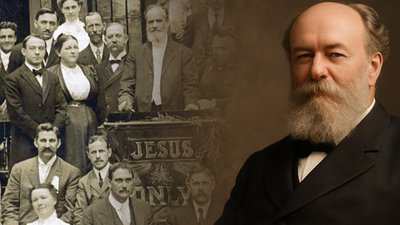
A. B. Simpson: From Million Dollar Revivals to Doomsday Prophecy
A. B. Simpson, founder of the Christian and Missionary Alliance, promoted Keswick-style “Higher Life” teachings, sensational revival practices, and apocalyptic fundraising that critics linked to manipulation and misuse of donated funds. His influence—directly and through figures like the Raders, Bosworth, and Frank Sandford—helped spread Second-Blessing theology and shaped later healing-revival movements, even as many of his doctrines and failed predictions drew significant theological and ethical criticism.
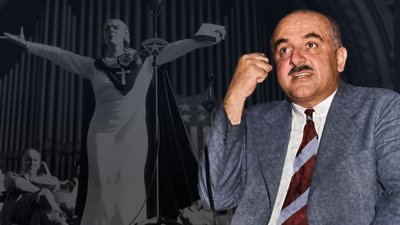
Gerald Burton Winrod
Gerald Burton Winrod was a fundamentalist preacher, publisher, political agitator, and Christian-fascist organizer whose antisemitic, anti-Catholic, British Israelite, anti-Roosevelt, and pro-Nazi propaganda helped shape the ideological world that later fed Christian Identity, Serpent's Seed theology, and parts of the radical revivalist atmosphere surrounding the postwar healing movement; through his Defenders of the Christian Faith, Capitol News and Feature Service, promotion of the Protocols of the Elders of Zion, ties to William J. Cameron, William D. Upshaw, Roy E. Davis, Paul Rader, F. F. Bosworth, Gordon Lindsay, and other fundamentalist and Pentecostal figures, Winrod functioned as a bridge between far-right religious politics, racialized prophecy, anti-communist conspiracy, British Israelism, and the networks that later overlapped with William Branham, Latter Rain, and the Voice of Healing revival world.
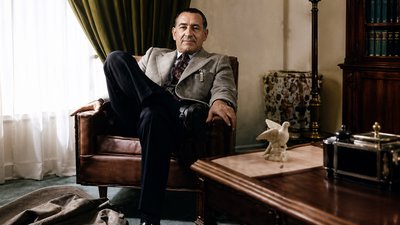
Lee Vayle
Lee Vayle was one of William Branham's closest collaborators, serving as editor, publisher, public interpreter, and doctrinal assistant for the Message movement, with Branham honoring him as "Doctor" and relying on him to help shape, preserve, and promote teachings that later became central to Branham's cult of personality; Vayle's reported explanations of the hidden racial meaning behind Serpent's Seed, including claims that the serpent produced a "colored" or Black race through Eve, show how Branham's public doctrine, private interpretations, and later Message defenses worked together to obscure the white supremacist implications of Branham's theology while continuing to transmit them through trusted leaders and sister churches.
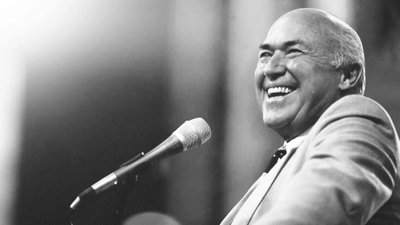
Chuck Smith
Chuck Smith, founder of Calvary Chapel, helped shape the Jesus People Movement while carrying forward influences from Foursquare Pentecostalism, Latter Rain revivalism, and figures connected to William Branham, Paul Cain, Lonnie Frisbee, and John Wimber.
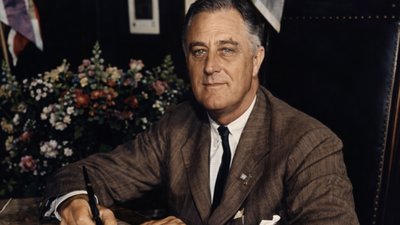
Franklin D. Roosevelt and William Branham’s Failed World War Prophecy
William Branham later claimed that a vision from 1932 or 1933 foretold Franklin D. Roosevelt leading the world into war, but his own recorded statements reveal shifting dates, expanding details, and retrospective framing. By comparing Branham’s evolving claims with the actual chronology of World War II, the narrative shows why the Roosevelt prophecy fails historical scrutiny.
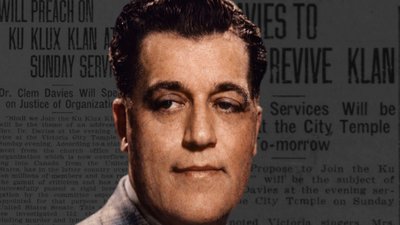
Clem Davies: The White Supremacist Preacher Behind Revivalist Networks
Clem Davies was a transnational revivalist figure whose ministry fused white supremacy, British-Israelism, and apocalyptic prophecy with mass revival techniques decades before the rise of postwar healing movements. His networks, teachings, and organizational methods formed an ideological and structural pipeline that carried racialized theology into later Pentecostal, Latter Rain, and charismatic revival contexts.
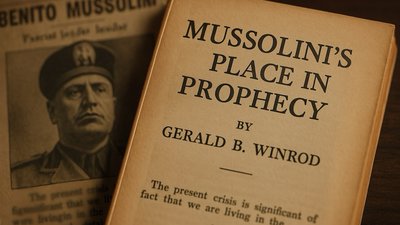
Benito Mussolini in Prophecy: How Fascism Fueled Identity Apocalypticism and Branham's 1933 Visions
William Branham’s later retellings of “1933 visions” about Mussolini, the “three isms,” and the Vatican’s destruction closely track themes already published and promoted within Christian Identity circles—especially Gerald B. Winrod’s 1933 prophetic framing of Mussolini. It then traces how those borrowed apocalyptic motifs were repackaged through Branham’s authority and carried forward into postwar revivalism, Latter Rain theology, and later Charismatic/NAR prophetic culture.
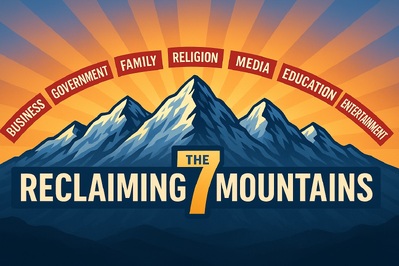
Seven Mountain Mandate

Anglo Saxon Christian World: The Vancouver Movement and the Making of Christian Identity
Anglo-Saxonism and its North American expression in the Anglo-Saxon Christian World fused British Israelism, apocalyptic rhetoric, militarism, and white supremacist ideology to construct a theologically sanctioned vision of a divinely chosen Anglo-Saxon race. Through figures such as J. G. Wright, Clem Davies, Gordon Lindsay, and Herbert W. Armstrong, the movement became an influential conduit linking early Christian Identity, the Latter Rain revival, and emerging forms of televangelism.
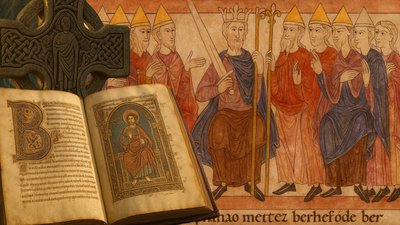
Anglo-Saxonism and Its Influence on Early Pentecostal and Latter Rain Movements
Anglo-Saxonism, rooted in British Israelism and later adapted into American white supremacist theology, influenced key figures who helped shape both the Christian Identity movement and segments of mid-century Pentecostalism. Through leaders such as Wesley Swift, Gordon Lindsay, and George Hawtin, elements of this racialized ideology permeated revival networks, leaving a lasting imprint on parts of the Latter Rain and healing
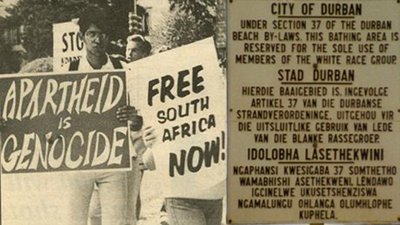
How Pentecostalism Helped Build Apartheid: The Hidden Latter Rain Connection
Apartheid was a religious and political system of racial segregation in South and current Nambia from 1948 to the early 1990s. The system enabled the white minority in South Africa to politically, socially, and economically dominate while discriminating against the black-skinned majority. While many factors contributed to apartheid, evidence suggests that the Latter Rain Movement played a key role in its creation.
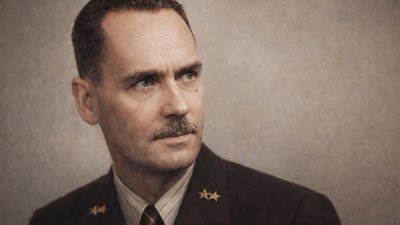
Conrad Gaard: The Forgotten Architect Behind Branham’s Pyramid and Zodiac Theology
Conrad Gaard functioned as a critical but largely unrecognized bridge between British-Israel theology, pyramidology, zodiac symbolism, and the organizational networks that later shaped William Branham’s ministry. By tracing Gaard’s lectures, institutional leadership, and ideological ties to figures such as Gordon Lindsay, Wesley Swift, and Gerald L. K. Smith, this study demonstrates that key elements of Branham’s prophetic framework were inherited rather than uniquely revealed.

Celestial Beings and the Hidden Roots of Charismatic Theology
This presentation traces the doctrine of celestial beings from British Israelism and Christian Identity movements into the Latter Rain revival through figures such as William Branham and Gordon Lindsay. By examining sermons, historical records, and theological claims, it reveals how pre-existence and celestial body teachings quietly reshaped modern Charismatic Christianity.
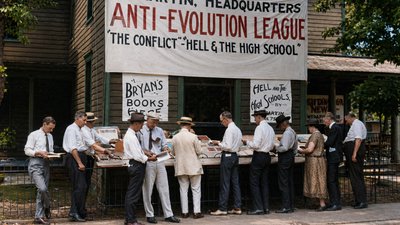
World Christian Fundamentals Association
The World Christian Fundamentals Association, founded by William Bell Riley in 1919, was a militant fundamentalist organization that moved beyond the original five doctrinal fundamentals of Christianity into aggressive political, cultural, and sectarian warfare against liberal theology, modernism, evolution, Catholicism, and religious pluralism. Under leaders and allies such as Riley, Roy E. Davis, John Roach Straton, Gerald Burton Winrod, and William Jennings Bryan, the WCFA framed opponents as false Christians and enemies of the faith, promoted investigations of schools, pulpits, seminaries, missionaries, and denominations, and used publications such as The Fundamentalist to identify and attack perceived modernist threats. Its campaigns against Darwinism, public education, Catholic influence, and theological liberalism helped radicalize American fundamentalism into a combative movement that blended apocalyptic fear, political activism, anti-modern rhetoric, and exclusionary religious identity.
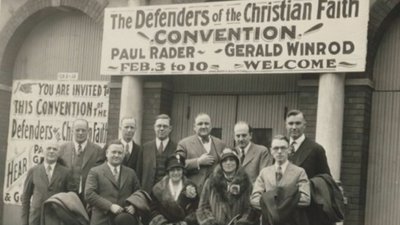
Defenders of the Christian Faith: How Fundamentalism Fueled Fascism in America
The Defenders of the Christian Faith emerged in the 1920s as a fundamentalist movement that fused biblical literalism with political radicalism, eventually aligning itself with fascist and antisemitic ideology. Under the leadership of Gerald Burton Winrod, the organization played a significant role in spreading Nazi propaganda in the United States and was ultimately named as a co-conspirator in the Great Sedition Trial of 1944.
No records found.