
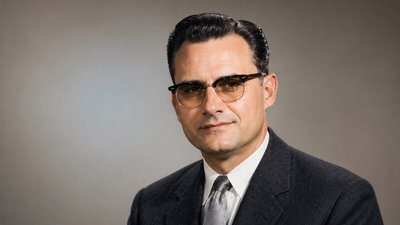
Rev. W. E. Best
Rev. Wilburn Elias Best was a Texas Baptist and later non-denominational minister whose 1950 debate with F. F. Bosworth during William Branham's Houston healing revival became the setting for Branham's famous "halo photograph." Local Baptist ministers had objected to Branham's advertised "miracles every night" campaign and appointed Best to challenge the theology and claims of the traveling divine-healing movement, though Branham's later retellings portrayed Best as angry, defeated, and aligned against God's healing power. Best's own writings show a more nuanced position: he did not deny that God could heal, but rejected what he saw as counterfeit healing ministries that tied salvation to physical healing, exaggerated miracles, and placed evangelists between believers and direct prayer to God. The Houston debate therefore became less a simple clash over healing itself than a contest between Branham's revival mythology and Best's warning against manipulative faith-healing claims.
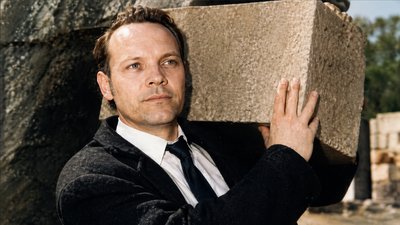
James Ayers
James Ayers was one of the Douglas Studios photographers connected to William Branham's famous 1950 Houston "halo" photograph, but his later significance lies in the criminal and religious scandals surrounding the image's afterlife. Ayers was convicted in a counterfeiting case involving his brother-in-law and business partner Theodore Kipperman, and his family became central to the sensational Leslie Douglas Ashley murder case after Ashley was condemned to death in Texas. During the same period tied to Branham's 1963 mystery cloud narrative, Branham and John Osteen joined efforts to help Ashley avoid execution, while Ayers formed the Ashley-Ayers Evangelistic Association and supported an insanity strategy that portrayed Ashley in prophetic terms as "Elijah the prophet." The result was a remarkable convergence of Branham's miracle-photo mythology, criminal scandal, Pentecostal influence, and competing Elijah claims within the same Houston-centered network.
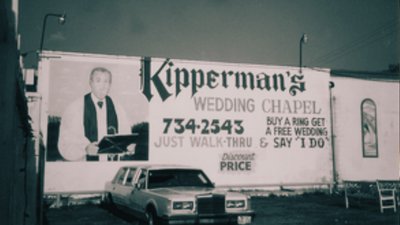
Theodore Kipperman
Theodore "Ted" Kipperman was one of the Douglas Studios photographers connected to William Branham's famous 1950 Houston "halo" photograph, but his surrounding history links that image to a much stranger network of scandal, crime, and religious mythmaking. Kipperman's business partner and brother-in-law, James Ayers, was convicted in a counterfeiting case in which Kipperman was also named, and the family later became tied to the sensational Leslie Douglas Ashley murder case, where Branham and other Pentecostal figures rallied to help Ashley avoid execution while ignoring his accomplice, Carolyn Lima. Through Ayers' Ashley-Ayers Evangelistic Association, Ashley was presented in prophetic terms during an insanity defense, intersecting oddly with Branham's own Elijah claims and the timeline of the 1963 mystery cloud narrative. Kipperman's later turn as a pawn-shop minister offering free weddings with ring purchases adds another unusual chapter to the troubled circle surrounding Branham's most iconic photograph.
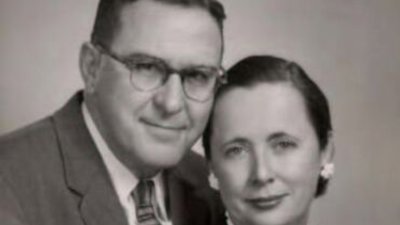
George J. Lacy
George J. Lacy was a Houston-based forensic examiner and private investigator whose limited report on William Branham's famous Houston photograph was later exaggerated into one of Branham's most important supernatural claims. Although Branham described Lacy as the "head of the FBI," FBI Director Clarence M. Kelly later confirmed that Lacy had never worked for the FBI and that the Bureau had no information about the photograph, undercutting Branham's version of the story. Lacy's actual report did not identify the light above Branham's head as supernatural, but merely concluded that the negative had not been retouched, composited, or double-exposed and that the halo-like streak was caused by light striking the negative, making the Lacy report an example of how ordinary forensic language was transformed into religious mythology within Branham's movement.
Light Exposure
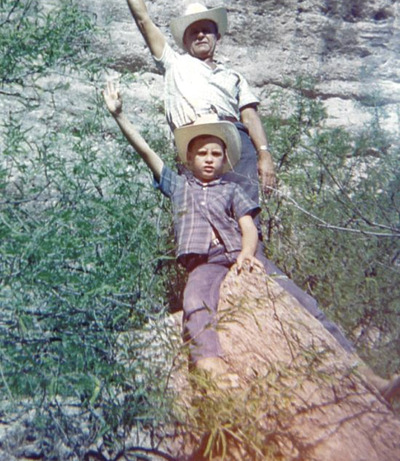
William Branham's "Message" cult members are manipulated into believing that light exposure before film development results in a "supernatural" photograph. While cult leaders have pushed this notion as part of the cult doctrine, many cult leaders were aware that the photographs were spoiled. In one sermon, cult leader Pearry Green admitted this fact:
Manufacturing the Supernatural: How William Branham’s Photographs Were Altered
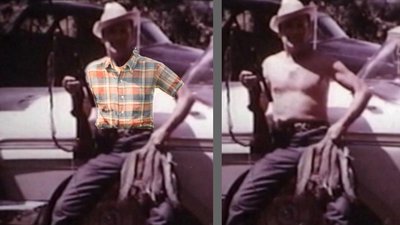
Photographic manipulation played a central role in shaping William Branham’s supernatural claims, particularly through selective editing, cropping, overexposure, and later colorization of key images. These practices, which continue among followers today, transformed ordinary photographic artifacts into enduring symbols used to reinforce Branham’s prophetic authority.
Halation
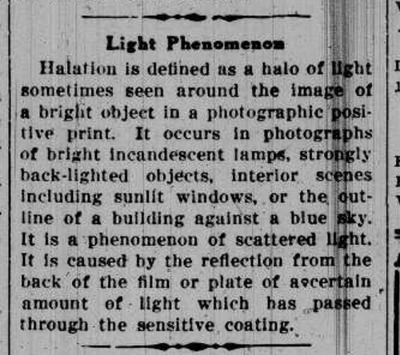
Halation is the action of light surrounding some object as if making a halo. It is caused by the blurring of light around a bright area of a photographic image, or on a television screen.
Pillar of Fire
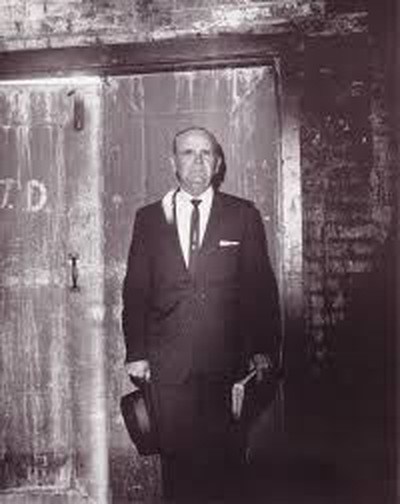
William Branham claimed that same the "Pillar of Fire" described in the Christian Bible was present in his meetings. Various photographs, usually black-and-white, were used to support this claim. According to Pearry Green, William Branham's close associate, some of the photographs were taken with a broken camera which allowed light exposure to the film.
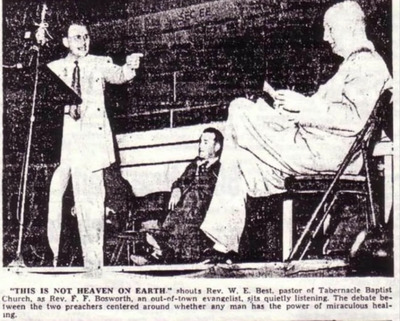
The Bosworth - Best Debate
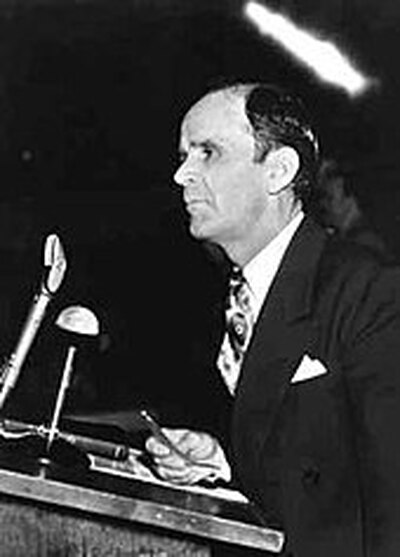
Houston Photograph
William Branham's story about the Houston Photograph of a light above William Branham's head, commonly referred to as his "halo photograph", was confirmed by the FBI to be a fictional tale invented for his stage persona. Freedom of Information Act response can be found here:FBI Response to Branham's Claims about George J. Lacy and Photo Examination
No records found.