
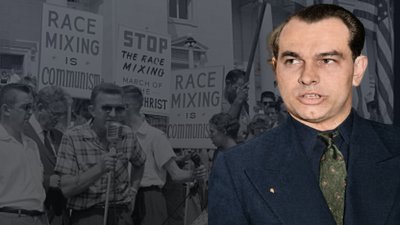
Wesley A. Swift
Wesley A. Swift was a central figure in the development of racist and antisemitic Christian Identity theology, drawing from British Israelism, Philip E. J. Monson's two-seed teaching, Gerald Winrod's far-right religious propaganda, and Anglo-Saxon Federation networks to promote a militant racial theology that identified white Anglo-Saxons as God's chosen people and nonwhite peoples and Jews as spiritually corrupted enemies; through his ties to Angelus Temple, LeRoy Kopp, Gerald L. K. Smith, Klan revival efforts in California, and later extremist groups such as Aryan Nations, Swift became a major bridge between British Israelism, Christian Identity, segregationist politics, white supremacy, and the Serpent's Seed doctrine later popularized by William Branham within Latter Rain and healing revival circles.
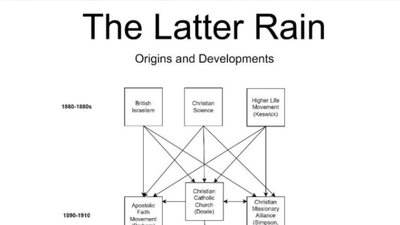
The Latter Rain Origins and Developments
The Latter Rain: Origins and Developments presents a simplified historical map of the religious movements, ministries, and organizations connected to or influenced by the Latter Rain Movement. It traces earlier roots through British Israelism, Christian Science, the Higher Life/Keswick tradition, John Alexander Dowie, Charles Parham, and the Christian and Missionary Alliance, then shows their influence on Pentecostalism and major Pentecostal denominations. From there, the chart places the Latter Rain Movement alongside the postwar Healing Revival and maps its later connections to Full Gospel Business Men’s Fellowship, William Branham’s Message movement, Voice of Healing, Word of Faith, prosperity teaching, the Shepherding Movement, Christian Identity groups, People’s Temple, Calvary Chapel, Vineyard, Bethel, and other charismatic, restorationist, and sectarian movements. The chart is not presented as a complete history, but as an overview of overlapping networks and lines of influence surrounding Latter Rain theology, Pentecostal revivalism, healing evangelism, and later apostolic-prophetic movements.
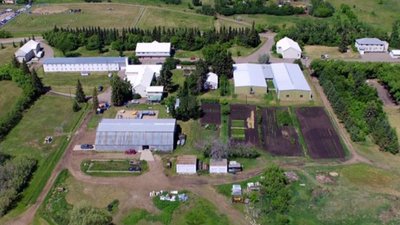
Sharon Orphanage
The Sharon Orphanage in North Battleford, Saskatchewan, was the epicenter of the Latter Rain Movement, emerging from a Foursquare-connected orphanage and Bible school environment tied to Aimee Semple McPherson's Angelus Temple, Herrick Holt, George Hawtin, and the wider postwar healing revival world; through teachings on Joel's Army, restored ministries, prophetic authority, end-time restoration, and spiritual elites, the Sharon network helped launch doctrines later carried through William Branham and the Latter Rain revivals, while its connections to figures such as Hawtin also expose the troubling presence of British Israelism, Christian Identity, and racial hierarchy within streams that shaped restorationist Pentecostal and charismatic theology.
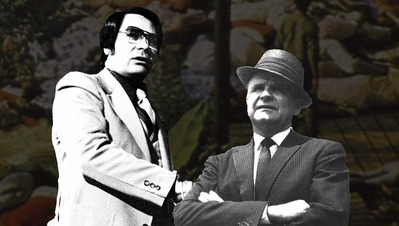
Manifest Sons Of God
William Branham was one of the main catalysts for, promoted by, and strongly affiliated with key individuals in the Latter Rain sect of Pentecostalism. This strange sect gave birth to various sub-sects, one of which was the “Manifest Sons of God” sect, or cult, of Pentecostalism. Like its parent sect of Latter Rain, the Manifest Sons of God sect was based upon doctrines that William Branham himself used as themes in his sermons.[1] Within the Manifest Sons of God sect, there were two major groups: The Walk led by John Robert Stevens and the Body of Christ.
Latter Rain Message
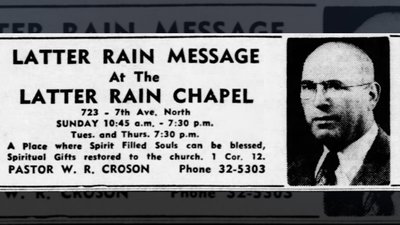
As the Latter Rain sect of Pentecostalism started to spread, and the Latter Rain Revival began to form, the differences in theology from mainstream Pentecostalism and mainstream Christianity became known as the "Latter Rain Message". Promoters of the Latter Rain Message also promoted William Branham's campaigns. The group based their theology upon Branham's doctrine, and Branham's revivals in Canada were viewed as the catalyst that sparked the group's creation. During this time, William Branham referred to his own ministry as "the Message". This term was used and promoted by Joseph Mattsson-Boze, who was critical to the spreading of the New Order of Latter Rain into the United States. Also at this time, Rev. Jim Jones and Peoples Temple referred to their sect's beliefs as "the Message". Jones was ordained as a minister by Joseph Mattsson-Boze, and both Branham and Boze launched Jones' career as a "faith healer" at the Cadle Tabernacle in Indianapolis.
Latter Rain
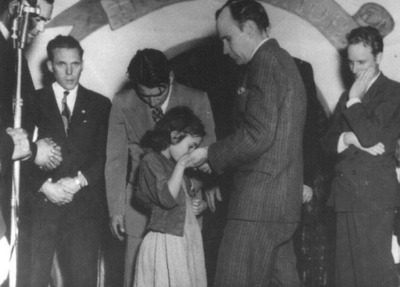
In the fall of 1947, William Branham connected with Gordon Lindsay. Through the campaign management of Gordon Lindsay, William Branham's revival meetings continued into Winnipeg, Manitoba, Canada. There he preached a series of meetings at the "Zion Church of the Original Gospel" to Canadians from near and far. Many people had followed him from the United States. Sick, afflicted, and crippled were being flown to the Zion church from up to 1500 miles away. Branham's followers were sleeping in their cars, and all vacant lots were over crowded. He had been invited by church leaders in larger Canadian cities, and was in very high demand. With the sudden excitement displayed for "faith healers" in the United States, healing campaigns were increasingly popular in Canada. The crowds followed Branham as he traveled from Winnipeg to Saskatoon, and finally to Vancouver, BC.
No records found.