
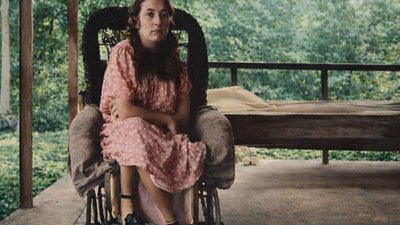
Edith Wright: How a Lifelong Disability Became a Prophetic Narrative
Edith Wright’s case provides a clear, traceable example of a healing claim that can be followed from initial prayer through decades of reinterpretation. Despite repeated prayers, prophetic declarations, and theological reframing, Edith remained disabled until her death, revealing how failed healings were absorbed into narrative systems designed to preserve spiritual authority.
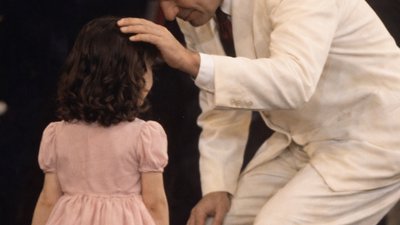
Carol Ruth Strubler: A Documented Case of Failed Faith Healing
Carol Ruth Strubler was a nine-year-old child diagnosed with terminal acute leukemia who was publicly pronounced healed by William Branham during a June 24, 1954 revival meeting in Washington, D.C. Contemporary newspaper reports, Branham’s own recorded words, and later eyewitness testimony show that the healing claim failed, exposing a clear gap between revivalist assurances and verifiable outcomes.

Lost Your Healing
William Branham's healing ministry relied on a self-protecting system in which alleged successes were promoted as proof of divine power while failures were blamed on the supposed sins, doubts, or disobedience of the person seeking healing. Working alongside F. F. Bosworth, Branham helped popularize the idea that people could "lose" or fail to "keep" their healing for reasons unrelated to the healer, allowing failed outcomes to be reinterpreted as moral or spiritual failure. Examples such as the boy whose missing eye was blamed on reading comic books, Walker Beck's failed healing being blamed on tobacco, and revival claims surrounding Ronnie Coyne's prosthetic eye illustrate how Branham's movement used spectacle, victim-blaming, and unverifiable healing testimonies to preserve the reputation of the healer even when promised miracles did not occur.
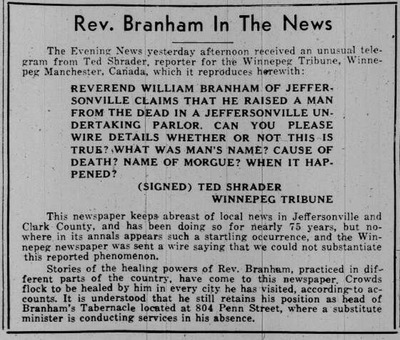
Raised A Man From The Dead
William Branham frequently claimed in his healing revivals that he had raised people from the dead and that these miracles were supported by verifiable, "bona-fide" statements, but newspaper investigations found that at least one major claim collapsed under scrutiny: when Branham told Canadian audiences that he had raised a man from the dead in a Jeffersonville undertaking parlor, reporters contacted the Jeffersonville Evening News, whose staff found no record of such a sensational event and traced the story instead to Elijah Perry, a sick railroad worker whom Branham himself had apparently pronounced dead without a physician present, revealing how Branham's stage persona transformed an unverified private prayer episode into a public resurrection claim.
No records found.