
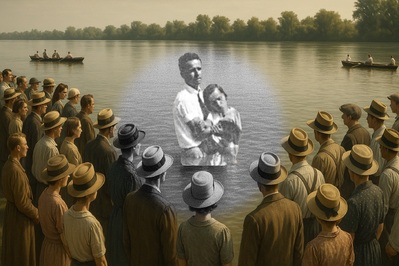
1933 Baptism: The Voice No One Heard
Dismantling William Branham’s famed 1933 Ohio River baptism story—showing that claims of a visible light, an audible commissioning voice, massive crowds, and nationwide newspaper coverage are contradicted by eyewitnesses, contemporary press records, and the documented history of his church and mentor, Roy E. Davis. It argues that the baptism narrative and the so-called 1933 prophecies were retrofitted into Branham’s biography as tools of authority, illustrating how myth-making and repetition, rather than verifiable evidence, became the foundation for prophetic belief in the Message movement.

Berniece Hicks: Branham’s Sunday School “Messenger” and the Rise of Christ Gospel Church International
Berniece Hicks emerged from William Branham’s inner circle—teaching in his tabernacle, participating in early revival networks, and adopting the same “Message”-adjacent doctrines and source-material claims—before building Christ Gospel Church International into an isolationist movement centered on her own prophetic authority. Over time, her teachings expanded into militant Manifest Sons/“Joel’s Army” themes, increasingly extraordinary supernatural claims, and accusations from former members that drew public scrutiny, including a 1979 Louisville Courier-Journal investigation.
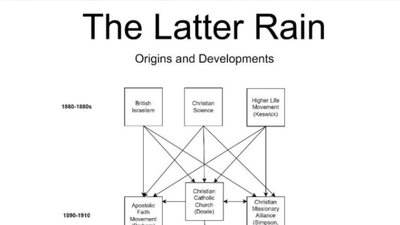
The Latter Rain Origins and Developments
The Latter Rain: Origins and Developments presents a simplified historical map of the religious movements, ministries, and organizations connected to or influenced by the Latter Rain Movement. It traces earlier roots through British Israelism, Christian Science, the Higher Life/Keswick tradition, John Alexander Dowie, Charles Parham, and the Christian and Missionary Alliance, then shows their influence on Pentecostalism and major Pentecostal denominations. From there, the chart places the Latter Rain Movement alongside the postwar Healing Revival and maps its later connections to Full Gospel Business Men’s Fellowship, William Branham’s Message movement, Voice of Healing, Word of Faith, prosperity teaching, the Shepherding Movement, Christian Identity groups, People’s Temple, Calvary Chapel, Vineyard, Bethel, and other charismatic, restorationist, and sectarian movements. The chart is not presented as a complete history, but as an overview of overlapping networks and lines of influence surrounding Latter Rain theology, Pentecostal revivalism, healing evangelism, and later apostolic-prophetic movements.
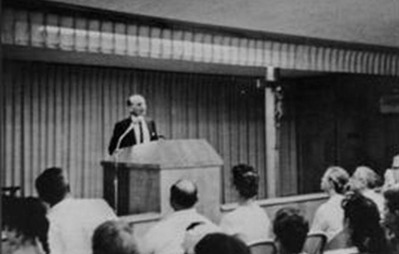
The Message
"The Message" is the name collectively used by members of William Branham's religious cult following to describe themselves. Other names are also used, including but not limited to, "End Time Message", "Bride", "Bride Church", "The Elect".

Editing the Prophetic: How William Branham Controlled the Record
William Branham made deliberate use of lighting, recording controls, and post-production edits to maintain different versions of his public persona. Paused tapes, spliced recordings, and revised prophecies reveal a managed narrative that complicates claims of spontaneous or supernatural authority.
No records found.