

Donny Reagan: A Case Study of Racism in Branham Cult Leadership
Donny Reagan’s viral sermon opposing interracial marriage revealed the continued influence of William Branham’s racial theology within contemporary churches aligned with the Branham movement. Media coverage, church defenses, and Reagan’s own quotations demonstrate that the controversy was not an isolated incident but a modern expression of a long-standing doctrinal system rooted in segregationist beliefs.

Pentecostal Hairstyle Doctrine
Dionysian worship in ancient Corinth provides important background for understanding Paul's instructions about women praying or prophesying with uncovered heads in 1 Corinthians 11, because the cult of Dionysus emphasized ecstatic worship, intoxication, mystery initiation, female frenzy, loosened hair, ritual madness, and symbolic death-and-rebirth practices that sharply contrasted with ordered Christian worship; later Pentecostal interpretations often detached Paul's comments from this Greco-Roman religious setting and turned the passage into a rule against women cutting their hair, even though the Corinthian issue appears more closely tied to public worship, veiling, sexual and religious signaling, and the rejection of pagan ecstatic customs rather than a universal ban on hair trimming.

William Branham’s Divorce Doctrine and the Collapse of Biblical Authority
William Branham taught that a woman cutting her hair constituted biblical grounds for divorce, presenting this claim as a direct divine decree rather than interpretive opinion. This doctrine conflicts with explicit apostolic teaching on marriage, revealing deeper theological problems involving authority, revelation, and the sufficiency of Scripture.

Women Saved Through Sex
Some versions of William Branham's stage persona taught that female Christians could only be saved through sex. Building upon his Serpent's Seed (Christian Identity) doctrine, Branham insinuated that the "good bloodline" would be maintained through the offspring of the female, which was her sole purpose in God's "master plan" for the "master race". During sermons preached by this version of the stage persona, Branham disagreed with Genesis 5:2, claiming that the female human was not in the original creation, and instead was designed by Satan.

William Branham’s “Giant Ants” Prophecy: Fear, Fantasy, and Control in the Message Movement
In his later years, William Branham introduced increasingly extreme apocalyptic teachings—such as visions of giant ants and birds—that he linked to end-time plagues and used to reinforce gender-focused punishments and fear-based control. After his death, some “Message” leaders, including Roger Rudin in Phoenix, further exploited these prophecies to drive doomsday migration, suppress critical thinking, and conceal personal hypocrisy, even as followers’ tithes quietly funded Rudin’s gay bar.
Women Preachers
In some versions of his stage persona, William Branham opposed women taking an active role in the church. Those versions of the stage persona preached very strongly against female ministers but also preached against women participating in spiritual gifts. According to Branham in those instances, women should be "in the kitchen" instead of participating in the worship service.

William Branham’s Creation Theology: How Heresy, Racism, and Misogyny Were Rebranded as Revelation
William Branham’s creation theology departed sharply from Scripture by redefining the image of God, denying the divine creation of women, and introducing racialized identity doctrines rooted in extra-biblical revelation. This examination contrasts Branham’s teachings with the biblical account of creation, sin, and redemption, demonstrating how his theology distorted Christian doctrine and produced lasting spiritual and social harm.

Women
William Branham admitted to having struggled with destructive views of women from an early age. According to Branham, he had thoughts of killing women during his youth, and still struggled with thoughts of killing as an evangelist.[1] Branham recognized the fact that others were aware of his issue with women, and frequently stated that his thoughts of killing excluded women within his own following.[2] According to the testimony of former followers, Branham's statements were used as the basis for physical and sexual abuse. [3]

The Woman's Breast
William Branham preached strongly against women wearing support bras. According to Branham, women who wore support bras were doing so because of getting a "devil spirit", not understanding the purpose of wearing proper support. As a result, some women in Branham's "Message" cult following feel ashamed of their shape, especially those women with larger cup sizes, and some women do not wear the proper support. Others try to conceal their shape, either through loosely fitting blouses or by folding their shoulders inward. They do not want to be at risk of being accused of supporting their breasts "to attract [the] attention of men through sex".
Tree of Death
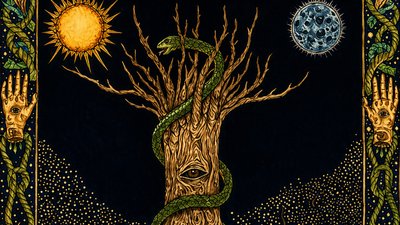
William Branham's "Tree of Death" teaching was a misogynistic extension of his Serpent's Seed doctrine, recasting the Genesis account so that original sin was not disobedience to God's command but a sexual act between Eve and the serpent, while portraying the female gender itself as a lower, Satan-designed "perversion," an incubator rather than a true bearer of life, and the symbolic tree through which death entered the world; in this system, women became central to Branham's theology of corruption, impurity, and spiritual danger, reinforcing cultic control over gender, sexuality, marriage, and female behavior within his Message movement.

Women Are Behind Every Crime
Later versions of William Branham's stage persona claimed that not only were women the cause for all sin on the earth, they were currently the reason for criminal activity. Branham supported this theory by agreeing with unknown statistics that claimed that ninety-eight percent of all crime — in any form — was either committed directly by a female or that a female was the mastermind behind it. The exact source of these statistics, however, was never mentioned.

Women's Gatherings
Though William Branham's first wife, Hope, enjoyed parties of all sorts, from pool parties,[1] to bunco,[2] to birthday parties with music and contests for William as a young pastor,[3] later versions of William Branham's stage persona spoke against such things — especially parties for women. According to Branham, when women gathered to sew, cross-stitch, or for casual tea parties, they were doing wrong. Women were not permitted to tell jokes.

Russia
William Branham's Russia and "isms" prophecy shifted repeatedly across his ministry, beginning with Cold War claims that Communism, Fascism, and Nazism would merge into one communist world system led by Russia, with Russia eventually destroying Rome and the Vatican, before later reversing into the opposite claim that Romanism, not Communism, would conquer the world and that Russia was merely a puppet or even a nation open to revival; the changing timeline shows how Branham adapted his alleged 1933 prophecy to political developments, campaign needs, anti-communist fear, failed predictions, and later opportunities in Russian revival work, transforming Russia from the divinely raised destroyer of nations into a field "hungering and thirsting for God."

John R. Rice
Rev. John Richard Rice was a Texas Baptist evangelist, founder of The Sword of the Lord, and a major fundamentalist influence whose anti-Catholic, patriarchal, anti-modernist, and white-supremacist religious framework helped shape the later Religious Right and overlapped strongly with doctrines promoted by William Branham. Raised in a Ku Klux Klan-connected family and rooted in the same Texas fundamentalist world that produced figures such as Roy E. Davis, Rice advanced teachings against women preachers, women in authority, and women cutting their hair, especially through Bobbed Hair, Bossy Wives, and Women Preachers, themes that later became central to Branham's sermons and cultic identity markers. Rice's role in post-Scopes fundamentalism, his connections to nationally recognized ministers, and his claims about Fascism and Mussolini show how many ideas Branham later presented as prophetic revelation were already circulating in radical fundamentalist networks before Branham's rise in the healing revivals.

William Branham’s Woman President Prophecy: The Myth of a 1933 Prophecy
William Branham claimed that a 1933 vision foretold a woman becoming President of the United States, yet the prediction only appeared in his preaching decades later, after the idea was already common in American culture. As political events unfolded, the claim was repeatedly reinterpreted and reassigned, revealing a pattern of retrospective adjustment rather than a stable prophetic forecast.

Marriage, Divorce, and Contradiction in William Branham’s Ministry
William Branham’s teachings on divorce and remarriage evolved from early permissive language to rigid, gender-asymmetric prohibitions that carried severe spiritual consequences. Civil records and Branham’s own admissions show that, despite these public teachings, he continued to officiate remarriages—especially within his own family—revealing a persistent gap between doctrine and practice.
No records found.