
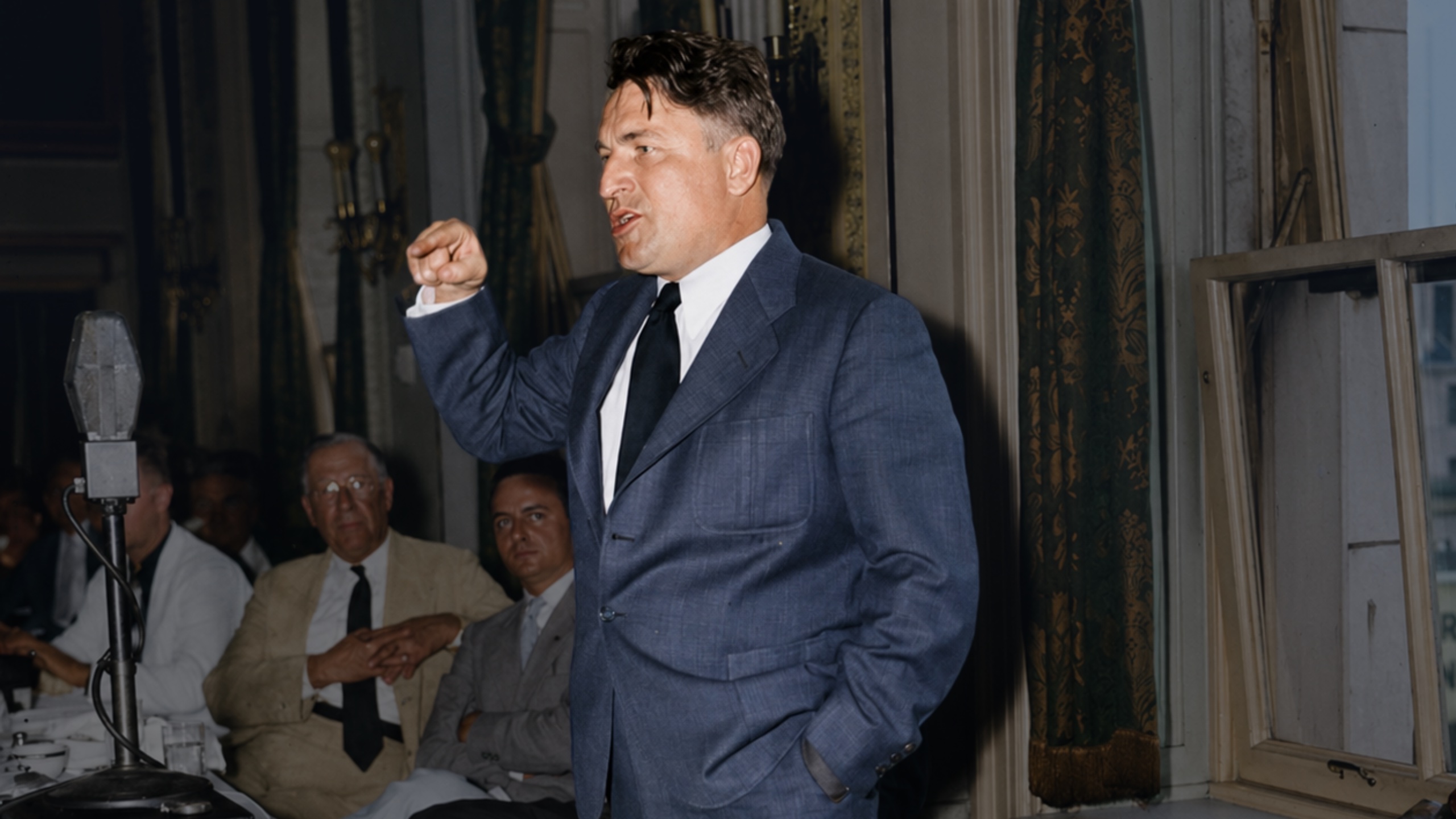
Gerald L. K. Smith
Rev. Gerald L. K. Smith was a minister from Wisconsin known for his mixture of religion and politics to spread the white supremacy agenda. He was instrumental in transforming British Israelism into the Christian Identity movement of the 1940s and 1950s. When the Americanized version of British Israelism began to develop themes of antisemitism and white supremacy, Smith was the leading ultra-right-wing figure[1] organizing movements that fueled the change.
Rev. Gerald L. K. Smith was a minister from Wisconsin known for his mixture of religion and politics to spread the white supremacy agenda. He was instrumental in transforming British Israelism into the Christian Identity movement of the 1940s and 1950s. When the Americanized version of British Israelism began to develop themes of antisemitism and white supremacy, Smith was the leading ultra-right-wing figure[1] organizing movements that fueled the change.
Smith's mixture of militant religion and politics began during his early years as a Disciples of Christ minister. Smith toured the states of Illinois and Indiana, sharing moving pictures of the Chicago Preparedness Parade in support of the Preparedness Movement.[2] The movement's objective of strengthening the United States Military was very popular among the Indiana churches, especially as Ku Klux Klan membership exploded in Indiana. During the heyday of the Indiana Klan in the 1920s, under the rule of D. C. Stephenson, the Klan had silently invaded everything from churches to government seats in Indianapolis. In 1924, the same year Stephenson was appointed Grand Dragon of the Indiana Klan, Smith moved to Indianapolis to lead the Seventh Christian church.[3]
In the mid-1920s, Gerald Smith's wife contracted tuberculosis, changing the course of Smith's life significantly. In August 1929, Smith resigned as head of the University Place Church to relocate to Shreveport.[4] Tuberculosis was, at the time, the leading cause of death in the United States and was especially bad in Indiana. There were over 800,000 tuberculosis cases in the nation at the time, which was half the rate during its peak,[5] yet Indianapolis did not have a tuberculosis hospital.[6] The Pines Sanitorium in Shreveport, however, advertised over 150 cases of tuberculosis restored to health.[7] At the end of August, Smith held services at the Kings Highway Christian Church in Shreveport and began preparing to take over as head pastor.[8]
It is unclear why Smith chose Shreveport as his city of residency. If simply for tuberculosis, Shreveport was but one of many places with medical care for the disease. The lowest death for tuberculosis was in Massachusetts, and a controlled government experiment a few years earlier had reduced the death rate by almost 70%. That statistic was announced in the Indianapolis Times before Smith's resignation announcement.[9] From both a Latter Rain and white supremacy standpoint, however, Shreveport was significant. Shreveport would later become the headquarters of the William Branham healing revivals, and Branham's primary organ, The Voice of Healing, would be published from Shreveport[10] until the organization moved to Dallas and transitioned into Christ For the Nations International (CFNI).[11] Nearby Bossier City was an integral part of the protestant revival and recruiting circuit[12] for Branham's mentor and former second-in-command of the 1915 Ku Klux Klan, Roy E. Davis.
Though Gerald L. K. Smith was a Disciples of Christ minister at the time William Branham and Roy Davis were establishing a Pentecostal sect called the "Pentecostal Baptist Church of God," the two religious sects were connected through Assemblies of God minister G. C. Lout. Lout was the founder of Shreveport's first Pentecostal church. [13] Lout had planted or helped plant several churches, including his son-in-law, Jack Moore's Life Tabernacle, from which Branham's organization was promoted. Lout came under fire for the Pentecostal stance against medicine during the early 1920s after the death of an infant due to rejection of medical care,[14] but by the time Smith arrived, Lout was the secretary of the Louisiana state council of the Pentecostal Church, and Shreveport was chosen for the 1929 convention of Pentecostals.[15] Interestingly, Lout was engaged in a covert mission initiated by Smith's Kings Highway Christian Church before Smith's move to Shreveport.
Rev. A. Preston Gray, pastor of the Kings Highway Christian Church until Smith, was the Secretary of the Shreveport Ministerial Association.[16] The Federal Council of Churches of Christ spearheaded several political and religious agendas through the Association,[17] the most interesting of which was a covert operation to root out violations of the Prohibition Act. Shreveport was also in the revival circuits of Temperance Movement leader and Branham's and Davis's close associate, Rev. William D. Upshaw.[18] Though he was a Baptist minister, Upshaw personally endorsed men who participated in revivals at Kings Highway Christian Church.[19] Gray spoke at state meetings of the Women's Christian Temperance Union in support of prohibition, aligned with Upshaw's agenda,[20] and used the power of the Ministerial Association to enforce that agenda in Shreveport. The covert mission began by announcing that the Ministerial association had appointed a "secret committee of ministers to keep tab on the courts."[21] After Gerald L. K. Smith replaced Gray, Pentecostal minister and association member G. C. Lout[22] became a double agent by spying on the Ministerial Association for police commissioner Dawkins.[23] In the aftermath, it was learned that former judge and then-Mayor J. G. Palmer knew of Lout's secret mission from the beginning.[24] Palmer had close ties to Gray and/or Smith; he was often involved with the activities of the King's Highway Christian Church[25] and sang hymns at the Ministerial Association meetings.[26]
Mayor J. G. Palmer was not the only political figure involved with the King's Highway Christian Church, A. Preston Gray, and Gerald L. K. Smith. Gray was personally acquainted with left-wing politician and anti-evolution leader William Jennings Bryan,[27] and Bryan held meetings sponsored by King's Highway Christian Church and announced by Judge J. G. Palmer.[28] Under Smith's leadership, the church included not only the mayor but also the two bank presidents and the president of the Chamber of Commerce. Those connections gained Gerald L. K. Smith a leading position with the senatorial campaign of left-wing populist and later Louisiana Governor Huey P. Long.[29] Smith was at Long's side when Dr. Carl Weiss fatally shot Long, and bodyguards pumped scores of submachine gun bullets into Weiss.[30]
In 1937, Gerald L. K. Smith organized a "Committee of 1,000,000 against communism or any other ism that threatens the overthrow of the United States government."[31] The "Anti-Ism Groups," as they came to be known, spread propaganda claiming that the "isms" were silently invading the United States. This ultimately led or strongly contributed to the events leading to the Great Sedition Trial of 1944. Though it was not successful as a political movement, the "Anti-Isms" fueled the religious movements for decades to come. In the mid-1950s, William Branham claimed to have prophesied against the "isms" in 1932 or 1933.[32] Branham, as leader of the post-WWII Healing Revival, spread "anti-ism" rhetoric combined with apocalyptic themes throughout the revivals. Smith's organization, however, was not limited to political activism; Smith, as a minister, created many of those themes from the group's inception and structured it much like the Ku Klux Klan. Members of the organization received "confidential admission cards" to "executive discussions of plans and purposes." Applications for membership required information on the applicant's religious background and military service.[33] Smith was building an army. In 1942, Smith named that army the "Christian Nationalists".[34]
Shortly after Roy E. Davis and William D. Upshaw began their operation to fund the third wave of the Ku Klux Klan using the Ussher-Davis Children's Orphanage as a front in 1944, the California Ku Klux Klan was revived.[35] That same year, Gerald Smith reorganized under the name "America First," centering his political campaign around issues of "nationalism" with the same "Christian Nationalism" theme.[36] By 1946, the Klan was out in force, burning crosses, attacking Jews and blacks, and brandishing weapons. Former Foursquare minister Wesley A. Swift became the public face of the movement, and he named Gerald L. K. Smith as the national leader.[37]
After being active in the same areas in Shreveport in the 1930s and Los Angeles in the 1940s, Gerald L. K. Smith and Roy E. Davis joined forces in the 1950s at the Little Rock Nine incident in the battle for Civil Rights. Declassified FBI documents named Davis as the Imperial Grand Dragon in charge of all members of the Klan in Little Rock.[38] Among those in white hoods was Wesley Swift, acting as a bodyguard escorting and protecting Gerald Smith as Smith rallied the white supremacists in Little Rock.[39]
Interestingly, after President John F. Kennedy was assassinated in 1963, Gerald Smith "retired". In 1964, Smith moved to Eureka Springs, Arkansas. He erected a 70-foot statue of Jesus overlooking Eureka Springs, started a Passion play portraying the last week of the life of Jesus, and opened a "Christ Only Art Gallery" and 7,300-volume Bible Museum.[40]