John Alexander Dowie
John Alexander Dowie was a late nineteenth- and early twentieth-century faith-healing evangelist, founder of Zion City, Illinois, and leader of a restorationist religious movement that emphasized divine healing, holiness, opposition to conventional medicine, apostolic authority, and the creation of a purified Christian community, making him an important forerunner to Pentecostal healing revival culture while also becoming a cautionary example of how charismatic authority, utopian ambition, financial control, and prophetic self-exaltation can produce authoritarian and unstable religious systems.
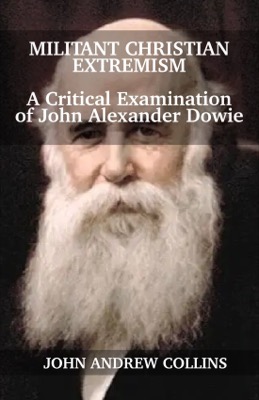
John Alexander Dowie (1847-1907) was a Scottish evangelist and faith healer who ministered in Australia and the United States. He founded the city of Zion, Illinois, and the Christian Catholic Apostolic Church. Dowie claimed to be the "spirit of Elijah", and during the height of his career, was nicknamed "Elijah II".
In 1876, Roger William Bede Vaughan, second Roman Catholic Archbishop of Sydney, Australia, began speaking and publishing evidence supporting his stance against Freemasonry. According to Vaughan, the Freemasons were involved in a conspiracy to subvert religion and take over the education system. He delivered an address on October 9, 1876, at the Catholic guild hall and published under the title, "Hidden Springs." In response, a minister in his early thirties began making waves throughout the religious communities of Australia when he began claiming that the Roman Catholic Church had "polluted springs." By April of 1877, his retaliation to Vaughan was compiled into a book entitled, "Rome's Polluted Springs." This young minister was the Reverend John Alexander Dowie, a well-known Christian public speaker. In the years that followed, Dowie's "Polluted Springs" gained him opportunities to speak many times to eager crowds, on subjects ranging from the evils of Catholicism to Christian spiritualism. Eventually, his followers became to know him as a "Christian Spiritualist," and Dowie spoke on topics such as "How I Became a Medium." He became known throughout parts of Australia as a "healer by faith," using his "supernatural powers" to heal the sick and afflicted. By 1880, he had such a strong following that he began receiving large donations to start a church, and decided to run for Parliament.
His self-proclaimed spiritualism did not go unnoticed, however. Thomas Walker, a well-known free-thought lecturer, began exposing Dowie's claim to be a "medium," and published an article in The Age (Melbourne newspaper). Shortly after his "Spiritualism Unmasked" was published, Dowie sued Walker for libel. Whether because of Walker's influence or not, the Melbourne government got involved in the action against Dowie by creating city ordinances to block the activities in Dowie's Temple. In 1885, Dowie was sentenced to a short jail term for failure to comply. Three years later, in 1888, Reverend John Alexander Dowie came to the United States and announced his presence in the country as a medium and a healer by faith. According to Dowie, 7,000 people had been healed by his supernatural powers in Australia, India and other countries. This number grew to 8,000 after a meeting in the hall of the Young Men's Christian Association in Oakland, California. Before a large crowd of people, Dowie claimed that his supernatural experiences first came when he was seven years old.
"One night I was sitting on the steps of the old pulpit singing an old familiar paraphrase. I was a little bairn but 7 years old, and I well remember the evening. It was a soft summer night, and the stars were gleaming in the sky. The little children were singing, and the good people were praying, and everything was quiet and full of peace. Suddenly it seemed to me, a little choir of boys sitting there on the steps of the great pulpit, as if the sky was lighted up and filled with Christ. The stars looked like little ornaments in his robe, and Christ seemed to fill the air. A thrill went through my body, and I felt as if I had been converted. Thirty-four years have passed since that night, and I still believe that I was then taken by Christ. After that I suppose I did like all other boys. I signed a pledge, and I have not become a slave to that vile dirty, filthy, stinking, and ungodly habit of smoking. {…} Since I was 16 years old I have not taken a drop of medicine, and up to that time I had taken gallons. I was a sickly boy, but I decided that if my spirit belonged to God, and if he would take care of it, he would also take care of my soul and body. " After the meeting, there was a gathering for those seeking "healing and salvation." According to the Oakland Tribune reporter present, he waited an hour and twenty minutes listening to fervent prayers and expecting to see a modern miracle, yet none came. One young lady summed up the service well:
"Now I think it is a shame that this man should be allowed the use of Christian churches to talk and set good but weak minded people crazy. I have an aged mother in there, and I've been waiting for her nearly three hours. She's nearly lost her reason several times over the doctrines, and now I think this man will utterly upset her mind."
After the series of meetings, a handful of people claimed they were cured of various diseases, and gave written testimonies to the Oakland Tribune The Tribune published these testimonies alongside an evaluation of the "healings" by local ministers, who claimed they had examined some of the "healed" to find them not healed at all. When a brief period of time passed and Dowie's "miracles" were found to be lacking in actual healing, the public opinion of the "healer" from Australia began to quickly change. By January of 1889, Dowie found himself unable to gain an audience at many of the churches in Oakland. According to the newspapers, Dowie's "ways did not suit some of those who were good Christians." His public opinion worsened when one Mrs. Georgiana Wyatt, a constant attendant of the Dowie meetings, become a raving maniac.
Shortly thereafter, Dowie relocated his "healing ministry" to Chicago, Illinois. In a big tent at Western Springs, under the heat of the summer sun, Dowie attracted a crowd of 200 people to hear him speak on "Divine Healing." Mrs. E. V. Baker, who spoke on the same subject, introduced him. Dowie called attention to the subject of "sanctification," which he defined as a cleansing of the spirit, soul, and body. He called special attention to the Catholic Church and its views, stating that the "Catholics are wrong." At the end of his speech, he told the crowd that he was going to "get down to business," referring to his work in Chicago. He said that he would "rather go to Heaven than Chicago, but [he] must do his work," at which point he stated his intentions of settling there. After his tent meeting, Dowie established himself in the Chicago area with a small church and printing presses for magazine publication. Once his Chicago ministry was up and running, he interviewed with the Chicago Tribune to describe his faith healing practice. According to his testimony, he simply laid his hands upon the person seeking healing, and if they had faith, they were cured. Tuberculosis, impaired eye-sight, cancer, catarrh, hay-fever, lumbago, dysentery, hip disease, softening of the brain, paresis, hydrocephalus, and even soft corns could be healed by the Australian minister, or so he claimed. Dowie boasted that he was the "head of the faith healers in this country and Canada." The newspaper journalist took the story, and printed it in the May 23, 1891 issue of the Chicago Tribune. At the end of the article, he jokingly asked the public, "By the way, is there not a State Board of Health that looks after physicians?" By 1891, Dowie gave himself the self-named title, "President of the International Divine Healing Association."
Later that year, Dowie began traveling through the country spreading his peculiar mixture of spiritualism and Christianity. When newspapers began printing his new title, it began to become much more than a self-proclamation. Newspapers began calling him the "Chief of Faith-Healers," and reprinting testimonies Dowie had published in his magazine, Leaves of Healing. His fame began to spread even more quickly after claiming to have resurrected one Mrs. S. A. Kelly of San Francisco from the dead during his meetings on the West Coast.
By the time he reached Pittsburgh, Dowie's publicized ministry was gathering quite a bit of attention. He held a series of meetings, leading up to a climax at Carnegie Hall. At Carnegie Hall, Dowie announced, he would be healing the sick. Though newspaper reporters attempted to gain access to witness the "healings," Dowie refused to allow them inside. "It is hard for reporters to tell the truth," Dowie said. "They do it sometimes, but it is so hard. We will see whether they tell the truth tomorrow. I can bear witness that you are a great big people and can tell great big lies. There are some of you that can tell the truth, and we of the British Isles thank you for it." Dowie pushed the people of Pittsburgh for money. He claimed that many thousand dollars were required to carry on "the work," and that all missions thus far had been at his own expense. He then took a collection and gathered what was assumed to be a large sum of money. At 6:30 in the evening, twenty-seven of the persons attending who claimed to have been healed met in the "Green Room" of Carnegie Hall gathered to receive instructions from Rev. Dowie. Dowie interrogated the "healed," screening them to confirm that their testimony to the newspapers would be in his favor. But when a physician examined the situation, he declared that he was greatly concerned with Dowie's mental stability. "His mind, like others, is so full of ego that he cannot come into a harmonious touch with the world. He really thinks he possesses the power of curing, or, as he words it, that he can cure with the help of God. These people {who?}tragically throw away their crutches are not cured. A man, for instance, may suffer from hysterical paralysis, and being worked up to a state of frenzy by Dr. Dowie's words, he will stir up all his latent energy and will by a supreme effort dispense with artificial means of support. When his enthusiasm deserts him, however, a relapse must occur. In the same way with other maladies, the great French physicians have temporarily banished pain by hypnotizing their subject. If we examine this matter closely, we will see how closely allied divine healing is to hypnotizing. I have no doubt the doctor is honest, but that he performs what some dyspeptic old ladies think is simply ridiculous. Yes! I would most assuredly like to examine Dr. Dowie's head. It would prove, I am certain, a most interesting study.
This did not dissuade Dowie from returning to Pittsburgh, however. Just three months later, he returned to the city appealing for liberal offerings to support his cause. According to the newspaper reports, Dowie slung insults at local ministers and local newspapers. He claimed that if the ministers would not join with him, he would use a "weapon God had given him to punish them." He went on to speak specifically against the Methodist Episcopal clergy, saying, "The lay members of the Methodist Episcopal church have been our warmest friends, but everywhere we have found the ministers of that denomination slaves to conferences, presiding elders and bishops. One minister here stands branded as a liar, and he makes no reply. Presiding Elder F. D. Bovard of San Francisco called us imposters. I denounced him as a liar and prophesied that he would be punished. Today, F. D. Bovard is dead and buried under the sod. He died, and I stand before God a witness that he was a liar." The newspaper article claimed that he repeated the last sentence four times, gloating over the death of the minister. The hate speech was so harsh that many in the meeting quickly grew tired and left. By the time he concluded, not even a third of the original audience was present. After the series of meetings, Dowie gave a farewell lecture in which he condemned those who he claimed had "fallen from grace" by securing the services of a physician. A few months later, in October, he returned to Carnegie Hall. Only thirty people came to see him. When he returned to Chicago after his evangelism, Dowie was met with a much different sentiment. The people of Chicago hailed him as a respected spiritual leader, and his following quickly grew. Before long, two thousand people filled his tabernacle, all seeking miracles from the nationally famous healer. Reporters from the Inter-Ocean newspaper in Chicago gave Dowie an almost full front-page spread, boldly printing examples of "Latter Day Miracles." Written testimonies Dowie had collected from his "healed" were printed one-by-one across the front page. The people of Chicago opened their papers to read articles describing Dowie as a divine healer who made the lame to walk and the blind to see. The paper went so far as to say that "victims are snatched from the brink of the grave." It made no mention of those in the Pittsburgh meetings who sought professional care after their trip to the healer, and did not describe Dowie's careful process of excluding reporters from the actual "healing" to prep those who might testify and eliminate those with negative statements. The public attention gained by the newspaper's promotion of his ministry was highly effective. By April of 1894, Dowie's following had grown so large that he began seeking land to hold them all.
"Brethren," he said, "I want you to help me. Yes, brethren, I need your help. You know what the Bible says about faith without works being dead. You think you have faith in me. Now, I want you to prove that faith. This morning I gave all I had to the Lord – all except twenty-seven paltry dollars. Just $27 are left to my credit in the bank. Think of it, my friends! I am doing the Lord's work with but $27. I had so much more this morning, but the Lord called and I began signing checks. You know, some of you, that we are preparing a Divine Healing Home at No. 6020 Edgerton Avenue. It was for this home that I signed these checks – this home where the suffering are to be cured. All for you, brethren; you and the Lord. Now I want to ask you to contribute a dollar each – that is, not less than a dollar; you can give more if you are able. This money will go toward completing the purchase of this beautiful home, which will be all for you. I wish to speak of another thing. We need a piece of land in this vicinity on which to erect a large canvas pavilion for the summer. It could be much better if we could own our own land. I will now have the hat passed, and I want everyone to contribute according to his wealth. Let it be a good, liberal collection." According to the newspaper, several hats full were collected.
Not all were so receptive to the faith healer in Chicago, however. Dowie was refused permission to hold meetings in Battery D, a large military building normally used for military, religious, and political events. According to Lieut. Alfred Russell, they decided not to allow cheap dances, prizefights, or Dowie in the building. Things grew quite a bit worse for Dowie and his followers later that year when a young Albert Garbett, a youth from Minneapolis who came to "Doctor" Dowie to be healed, died of spinal illness. Many began to question his "power" of healing, and became overly cautious. A few months later, in January of 1895, Dowie was arrested after taking $120 from a patient under his care. According to the report, Frank E. King had given "Doctor" Dowie $120 for healing. King was in the final stages of consumption, and was taken to the Zion establishment. When he could not be cured, and was put out to die, the State Board of Health was informed and intervened. Dowie was finally arrested.
In the nationally publicized trial that followed, readers began to see a much different side of the "faith healing doctor." Dowie testified in his own defense, claiming that he never pretended to treat patients as a physician or surgeon. Though his houses in Chicago were named "Divine Healing Homes," he claimed they were organized for pleasure, and that guests did not come to them for treatment.
This did little to stop the momentum Dowie had already gained by his nationally publicized evangelism. Only five months later, he selected the site for his Zion compound, a large complex two and a half miles southwest of Blue Island just outside Chicago. His plans included the Zion Temple, a church that would hold about ten thousand people, "Divine Healing Homes" arranged around an inner garden, Zion College, a series of schools from kindergarten to university-prep, Zion Printing and Publishing House, Zion Refectory to supply refreshments, Zion Homes for young men, women, and orphans, and the Zion Library. The entire cost of the complex was $500,000, and Dowie claimed that he himself would contribute nothing to the project.
This announcement raised even more concern with government officials in Chicago. Dowie quickly became a well-known, frequent prisoner in police courts for operating a "hospital" without a license. By August, of 1895, he had forty-four cases against him, for which they were all finally dismissed. Judge Chetlain eventually issued a restraining order preventing the city from interfering with "the doctor." The restraining order did little to stop the many arrests and trials, however. As "patients" and family involved with Dowie's "hospital" continued to file civil suits for malpractice and even death, Dowie and his elders found themselves in and out of the court system. In August of 1899, Mrs. Henrikka Bratz and D. C. Holmes, elders in the Zion commune, were arrested after the death of Mrs. Anneta Flanders. They were arrested on charges of criminal negligence and malpractice after Flanders, who was suffering from blood poisoning, died for lack of treatment. The trial that ensued was nationally publicized, feeding the frenzy of a nation gripped with the interesting saga. Even the New York Times noted that Dowie was untouchable – "laws do not reach him." The publicity seemed to have a noticeable effect on Dowie's mental stability. Shortly after the news began to spread, Dowie began claiming that he feared assassination. Battered from the frequent arrests, civil suits, criminal suits, and barrage of negative press, Dowie pressed his cult victims at Zion for more money. Declaring himself the "General Overseer of the Christian Catholic Church of Chicago," he asked that they give him $1,000,000.
"I call for a New Year's gift of $1,000,000. You can answer that call, each according to his several abilities. If each one will do that fully Zion's storehouse will have meat for many workers, and I shall be able to put many powers into operation which are now unused because of lack of service or sacrifice on your part. God has given me the right to ask this from you in Jesus' name."
Shortly after, the mystery behind this sudden request for funding was made known. Dowie announced that he was raising a company of his disciples to protect him, creating a military division at Zion. He said that he did not trust his safety to the Chicago authorities. The funds were also to be used for a 6,000-acre expansion fronting Lake Michigan between Waukegan and the state line. The newspaper reporter recognized the strategic business aspects of this purchase, as it would place Zion at the center of its own commerce. He compared Dowie's business qualities to that of Brigham Young who made his fortune in Salt Lake City. By May 1, he had 20,000 acres. By 1901, Dowie started claiming that he was the reincarnation of Elijah the prophet, as predicted in the fourth chapter of Malachi.
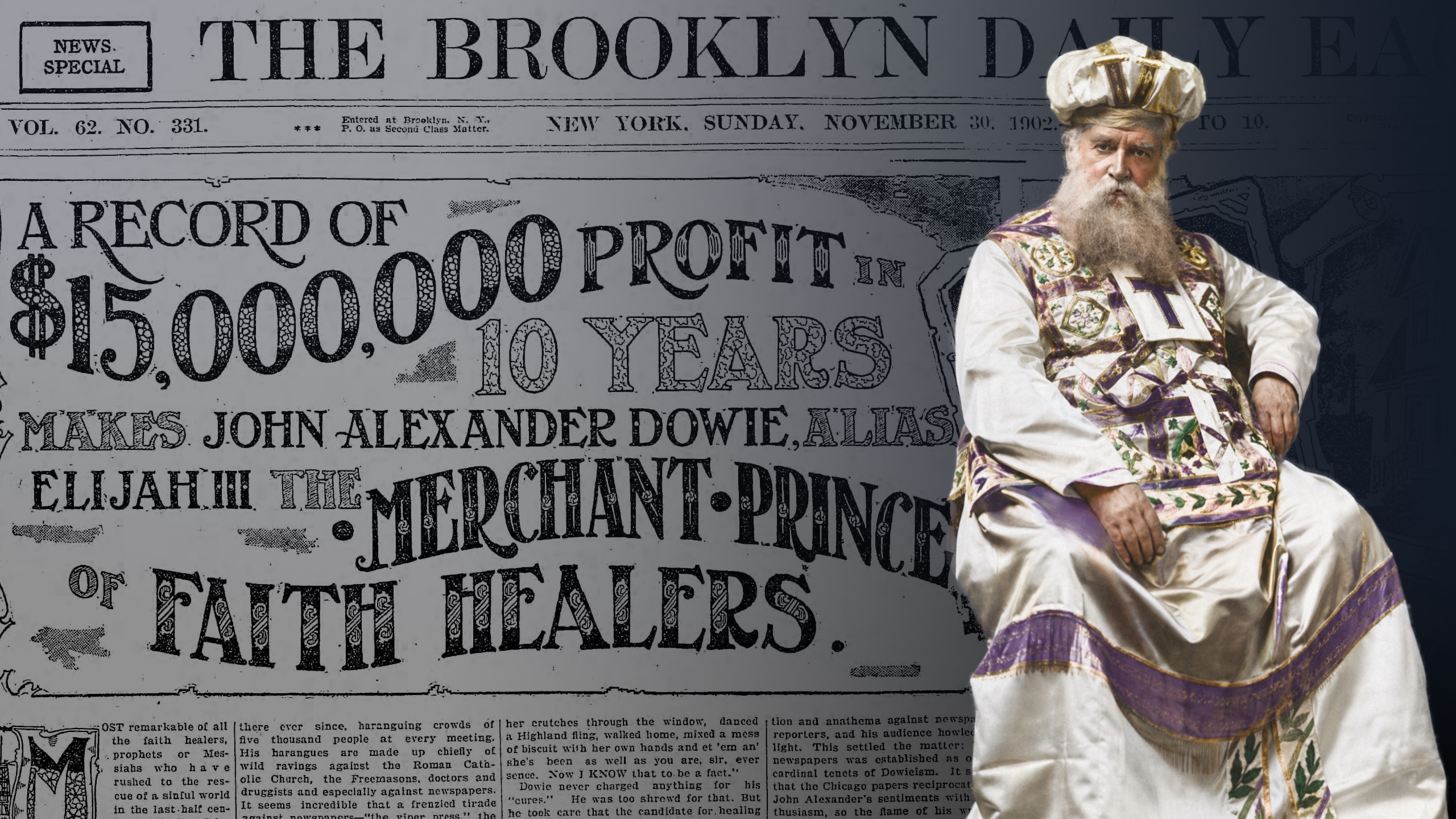
This strategic move turned out to be highly profitable, both from a financial standpoint and a public relations standpoint. Shortly after claiming to be the reincarnation of Elijah the prophet, Dowie's wealth and popularity skyrocketed. Newspapers all across the nation published full-page, front-page spreads of the famous "divine healer" from Zion, Illinois who made a record profit of $15,000,000 in just ten years. Some soon labeled him as the "richest man in the West." Interestingly, the timeline for Dowie's highly publicized ministry and successful establishment of his "holy city" Zion coincides directly with Frank Sandford's "vision" to establish his own. As Dowie was breaking ground for Zion city, Sandford began claiming to have seen visions and angelic beings. John Alexander Dowie began claiming to be the reincarnation of Elijah in 1901, about the time Sandford made the same proclamation in his Holy Ghost and Us society. And like Sandford, Dowie asked his cult victims to forfeit all of their possessions and surrender to his full authority.