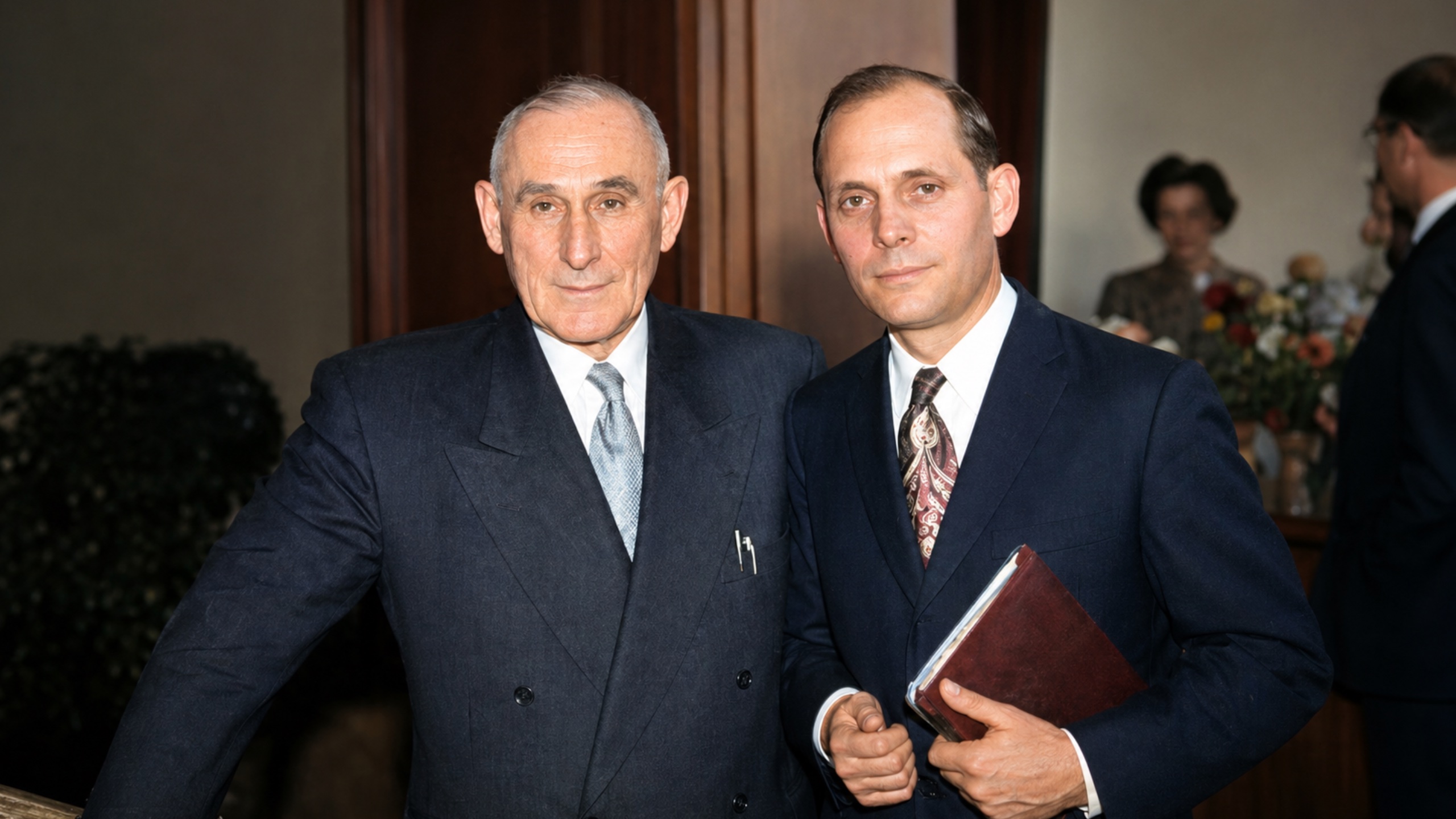
Raymond Hoekstra
Raymond "Chaplain Ray" Hoekstra was a pivotal but often overlooked Pentecostal operator whose career connected early Oneness Pentecostalism, the formation of UPCI networks, William Branham's early healing revivals, Latter Rain spectacle, child-preacher promotion, criminal-case publicity, and later prison ministry, while repeatedly relying on stagecraft, reinvention, sensational testimony, and strategic alliances to maintain influence; from his ties to Branham, Midway Gospel Tabernacle, Calvary Tabernacle, Nathaniel Urshan, and David Walker to his role in the Leslie Douglas Ashley campaign and later International Prison Ministry, Hoekstra illustrates how revival culture could turn supernatural claims, vulnerable people, public scandal, and emotional performance into religious authority while avoiding lasting accountability.
Raymond "Chaplain Ray" Hoekstra was a pivotal yet largely overlooked figure in Pentecostal history, serving as a critical link between early Oneness Pentecostalism and the Latter Rain movement, to William Branham's healing revivals. His ministry was marked by a pattern of religious spectacle, opportunism, and strategic reinvention, enabling him to shape revival culture behind the scenes while avoiding the direct scrutiny faced by many of his contemporaries.
Hoekstra's early connections to the early United Pentecostal Church International (UPCI) place him at the foundation of modern Oneness Pentecostalism. As an evangelist preaching throughout Indiana, he was already positioned within the Pentecostal power structure by the mid-1930s, long before Branham's supposed "introduction" to Pentecostalism in 1947.[1] In reality, Branham's early revival career was deeply tied to Hoekstra, contradicting Branham's later claims of an independent prophetic calling.
Hoekstra's influence extended into the Latter Rain movement, where his emphasis on supernaturalism and orchestrated revivalism helped shape the expectations of a new wave of charismatic leaders. From promoting child preacher David Walker to managing faith-healing spectacles, Hoekstra's legacy is not one of theological innovation but of religious theatrics to create stage personas, and opportunistic alliances that forever shaped the Pentecostal world.
The Making of a Revivalist: Hoekstra's Early Life and Fabricated Narratives
Raymond G. Hoekstra's early life has been heavily mythologized in revivalist circles, with later biographies omitting or distorting critical details. Contrary to many accounts, Hoekstra was not merely an independent evangelist who rose to prominence through spontaneous spiritual experiences but was deeply embedded in early Pentecostal power structures, particularly in the formation of the United Pentecostal Church International (UPCI). His pastoral leadership at Fletcher Pentecostal Church—later renamed Calvary Tabernacle[2] —places him at the heart of Oneness Pentecostalism's foundational years, the real history of which is obscured in both later retellings of his ministry and UPCI history. Calvary Tabernacle is one of the most influential churches in the UPCI. Pentecostal evangelist and future General Superintendent of the UPCI,[3] Nathaniel Urshan, was the assistant pastor.[4] Hoekstra served as Branham's campaign manager[5] and Urshan toured with William Branham in the late 1940s in the "Branham-Urshan Healing Campaign."[6] Urshan sponsored William Branham's campaigns as late as 1964.[7]
Hoekstra's early revivals were marked by a willingness to associate with controversial figures and movements. His evangelism at Midway Gospel Tabernacle in 1936[8] connected him to William Branham, a bishop in a newly created Pentecostal sect. Though held in a racially integrated congregation that was actively opposed by the Indiana Ku Klux Klan, this connection would bind Hoekstra's ministry to white supremacy. The General Overseer of Branham's Pentecostal sect was Roy E. Davis,[9] formerly the second-in-command of the 1915 Ku Klux Klan and future Imperial Wizard. It was Davis who ordained and mentored William Branham, and the two collaborated with other key figures in white supremacy during the heydey of the Indiana Klan. Davis planted the Pentecostal Baptist Church headquarters in Jeffersonville, Indiana,[10] and by the time of his connecting with Hoekstra, Branham had become a leader in the sect. It is unlikely Hoekstra was unaware of Branham's ties to Daivs, especially since Branham openly talked about that connection throughout his entire ministry.[11]
Hoekstra's revivalist narrative omits key events that contradict the spontaneous, spirit-led image often promoted in Pentecostal history. By the mid-1930s, he was already positioned within an established Pentecostal framework, and his rise was facilitated by strategic alliances rather than mere spiritual fervor. His 1936 revival at Midway Gospel Tabernacle is a crucial piece of evidence that he was deeply entrenched in Pentecostal leadership and connected to Branham long before his later career exploits. This historical context undermines the notion that Hoekstra was simply a man anointed by God in isolation; rather, he was a skilled religious operator who knew how to maneuver within the existing structures of Pentecostal power.
William Branham and the Myth of an Untouched Prophet
One of the most persistent falsehoods in Pentecostal and Latter Rain history is the claim that William Branham had no exposure to Pentecostalism before 1947. This misinformation is central to the narratives of both the UPCI and Branham's "Message" cult of personality, as both groups reject the historical intersection due to their various religious beliefs and allegedly supernatural experiences. Branham himself maintained that he was a humble Baptist minister unfamiliar with Pentecostal teachings[12] until he experienced a divine revelation[13] (later changed to an angelic visitation[14] ) that launched his healing ministry.[15] However, documented evidence, including his deep ties to Raymond Hoekstra and Midway Gospel Tabernacle, contradicts this narrative entirely.
Branham was not only exposed to Pentecostalism well before 1947 but was an active participant in healing revivals as early as 1934. At the Midway Gospel Tabernacle revival in September 1934, Branham was already documented as a revivalist, driving a panel truck to promote healing meetings.[16] This alone debunks the claim that he was unfamiliar with Pentecostal revivalism. Furthermore, Branham attending Hoekstra's revival at Midway Gospel Tabernacle in 1936 places Branham in direct association with one of the key figures in early Pentecostalism, long before his widely accepted "conversion" story.
The intersection between William Branham and Raymond Hoekstra occurred during a pivotal era in Pentecostal history, particularly around the merger that formed the UPCI. It appears that Davis and Branham were attempting to join their sect into the merger, strategically aligning themselves with key Pentecostal figures, including W. E. Kidson, who headed the Pentecostal Church Incorporated (PCI) and served as one of Branham's influential campaign managers. Branham's role as editor of the PCI's primary publication, Herald of Truth,[17] further highlights the deep connections he cultivated within Pentecostal circles. Calvary Tabernacle was integral to the merger that created the UPCI. This merger, finalized in 1945, brought together Hoekstra's Apostolic assemblies and Kidson's PCI into one unified Pentecostal denomination.
Engineering a Child Prodigy: The David Walker Scandal
Perhaps the most damning episode in Raymond Hoekstra's career was his exploitation of David Walker, the so-called "Little David" child preacher. Walker was presented as a Pentecostal prodigy, allegedly anointed by God to preach from the age of nine, but behind the sensational revival meetings was a story of manipulation, legal battles, and financial exploitation. Hoekstra paired Walker with Branham to form what was advertised as "The Most Powerful Gospel Team in America."[18]
Hoekstra played a central role in crafting Walker's public image, heavily promoting him through revivalist media. Walker was marketed as a supernatural phenomenon, with claims that he had been to heaven for five hours,[19] could levitate,[20] and had divine knowledge beyond his years. These claims, widely publicized in Pentecostal circles, drew massive crowds and made Walker an overnight sensation. However, the reality behind the scenes was far more sinister. The parents claimed that Hoekstra was overworking and exploiting their 13-year-old child for the stage act[21] for money.
Legal documents reveal that Hoekstra obtained custody of Walker through deceptive legal maneuvers, convincing the boy's parents to sign over guardianship[22] under the impression they were only relinquishing financial control. When Walker's father, Jack Walker, later realized the extent of Hoekstra's influence and the financial success of his son's ministry, he attempted to regain custody. His efforts were met with fierce resistance, with Hoekstra using both legal and public relations tactics to frame the Walkers as greedy parents trying to capitalize on their son's ministry.
By 1948, Walker's sermons were generating upwards of $1,000 per event,[23] a staggering sum for the time. (This is worth over $13,000 per event in 2025).[24] Court records indicate that Hoekstra controlled the finances and that the vast majority of these earnings were unaccounted for. When the case reached the courts, Walker's parents testified that their son was being overworked to the point of vocal strain and permanent damage. Medical reports confirmed these allegations, adding credibility to the claims that Hoekstra had pushed Walker beyond healthy limits to maximize revival profits.
The controversy culminated in Hoekstra's removal as Walker's manager in 1949 by a court ruling that found him financially negligent and unfit to continue overseeing the child's career. The ruling ordered an accounting of Walker's earnings, totaling $67,000, yet only $700 remained,[25] leading the judge to question whether the revival tours were truly "Christian ventures" or just business enterprises designed to enrich their organizers. This marked a massive public disgrace for Hoekstra, though he never admitted wrongdoing and later attempted to rehabilitate his image.
The Leslie Douglas Ashley Affair: Manipulating a Convicted Murderer
Raymond Hoekstra's role in the Leslie Douglas Ashley case represents one of the most bizarre and morally questionable episodes in his career. Ashley, a transgender prostitute and convicted murderer, became the centerpiece of a coordinated Pentecostal propaganda campaign, with Hoekstra,[26] William Branham,[27] John Osteen,[28] and other key figures in the Latter Rain movement playing key roles in turning a death row inmate into a supposed prophetic figure.
Ashley's case involved the violent death of Fred Tones during what was described as a brutal sexual encounter. After his conviction, Ashley was sentenced to death in Texas, but his mother sought help from religious figures to secure a stay of execution. Enter Hoekstra, who, along with Branham and John Osteen (father of televangelist Joel Osteen), began using the case to mobilize support within Pentecostal revival circles.
Branham, leveraging his status as a so-called prophet, claimed divine intervention had saved Ashley's life. He boasted that his efforts in Houston on Ashley's behalf led to a miraculous outcome, conveniently aligning with the date of the infamous "mystery cloud" event in 1963 and that his performance gained him "an Oscar from the Humane Society."[29] This fabricated connection between a cosmic event and a criminal case helped Branham maintain his image as an end-times prophet, while Hoekstra played the role of religious organizer, coordinating public support through Pentecostal networks. Both the "mystery cloud" and the "halo photograph" became relics in the movement, both of which still today hang in the sanctuary of churches around the world.
The real purpose of the campaign was to protect not just Ashley, but Branham's own image. Ashley's stepfather was James Ayers, one of the photographers behind Branham's so-called "halo" photo, the manipulated image that was used to validate Branham's supernatural status. If Ashley's case unraveled, it risked drawing attention to the photo's questionable origins and the fabricated narratives surrounding it.[30] Thus, Hoekstra's campaign wasn't just about saving Ashley—it was a coordinated public relations effort designed to preserve Branham's credibility and the stability of the Latter Rain and early development of the Word of Faith and Prosperity Gospel movements.
After escaping execution, Ashley continued to spiral into delusion, eventually claiming to be Elijah the Prophet[31] and forming the Ashley-Ayers Evangelistic Association in 1964.[32] Hoekstra's involvement didn't end there—he helped manage the Pentecostal response to Ashley's growing instability. Ashley's story took an even stranger turn when he escaped from a mental institution dressed as "Bobo the Clown",[33] landing him on the FBI's Most Wanted list in 1965.[34] Years later, after having given testimony of conversion to Christianity,[35] Ashley transitioned to Leslie Elaine Perez,[36] fully abandoning the Pentecostal movement.
The Cult of Spectacle: Hoekstra's Theatrical Revival Tactics
Raymond Hoekstra was not merely a preacher—he was a showman, fully aware of how to manipulate audiences through staged supernaturalism, emotional appeal, and grand spectacle. His entire career revolved around creating illusions of divine power, often through questionable methods that blurred the line between religious fervor and outright deception.
From the earliest records of his revival work, Hoekstra consistently engineered dramatic performances to captivate his followers. Whether through faith healings, exaggerated prophecies, or child evangelists like David Walker, he demonstrated a pattern of using individuals as tools to manufacture revival hysteria. This was not unique to Hoekstra, but his tactics were particularly aggressive.
One of the most telling examples of this choreographed revivalism was his association with William Branham's staged faith healings. Branham's healing services often featured pre-screened prayer lines,[37] apparently ensuring that only those with psychosomatic illnesses or vague conditions would be called forward to receive a "miracle." During the years of working with Hoekstra, Branham's stage act included hands that allegedly changed color to detect diseases. If the hands did not change color, Branham stated that he was unable to heal the disease.[38] Hoekstra not only defended these deceptive practices but actively worked to promote Branham's ministry, ensuring that the financial backing remained strong.
Hoekstra also capitalized on religious fear and apocalyptic themes to keep his audiences engaged. His sermons often highlighted catastrophic events, natural disasters, and divine signs as proof of impending judgment. His 1936 revival at Midway Gospel Tabernacle included a dramatic retelling of the 1933 Long Beach earthquake,[39] in which he positioned himself as an eyewitness to the power of God's wrath. This tactic—linking natural disasters to divine prophecy—became a recurring theme in Pentecostal revivalism, influencing later televangelists and doomsday preachers.
Even after being legally ousted from Walker's ministry, Hoekstra continued to reinvent himself, shifting his tactics from revival campaigns to prison ministry,[40] where he could employ the same techniques on a captive audience. Ultimately, Hoekstra would become better known for founding the International Prison Ministry than for his earlier role in launching Branham's career during the formative years of the UPCI.
The Prison Ministry and Final Reinvention
After facing legal and financial ruin from the David Walker scandal and the collapse of his credibility in Pentecostal revival circles, Raymond Hoekstra sought a new platform where he could regain control over a captive audience. Combined with the success in rallying Pentecostals and the developing Charismatic movement to support the transgender murdered, this led to the creation of his prison ministry in 1972. Raymond Hoekstra and his wife Leola officially organized the International Prison Ministry and began visiting prisons across the United States.[41]
Hoekstra branded himself as "Chaplain Ray", a self-styled prison evangelist who claimed to bring redemption to hardened criminals.[42] However, his entire prison ministry narrative was built on the same manipulative tactics he had used in revivals. He capitalized on the notoriety of violent criminals and exaggerated their conversions into grandiose, headline-grabbing testimonies. Instead of faith healings and child preachers, Hoekstra now had murderers and gangsters as his new spectacle.
Having been instrumental in managing Ashley's public perception[43] during the Houston trial, Hoekstra repurposed the convicted murderer's story as a dramatic conversion tale to fit his prison outreach efforts. While there is no doubt that Hoekstra reached thousands of inmates with his ministry, the pattern of exaggeration, sensationalized testimonies, and unverifiable claims raises concerns about the authenticity of his so-called redemptive work. Notably, Hoekstra worked closely with notorious figures like Tex Watson, one of Charles Manson's most infamous associates, further complicating perceptions of his prison ministry.
The Danger of Religious Showmanship
Raymond Hoekstra's career serves as a case study of the dangers of unchecked religious showmanship, where spectacle and deception can overshadow theological integrity. His life was not defined by spiritual breakthroughs but by a series of reinventions—each designed to sustain his influence and financial security at the expense of others. From shaping William Branham's early ministry to exploiting David Walker, to manipulating the Leslie Douglas Ashley case, Hoekstra demonstrated a consistent willingness to distort reality in pursuit of personal gain.
His influence on revival culture cannot be ignored. The methods he perfected—staged faith healings, manufactured child prodigies, dramatic conversion narratives, and strategic PR manipulation—became standard practice in Pentecostal and charismatic movements. Even today, modern televangelists and prosperity gospel preachers mirror Hoekstra's tactics, proving that his legacy lives on in the very excesses that have defined contemporary Pentecostalism.
The most troubling aspect of Hoekstra's career is that he never faced meaningful accountability. Despite being removed from managing David Walker's finances, despite his involvement in one of the most bizarre religious criminal cases in history, and despite the glaring contradictions in his theological claims, Hoekstra continued to be accepted in evangelical circles. His ability to escape the consequences of his actions reveals a larger issue within the revivalist culture—where charisma often outweighs character.
In the end, Hoekstra's greatest skill was not evangelism, but illusion. His ability to reinvent himself time and again—from revivalist to child preacher manager, to criminal case handler, to prison chaplain—demonstrates that his primary concern was never the truth of the gospel, but the preservation of his own influence.